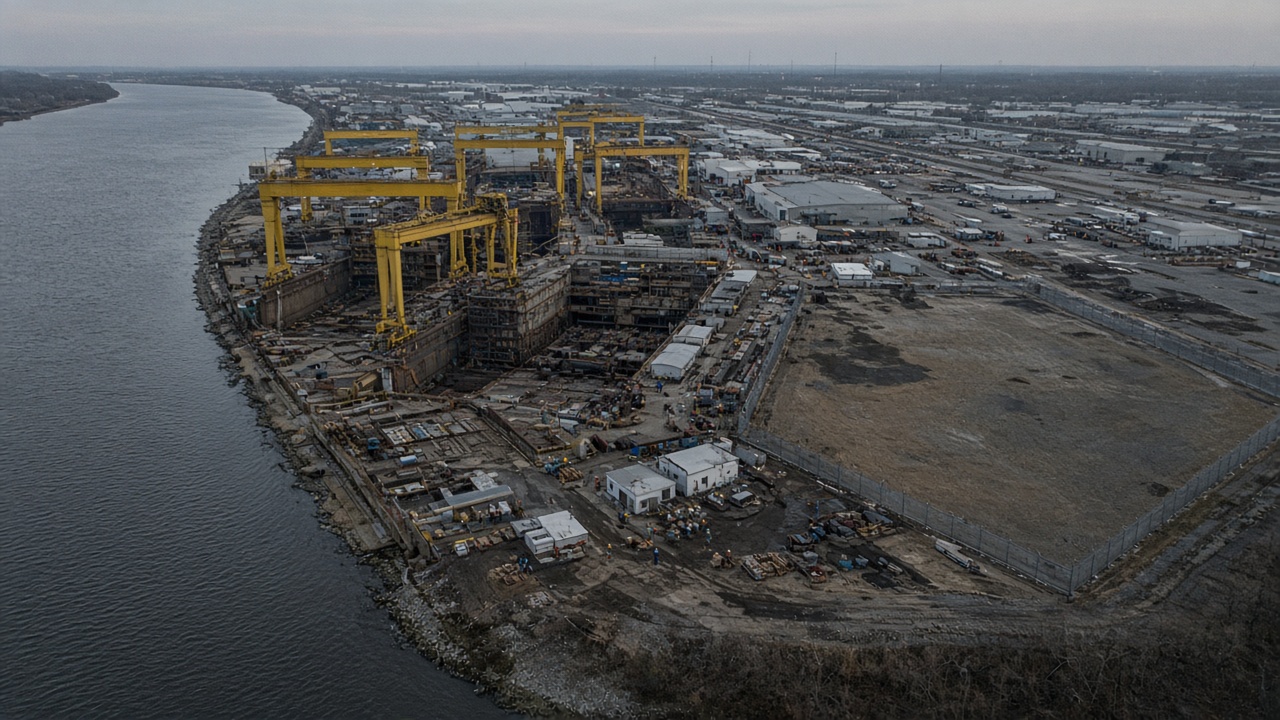
Hanwha Philly Shipyard has signed a 47-acre lease with PIDC at the Philadelphia Navy Yard, the Philadelphia Inquirer reported on Sept. 23, giving the Korean group a larger physical footprint in the U.S. shipbuilding base at the same moment Seoul and Washington are talking up naval construction. The lease was reported the same day South Korea's presidential office said President Lee Jae Myung discussed warship construction with President Donald Trump on the sidelines of the U.N. General Assembly. The sideline meeting lasted about 30 minutes. It sits inside a $350 billion U.S.-Korea investment package, including a $150 billion shipbuilding slice.
The juxtaposition matters. A summit readout can signal intent. A lease from PIDC, the city development corporation that manages the Navy Yard, is an operating decision. It gives Hanwha control of land, not a contract. But in shipbuilding, land is the first constraint. Steel storage, prefabrication halls, staging areas, and workforce parking all need space. The 47 acres expand what Hanwha Philly Shipyard can do at the site. The company has not tied the lease to a specific warship program in the reports, and that distinction should stay clear.
The Lee-Trump backdrop
Lee and Trump used their UNGA sidelines meeting to discuss warship construction, South Korea's presidential office said. Reuters and Yonhap reported the talks, while Baird Maritime noted that warship building formed part of the U.S.-South Korea meeting agenda. The $350 billion package is the headline. The $150 billion shipbuilding slice is the piece that matters for yards. It is also the piece that needs projects, permits, and payrolls to become real.
Hanwha's lease is one of the first on-the-ground signs that the conversation is moving from leader-level language to industrial site decisions. The Philadelphia Navy Yard already has deep-water access and a shipyard workforce. PIDC's role as landlord makes the lease a city-level transaction as much as a national-security one. The yard is inside a former naval complex that Philadelphia has spent decades redeveloping. A Korean-owned shipbuilder taking more land there is a signal to U.S. officials that Hanwha wants to be inside the domestic base, not just export to it.
What Hanwha's affiliates get
For Hanwha Group, the decision runs through its shipbuilding and defense units. Hanwha Philly Shipyard is the U.S. operating platform; Hanwha Ocean is the group's listed shipbuilding arm. Korean listed companies disclose material contracts, capex, guarantees, and related-party transactions through DART. A U.S. lease of this size may not trigger a standalone filing on its own. But the commitments that follow could: parent guarantees, capital injections, equipment orders from affiliates, or a board-approved expansion budget.
That is where the chaebol question comes in. The group is not simply buying land. It is deciding which affiliate carries the U.S. expansion risk and which one books the upside. If Hanwha Philly Shipyard wins U.S. government or commercial orders, the benefit flows through the ownership chain. If the yard needs more capital, the listed parents may have to show how they will fund it. The lease is an option on capacity. The filings will show the price.
Why Philadelphia, why now
Philadelphia offers a combination that is hard to replicate: a working shipyard, a landlord set up for industrial redevelopment, and proximity to East Coast naval and commercial customers. Hanwha, meanwhile, has Korean yard expertise and a balance sheet that can support U.S. expansion. The political environment is also more open to Korean shipbuilding investment than it was a few years ago. Washington wants more domestic shipbuilding capacity; Seoul wants a larger role in U.S. industrial supply chains.
But the lease is not a guarantee. U.S. shipbuilding remains constrained by labor shortages, high costs, and procurement rules that favor domestic content. Commercial shipbuilding under the Jones Act is a narrow market. Naval work requires security clearances, U.S. supply chains, and long qualification cycles. Hanwha can control the land and still fail to convert it into steady contracts. The 47 acres create room. They do not create demand.
What to watch
First, DART disclosures from Hanwha Ocean and other listed Hanwha affiliates. Look for capex, guarantees, and related-party transactions tied to the U.S. yard. Second, local permits and hiring at the Navy Yard. A lease is paperwork. A new fabrication hall or drydock upgrade is investment. Third, U.S. Navy, MARAD, or commercial order announcements. Fourth, the Korean government's implementation of the $150 billion shipbuilding slice. The Lee-Trump meeting set the frame. The next phase is contracts and construction schedules.
The Philadelphia lease is small relative to the $150 billion headline. That is exactly why it is worth watching. It shows how a summit-level pledge becomes a site-level decision. For Hanwha, the question is whether 47 acres at the Navy Yard become a bridgehead for U.S. shipbuilding or a land bank with cranes. For the group's listed affiliates, the answer will arrive in filings, not press releases.