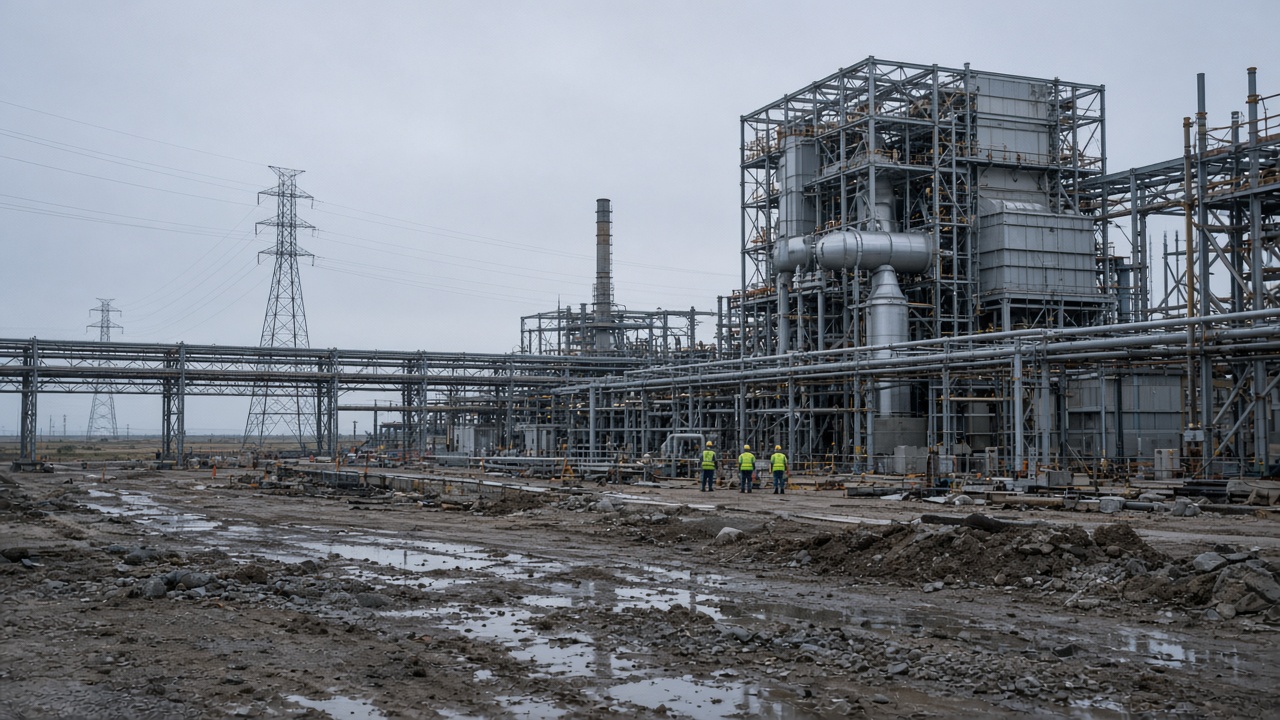
Lawmakers were told this week that a gas-fired power plant in Texas could become the first concrete project to draw on South Korea's $350 billion U.S. investment pledge, according to briefing details reported by Reuters and Baird Maritime. The project, still early in the pipeline, would test how Seoul turns a headline number into signed contracts, financing, and shovels in the ground.
The briefing followed a 30-minute meeting between President Lee Jae-myung and U.S. President Donald Trump on the sidelines of the United Nations General Assembly, where warship construction and industrial cooperation were on the agenda. Yonhap reported that Lee discussed warship construction with Trump. The U.S.-South Korea package includes a $150 billion shipbuilding slice, making the maritime sector the largest single component under discussion.
But the first check may not be a shipyard. The Texas gas plant, if selected, would put energy infrastructure at the front of the queue. That matters for Korean manufacturers because power availability is a precondition for advanced factories, data centers, and shipyards. A gas project can also move faster than nuclear or offshore wind, though it still needs permits, grid connections, and long-term offtake agreements.
Why a Texas gas plant
Texas has become a test bed for new power demand from industrial and technology loads. A gas-fired plant can be built in phases, paired with existing pipelines, and financed through a mix of U.S. utilities, infrastructure funds, and strategic investors. For Seoul, the appeal is that a power project can show visible progress without waiting for a full semiconductor or battery supply chain to be relocated.
The political logic is equally direct. The $350 billion pledge is a framework, not a single appropriation. Lawmakers want to know which projects qualify, how much capital comes from Korea, and whether the work creates Korean exports or simply exports Korean capital. A Texas gas plant would not answer all of those questions, but it would set a template for the ones that follow.
Industry Ministry officials have been briefing lawmakers on implementation as the government tries to convert the summit-level agreement into an interagency process. The briefing's focus on a potential first project suggests Seoul wants to avoid the fate of previous overseas investment packages that stalled between announcement and execution.
Shipbuilding remains the big slice
The shipbuilding portion is larger than any single energy project. The $150 billion slice covers naval and commercial vessels, repair capacity, and possibly yard upgrades. Baird Maritime reported that warship-building talks were part of the U.S.-South Korea meeting agenda, a signal that defense procurement and commercial shipbuilding are being handled as one industrial file.
That creates a coordination problem. Shipyards need steel, engines, and skilled labor. Gas plants need turbines, pipelines, and grid interconnections. Both need U.S. regulatory approval. If the Texas project moves first, it could establish the financing and disclosure standards that shipbuilding projects later inherit.
Korean lawmakers are likely to press for a dashboard: how many projects have been approved, how much has been committed, and what share of components or services comes from Korea. Without that, the $350 billion figure remains a diplomatic talking point rather than an industrial policy.
What to watch
The next signals are mundane but decisive. Watch for a named developer, a power purchase agreement, and a financing structure. Watch whether the project is described as a Korean investment or a U.S. project with Korean participation. Watch how the shipbuilding slice is divided between naval orders and commercial yard work.
For Korean technology firms, the Texas plant is a reminder that the U.S. investment rollout is not only about chips and batteries. It is also about the power, ports, and shipyards that keep those industries running. The first project will not settle the $350 billion debate, but it will show whether Seoul can turn a pledge into a pipeline.