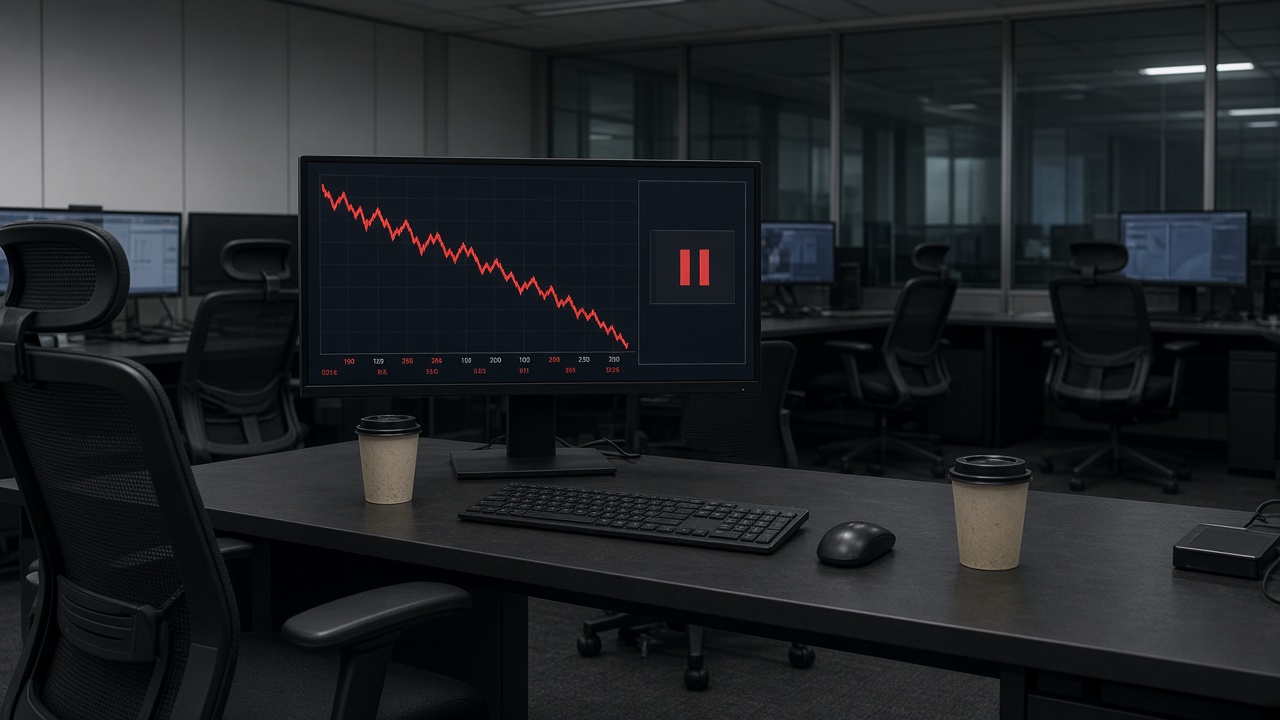
Korea's Kospi sidecar has been triggered 49 times so far this year, and the count itself has become the argument: a mechanism designed as a brief speed bump is firing at a record pace, and market-structure specialists are openly asking whether it still does what it was built to do.
The tally, reported by The Star on Sept 25 alongside 32 comparable triggers on the Kosdaq, puts sidecar use at a record relative to 2008, the crisis year that has long served as the reference point for how often this tool fires. That is not a stocks-recap story. It is a question about whether a five-minute pause in program trading still functions as intended in a market now driven by automated order flow. Korean equities are closed through the Chuseok holiday and reopen Sept 28, which is why the debate is running ahead of the tape rather than alongside it.
What the sidecar is, and is not
The sidecar is not a circuit breaker, and the distinction matters to anyone trying to read the 49 figure. When Kospi 200 futures swing sharply against the previous close, program trading is suspended for five minutes while the cash market keeps trading. Nothing on the screen goes dark. The assumption baked into the rule is that five minutes is enough for arbitrage and hedging flows to re-price, and for the queue of sell orders to thin out on its own.
Five minutes, then what
The skeptical case is that a halt cancels nothing. It defers. Sell algorithms that were working a position before the pause are still there when it lifts, and critics argue the reopening becomes a magnet: orders that might otherwise have been spread across several minutes arrive in the same instant. The reporting on Seoul's sidecar strategy raises precisely this doubt, that the interruption buys optics rather than liquidity.
The standard defense of the design is the mirror image: longer halts tend to produce worse gaps on reopen, not better ones, and a short interruption is the least bad option available. Neither side has published the tick data that would settle it, and that absence is part of why the argument keeps returning.
The backdrop is not a crash
What makes the record count strange is the market it is happening in. Kospi closed at 7,080.92 on Sept 23, up 0.9%, with Samsung Electronics at 285,500 won and SK hynix at 1,862,000 won. Sedaily reported that chips are leading the third-quarter earnings season while won strength is splitting the rest of the market into winners and losers. Repeated sidecar triggers against a rising index point less to panic than to uneven liquidity, with heavy flow concentrated in a handful of large caps where futures can move enough to trip a threshold the broader market never approaches.
Who holds the file
On the confirmed side, the mechanism has behaved as written: 49 triggers, no reported malfunction, no exchange statement that a trigger was erroneous, no enforcement case attached to any of the events. Operationally the trigger belongs to the Korea Exchange, which runs the sidecar; the Financial Services Commission sits above it with the rulemaking and oversight authority. Neither has signaled that a rewrite of the threshold or of the five-minute window is coming.
Liability is not the live question here. A five-minute program-trading pause is an exchange rule, not a transaction an investor can sue over, and no party has been accused of anything. Exposure would surface only if a trigger misfired or an operator failed to apply its own published rules, and there is no such allegation in the record.
What is still unknown
Whether either agency has opened, or intends to open, a formal review of sidecar parameters. Whether a five-minute window written for much slower order flow is still the right length. Whether the 2026 record will be treated as evidence of a structural problem or as an artifact of a narrow, chip-led market. And what the first post-holiday session on Sept 28 shows about how the order queue behaves after the longest break of the year. Until then, the accurate description of the 49 figure is that it is confirmed, unusual, and not yet explained.