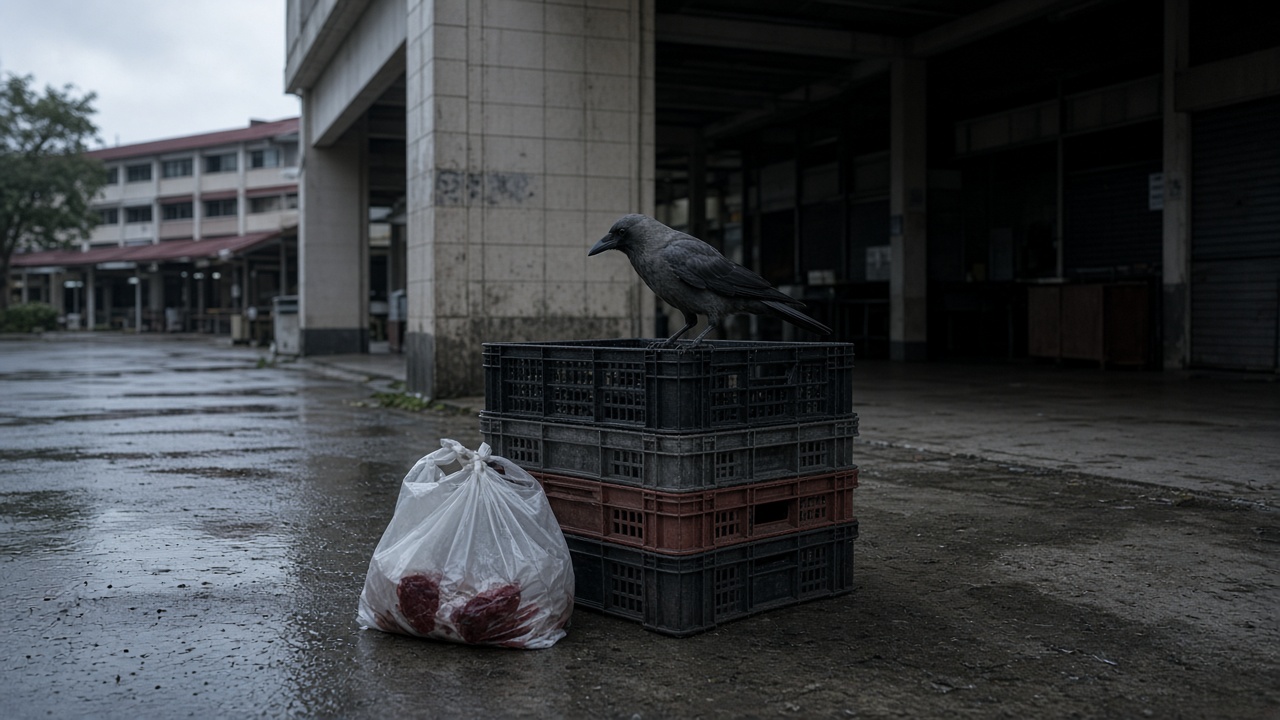
A grey crow was filmed standing on a plastic bag of raw meat outside the Koufu food court at Pioneer Mall in Jurong West, tearing at the contents while the bag sat on the ground. The footage is dated Sept 21 and spread online this week. According to AsiaOne, the meat arrived as part of a supplier delivery left there overnight. On Sept 25, the Singapore Food Agency said it was investigating.
It is a small scene, and on its face an unglamorous one: a bird, a bag, a stretch of pavement outside a neighbourhood mall food court. But it lands at a moment when the way Singapore inspects and rates its food stalls is being rebuilt, and it points at the part of the chain that inspections have historically found hardest to see — the hours before a stall opens.
What the footage does and does not show
Nothing in the clip establishes that the meat ever reached a kitchen, or which stall it belonged to. The reported sequence of events — an overnight drop-off, goods left outside, a food court that only comes to life in the morning — is a logistics story before it is a kitchen story.
That gap is not unique to Pioneer Mall. Food courts in HDB neighbourhoods routinely take deliveries in the small hours so stalls can prep before the breakfast crowd. Whoever is on the ground at that hour is usually a driver with a route to finish, not a stallholder with a licence to protect.
The rules that apply
Raw meat sits at the sharp end of food-safety regulation: it needs a cold chain, a covered container and a clean surface, and licensing conditions run to the food court operator as well as the individual stall. Common areas — loading bays, back corridors, bin centres — sit in the operator's scope, while the stallholder answers for what happens inside the unit. Where an unattended crate sits in between, responsibility is exactly the kind of thing an investigation has to sort out.
Why the timing matters
The Ministry of Sustainability and the Environment set out that shift in an oral reply to Parliament, framing it as a move away from judging a stall on one inspection day and toward judging it on how it behaves across many. For operators, the practical effect is that a bad morning can no longer be absorbed by a good snapshot. For consumers, it means the grade on the wall is being asked to say more than it used to.
The cost side
Hygiene lapses are cheap to prevent and expensive to be caught in. A covered crate and a schedule that matches a driver's arrival to someone who can receive the goods cost almost nothing. Repeat failures draw demerit points and, at the serious end, suspension — which for a stall means rent that keeps running while the shutters stay down. The margin on a plate of noodles does not leave much room for a fortnight of closed shutters.
That arithmetic is why the details matter more than the outrage. The question for the investigation is not only whether a crow got at a bag, but who was supposed to be standing there when the delivery landed, and what the arrangement between the food court and its suppliers says about how the handover is handled on an ordinary weekday.
For now, the food court is open and serving. The findings, when they come, will tell whether a single unattended drop-off is the story — or whether the drop-off was simply the visible end of a routine nobody owned.