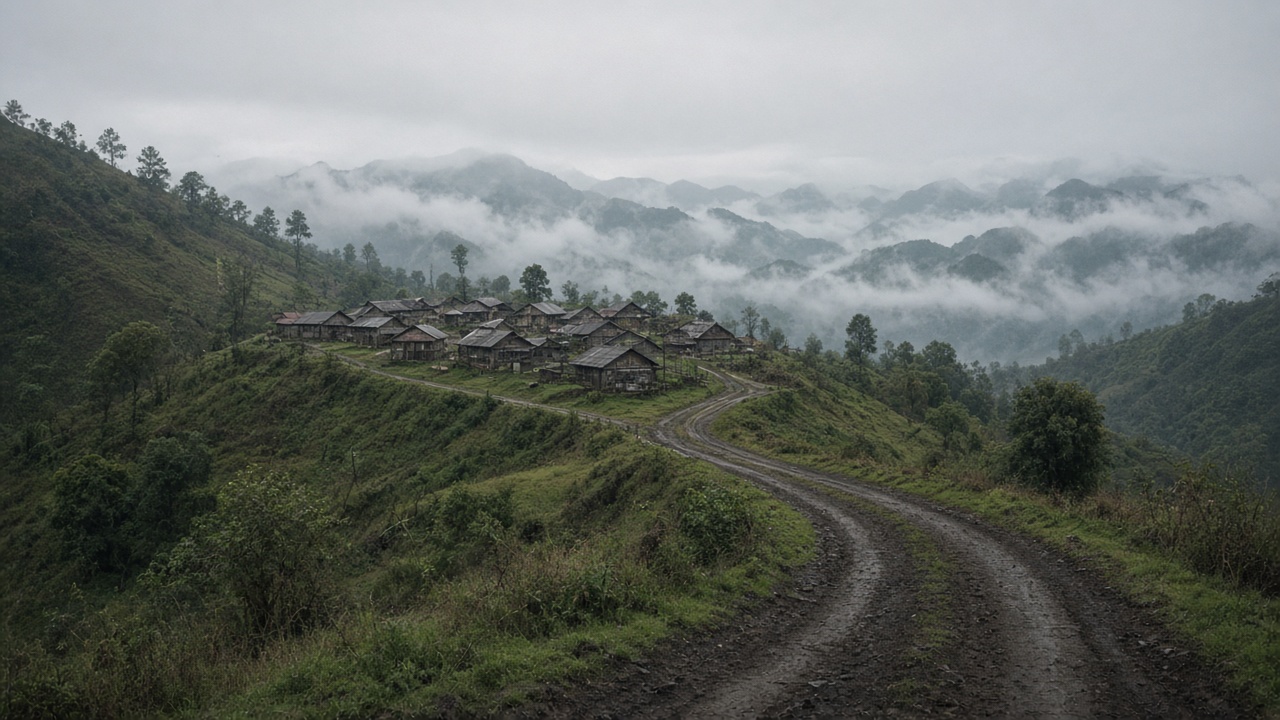
Four civilians were killed in Pilong village in Manipur’s Kamjong district on Friday night in what police described as a cross-border attack, hours after the Centre extended the Armed Forces (Special Powers) Act, or AFSPA, in the state. The killings have renewed questions about the security vacuum along the India-Myanmar border and the state’s ability to protect hill villages caught between insurgent movements and Myanmar’s civil war.
According to initial police accounts, the victims were residents of Pilong, a remote village in Kamjong, which shares a porous and largely unfenced boundary with Myanmar’s Sagaing region. Officials said the attackers fired from across the border before fleeing. No group has claimed responsibility, and the identity of the attackers remains unverified. The Manipur Police have registered a case and are investigating whether the assailants belonged to a Myanmar-based armed group or to an Indian insurgent outfit operating from camps across the border.
The attack comes as the Ministry of Home Affairs extended AFSPA for another six months in Manipur. The law, which gives security forces sweeping powers to search, arrest, and use lethal force in “disturbed areas,” has been in force in the state’s hill districts for years. Its extension was announced amid a broader security review following a series of attacks in the border belt. Officials argue that AFSPA is necessary to counter insurgent movements that use Myanmar’s lawless border zones as launchpads. Critics say the law has not prevented repeated attacks on civilians and has instead deepened distrust between communities and security forces.
What is confirmed — and what is not
Confirmed: four civilians are dead; the killings took place in Pilong village, Kamjong district; police are treating the incident as a cross-border attack; AFSPA has been extended. Not confirmed: the number of attackers, their affiliation, the weapons used, and whether Indian intelligence had any warning. Police have not released the names of the victims, pending notification of families. A post-mortem examination is expected to establish the exact cause of death. The National Investigation Agency has not yet taken over the case, though officials said it could if evidence points to a terror plot with cross-border links.
Kamjong is one of Manipur’s most sensitive districts. It borders Myanmar’s Sagaing region, where fighting between the military junta and People’s Defence Forces has pushed thousands of refugees into India and pushed armed groups deeper into the border hills. India shares a 1,643-km border with Myanmar. In 2024, the Centre scrapped the Free Movement Regime, which had allowed people to cross up to 16 km without a visa. The move was meant to curb illegal migration and insurgent movement, but it also disrupted traditional livelihoods and left border villages more isolated.
Who is liable in India
The case is being handled by the Manipur Police, with support from central paramilitary forces. Under Indian law, a cross-border attack on civilians can be prosecuted under the Bharatiya Nyaya Sanhita for murder and criminal conspiracy, and under the Unlawful Activities (Prevention) Act if the attackers are linked to a banned organisation. If the probe establishes a terror angle, the NIA can take over. The Ministry of Home Affairs is monitoring the situation, and the Army’s Eastern Command has been asked to review border domination along the Kamjong sector.
Local residents have demanded more security posts and better intelligence. But the deeper problem is structural: the border is rugged, thinly manned, and easy to cross. Insurgent groups have long used Myanmar’s Sagaing and Chin States as sanctuaries. Myanmar’s civil war has made those areas more volatile, with multiple armed actors controlling different pockets. Indian agencies must now contend with not just Indian insurgents but also Myanmar-based groups that may have their own agendas.
The AFSPA extension is unlikely to settle the debate. For the Centre, it is a necessary tool. For civil society groups in Manipur, it is a reminder that extraordinary powers have not delivered ordinary security. The immediate test is whether the police can identify and arrest the attackers. The larger test is whether India can secure a border that has become a permanent fault line.