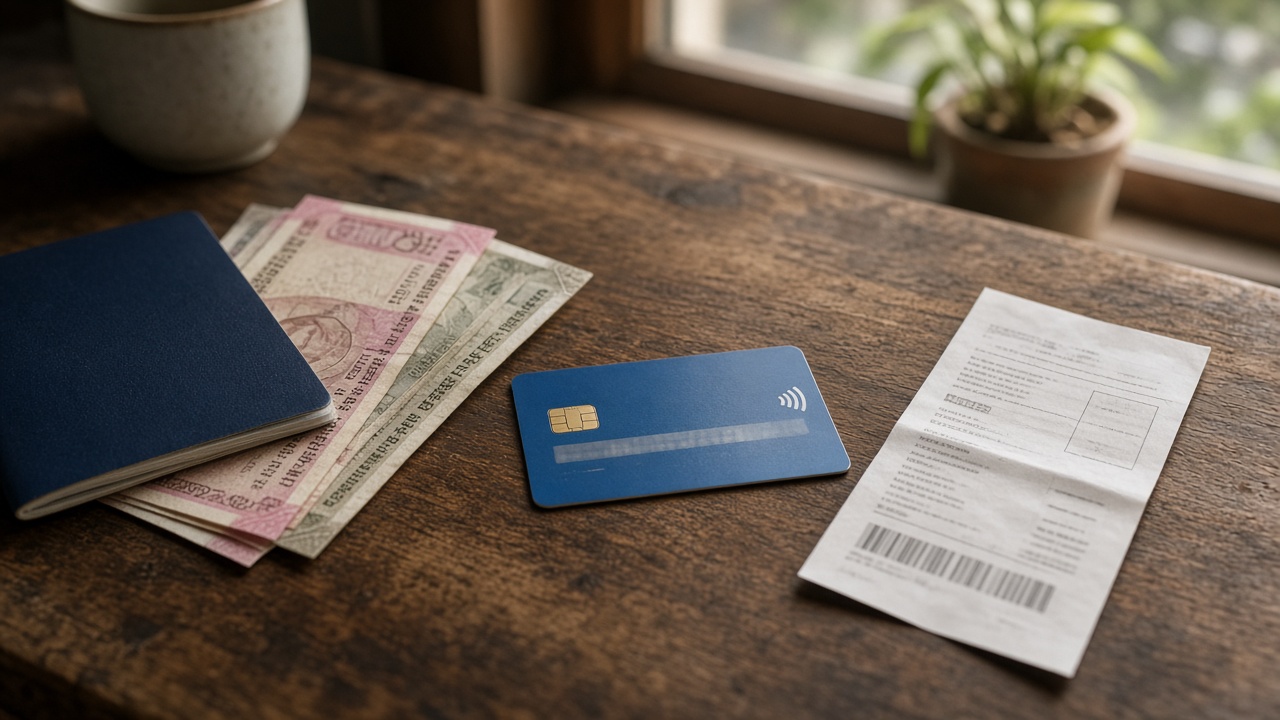
A number that lands on your card statement
The rupee traded around 95.88 to the dollar on September 25 after traders said the Reserve Bank of India likely sold dollars before the market opened to steady the currency. The spot print matters for importers, exporters and bond desks. It also matters for anyone who used an Indian credit or debit card abroad — or plans to in the coming weeks.
Foreign card spending is settled in dollars or another convertible currency, then converted back into rupees for the statement. That conversion is not the same as the headline rate. Card networks use a wholesale exchange rate, and issuers add a foreign transaction markup. Many Indian cards charge a markup in the 2% to 3.5% range, with GST applied on the fee. Overseas ATM withdrawals usually attract a separate fee, often a flat charge plus a percentage, and cash advances can accrue interest from the day of withdrawal.
The arithmetic is simple enough. A $100 overseas spend at 95.88 is ₹9,588 before markup. At 95.97, the earlier reference, it is ₹9,597. The raw currency move is ₹9. Add a 3% foreign transaction markup and 18% GST on that fee, and the same $100 can cost roughly ₹9,900 or more, depending on the issuer. A $500 hotel bill or a semester fee magnifies the difference.
Traders cited by The Hindu BusinessLine said the RBI stepped in before the open, with the rupee opening at 95.88 against the previous 95.97. That kind of pre-open dollar sale is a smoothing operation. It can reduce sharp intraday swings, but it does not change the cardholder’s markup, ATM fee or GST. It may affect the wholesale rate that ultimately feeds into the statement, but the benefit is partial and delayed.
Where the household bill gets heavier
For a family paying overseas tuition, booking an international holiday or sending money for a relative’s medical treatment, the rupee level sets the base cost. A weaker rupee makes each dollar more expensive. Card fees layer on top. If the merchant offers dynamic currency conversion at the point of sale — charging you in rupees instead of the local currency — the rate is often worse than letting the network convert. Choosing local currency is usually the cleaner option, though the issuer’s markup still applies.
Overseas ATM use is usually the most expensive way to access cash. A traveler may pay an ATM operator fee, a fixed issuer fee and a cash-advance fee, with interest starting immediately. Some cards offer zero-markup foreign spends or lower ATM fees as a feature. Others bundle travel benefits but keep a standard markup. The issuer schedule is the document that matters: foreign transaction fee, ATM withdrawal fee, cash-advance interest rate, and whether GST is added to each.
There is a second household risk that surfaces after the trip. If the card balance is revolved, the interest rate on unpaid amounts can be 36% to 48% annualized, depending on the issuer and card tier. A missed payment adds a late fee and can trigger a higher penalty rate. The foreign spend does not stay a foreign spend for long; it becomes part of the monthly bill, and that bill is denominated entirely in rupees.
The rupee’s backdrop is not only about cards. The RBI’s September bulletin flagged resilience alongside downside risks from the West Asia conflict, with reserves at $766 billion as of September 18 — about 11.2 months of import cover. That reserve cushion gives the central bank room to intervene. It does not shield households from the arithmetic of a 95-plus rupee.
Equities added to the cautious mood. The Sensex closed down 733.22 points at 80,426.46 on September 26, while the Nifty fell 236.15 points to 24,654.70, its sixth straight losing session, according to ET Now. A weaker rupee can weigh on importers and companies with dollar costs. For cardholders, the more immediate question is what their next statement will show.
What to check before the next swipe
Before an overseas transaction, check the issuer’s foreign transaction markup and ATM fee. If the card charges 3.5% plus GST, a $1,000 spend could add roughly ₹3,800 or more in fees at current rates. If the card has a zero-markup feature, confirm whether it applies to all foreign currency spends or only select merchants. For ATM withdrawals, calculate the flat fee plus the percentage, and remember that cash advances may not have an interest-free period.
If a payment is missed, the issuer can charge a late fee, raise the interest rate, and report the delinquency to credit bureaus. That is a bigger rupee cost than the difference between 95.88 and 95.97. The RBI’s pre-open dollar sales may steady the currency at the wholesale level. The household bill still depends on the card’s fee schedule, the amount spent, and whether the balance is cleared by the due date.