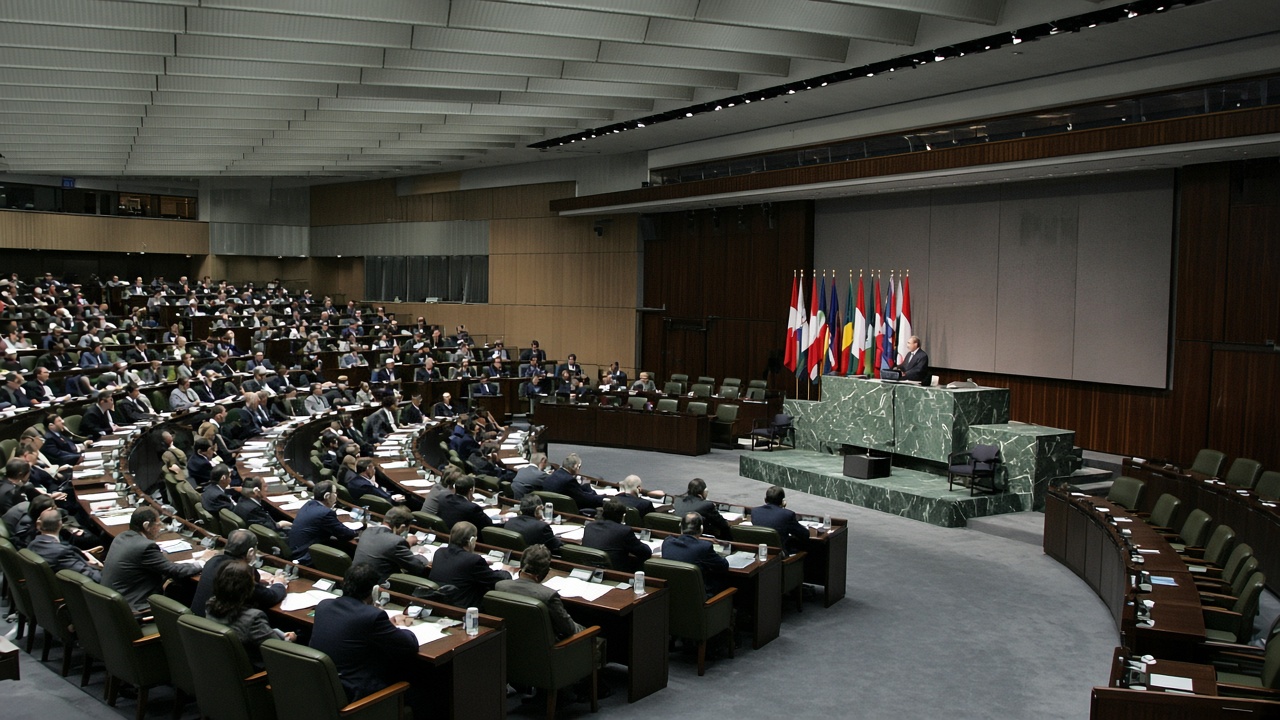
Pakistan Prime Minister Shehbaz Sharif told the United Nations General Assembly on Friday that any Indian move to divert or hold back Pakistan's share of the Indus river system would be treated as an act of war, moving the water dispute between the two nuclear-armed neighbours off the technical track and onto the UN floor.
His remarks, delivered from the UNGA rostrum in New York, came against the backdrop of India's decision to hold the Indus Waters Treaty in abeyance following the Pahalgam attack. Indian diplomats in the hall were reported to have reacted visibly as Sharif spoke.
The treaty, and what "abeyance" means
Signed in 1960 with World Bank brokerage, the Indus Waters Treaty split the basin — the three western rivers, Indus, Jhelum and Chenab, allocated largely to Pakistan, and the eastern Ravi, Beas and Sutlej to India — and set up a Permanent Indus Commission as the standing channel between the two governments.
India's decision to hold the treaty in abeyance did not formally terminate it, and New Delhi has maintained that it will not stop the flow of water. What changes is the obligation to keep working through the commission's machinery: project clearances, data sharing and inspection requests that were previously routinised now sit without a binding frame.
What is on the list
The near-term list is hydroelectric. Run-of-the-river projects in Jammu and Kashmir — among them Pakal Dul and Ratle on the Chenab — do not consume water the way irrigation diversions do; they pass it through turbines. That distinction has been the core of India's public position, and the core of Pakistan's objection, which has focused on storage and on the timing of releases rather than volume alone.
Sharif's framing shifts the argument from kilowatts to thresholds. Calling diversion an act of war converts a treaty-compliance question into a security question — and, by implication, into one in which Pakistan claims a right to respond outside the commission's procedures.
The Indian reply
India's right of reply at the UN is expected to restate the position that the treaty is in abeyance, not abrogated, and that India remains within its rights to use the waters of the western rivers for projects inside its own territory. New Delhi has also argued that the Pahalgam attack changed the basis on which it was prepared to continue cooperation.
For the South Asia file, the practical test is not the speech but the meetings. Whether the Permanent Indus Commission convenes, whether flow data resumes reaching the other side before the next sowing season, and whether either government takes a step that cannot be walked back — those are the dates that will decide whether Friday's language stays rhetoric or becomes a threshold test.
Both countries are nuclear-armed. The 2019 and 2025 cycles showed how quickly a single incident can compress the distance between a statement and a military posture. Water adds a slower clock — one measured in seasons rather than hours — but it is a clock that does not stop.