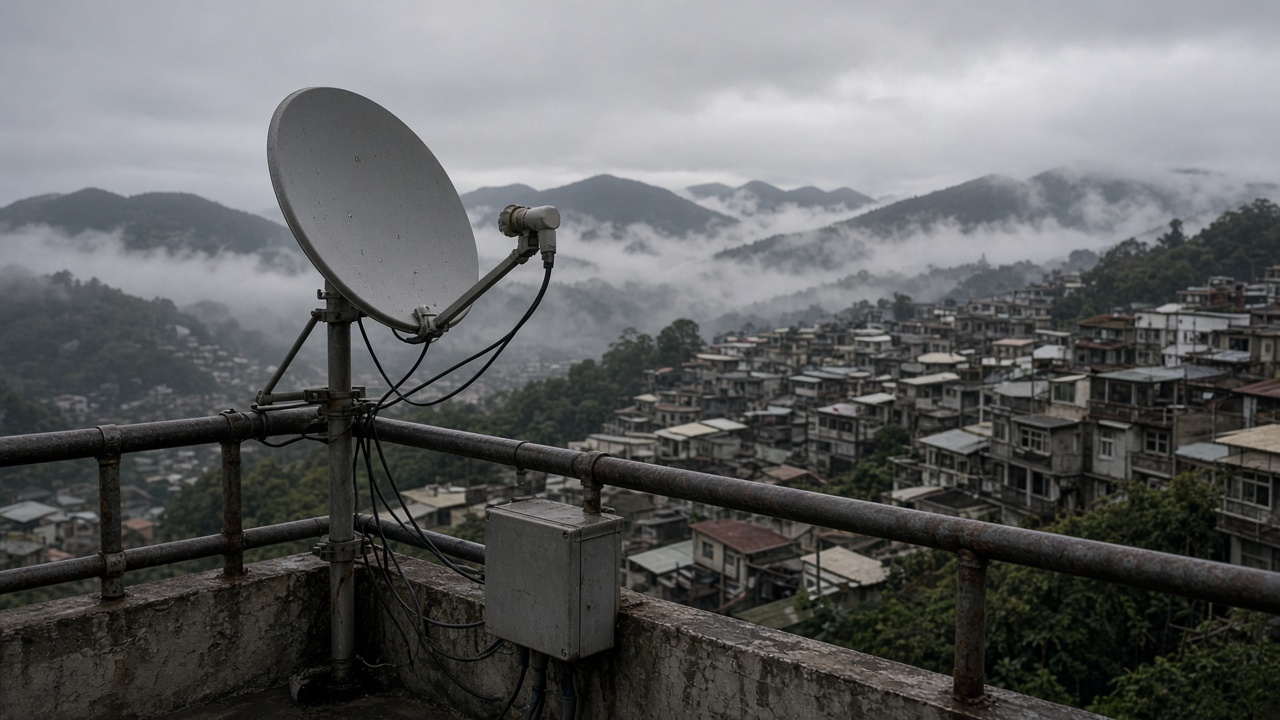
Taiwan published a legal door for low-Earth-orbit satellite broadband on Aug. 5. It has not been opened. Two paragraphs added to Article 36 of the Telecommunications Management Act (電信管理法) — the provisions intended to give satellite operators a licensing route — were promulgated by presidential decree, but the Executive Yuan has not issued the commencement order that puts them into force. Without that order, the National Communications Commission has no basis to accept applications, and SpaceX's Starlink still has no way to file for a Taiwan licence.
Coverage of the clause's status reaches the same conclusion: the text is on the books, the procedures are not.
What shipped, and what did not
Articles 36(9) and 36(10) sit in the section of the act that governs radio frequencies and radio equipment. They create the licensing category that satellite communications services have lacked — the route a non-geostationary constellation operator would use to offer service in Taiwan, together with the conditions attached to the frequencies and the earth stations it would need.
So the framework shipped. Almost nothing that makes a framework usable did: no effective date, no application form, no fee schedule, no published security review standard, no procedure for approving the terminals that would sit on customers' roofs.
A promulgated law is not a law in force
Taiwanese statutes routinely hand the commencement date of an industry-shaping amendment to the Executive Yuan. The logic is practical: ministries get time to write subordinate regulations before the main text starts biting, so an agency is not enforcing obligations with no procedure behind them. The side effect is that a law can be printed in the gazette, read by every firm in the sector, and still be legally inert.
For Starlink, the question is not whether the new paragraphs are well drafted. It is whether there is a window to file in. There is not.
The NCC's unfinished paperwork
A report on the clause's status notes that the commission's procedures remain pending, and that is the ordinary sequence rather than a scandal. A licensing regime for satellite service needs qualification rules for applicants, a national security review, frequency coordination with incumbent users, inspection and type approval for earth stations, tariff filing, and an enforcement mechanism for operators that breach the terms.
None of it can be improvised, and the NCC has not put a timetable on any of it. The sector's working assumption is that the sub-regulations will be drafted first and the commencement order will follow, which makes the agency's drafting queue — not the cabinet's signature — the real constraint.
Who has to live with the wait
In the places where satellite capacity matters most, the delay is not abstract. Mountain townships, offshore islands and the fishing fleet are the customers a constellation operator would chase first, and they are the users with the weakest redundancy when a submarine cable or a base station fails. A licensing route that exists on paper but not in force leaves them with the same thin backup they have now.
Domestic carriers are in a similar position. Any resale or partnership deal with a foreign constellation has to be built on a licence category that is not yet live; operating around the edge of the existing fixed-line and mobile rules is precisely what the amendment was meant to end. Taiwanese antenna and RF component makers, who already supply into global satellite supply chains, gain little from a domestic market they cannot yet be paid to serve.
Security agencies, meanwhile, get the part of the policy they care about least: a framework with the ownership and control conditions still unwritten, at a moment when the debate over foreign-operated infrastructure is live on both sides of the Pacific.
What to watch
Three signals. First, an Executive Yuan order in the gazette naming the commencement date. Second, draft NCC sub-regulations posted for public comment — that is when ownership limits, security conditions and frequency terms become visible, and lobbyable. Third, whether the two arrive together or far apart, which will show how much of the delay was legal design and how much was administrative backlog.
Until then, the accurate description of Starlink's position in Taiwan is not that it is banned. It is that there is nothing to apply to. The Aug. 5 promulgation was a decision; the blank line where the effective date should be is the policy.