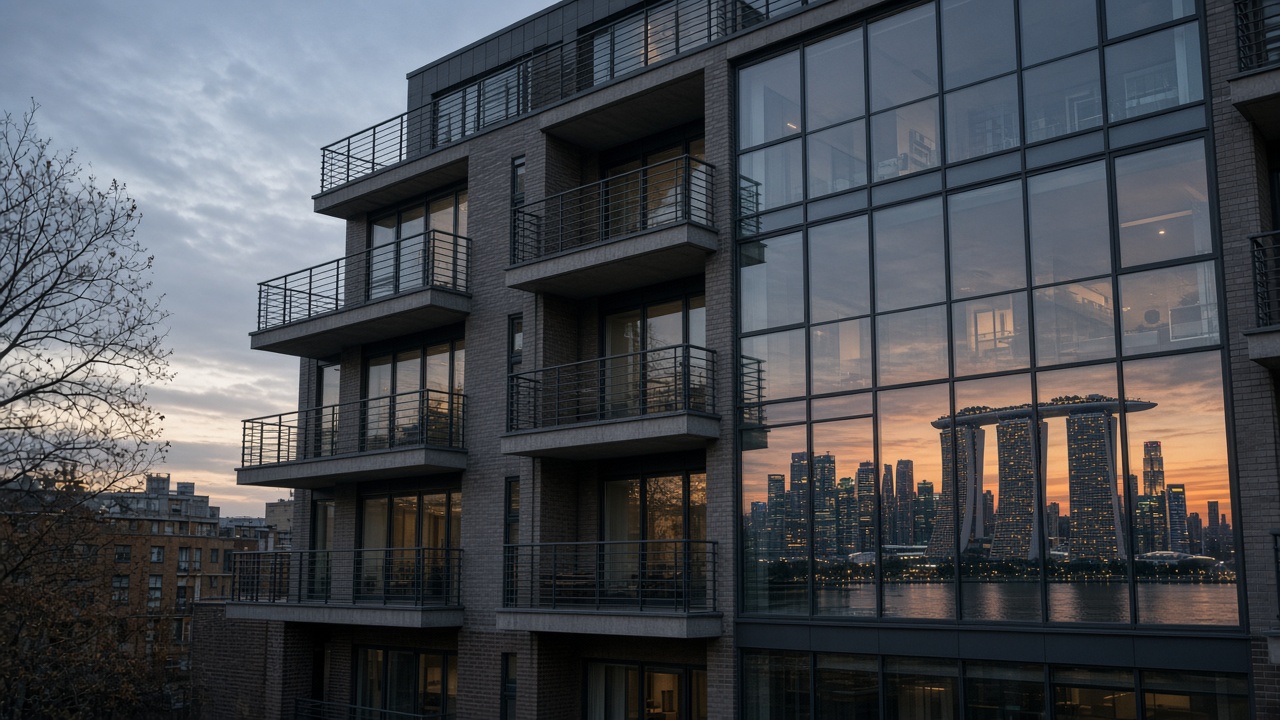
Singapore equities finished Friday higher, with the Straits Times Index closing at 5,711.12, up 0.5%, after trading in a 5,665–5,716 range. The benchmark's advance was modest but broad enough to leave the week's close near the top of the session's band, a sign that buyers were willing to hold risk into the weekend.
The headline that helped set the tone came from the property side: Far East Orchard agreed to buy a £60 million London student-housing asset with 444 beds, scheduled for completion in 2029. For a market that has spent much of 2026 debating the cost of capital and the durability of rental income, the deal offered a familiar story—Singapore capital finding yield in an overseas education hub.
Why the London deal matters for the tape
Far East Orchard is not the STI's biggest index heavyweight, so the deal's immediate effect on the benchmark is more about sentiment than index arithmetic. The transaction gives investors a read on how management is allocating capital: toward purpose-built student accommodation in a market with structural demand from universities, and away from assets that require heavier cyclical assumptions.
Student housing is a niche where cash flows can be underwritten with relatively high visibility. Leases are often shorter than conventional office or retail, but occupancy is driven by enrolment, not GDP. London's universities draw international students, and the supply of well-located beds has lagged demand for years. That does not make the asset risk-free—construction timing, planning, financing costs, and student-visa policy all matter—but it fits the income-oriented playbook that Singapore developers and REITs have been pitching to investors.
The £60 million price tag and 444 beds imply a per-bed cost of roughly £135,000. That is the number the street will use to benchmark the deal against similar UK student-housing transactions and against Far East Orchard's own cost of capital. If the yield on completion is not accretive relative to the group's funding costs, the market will treat it as a strategic move rather than an earnings upgrade.
Breadth beyond the headline
The session was not a one-stock story. Corporate news flow included CSE Global winning US$150 million of LNG-related contracts tied to the CP2 Louisiana project, and MetaOptics moving to OTCQX Level 1 ADR while keeping its SGX Catalist listing. Those items do not move the index the way a bank or Singtel does, but they add to the sense that Singapore-listed small and mid-caps are still finding pockets of demand.
That matters because the STI's 0.5% gain was not driven by a single sector melt-up. When the index closes near its high on a Friday, traders typically point to follow-through from regional markets, position-squaring, or specific corporate catalysts. The Far East Orchard deal belongs in the third category. It is a concrete capital-allocation decision that gives investors something to price, rather than another macro headline.
What the market already has in the price
Singapore stocks have already absorbed a lot of good news this year. The STI's move above 5,700 has been supported by expectations of stable interest rates, resilient bank dividends, and a pickup in corporate activity. A single £60 million overseas acquisition does not change the index's earnings power. It does, however, reinforce the narrative that local developers are willing to recycle capital into income-producing assets when the numbers work.
The street will also look at the financing. Far East Orchard has not disclosed the full funding mix, so the key question is whether the acquisition is funded with debt, equity, or a combination. In a market where financing costs remain a focus, a debt-funded deal at a tight yield could dilute the sentiment benefit. A joint-venture structure or a development-phase entry would spread the risk but also delay the income contribution.
What would falsify the signal
By Friday's close, the bullish read on the London deal would be challenged if Far East Orchard underperforms the broader property and REIT complex, or if the STI gives back the 0.5% gain in the next session. A single-day move is not a trend. The more meaningful test is whether other developers follow with similar overseas student-housing or living-sector transactions. If the deal is isolated, it is a company-specific headline; if it prompts a wave of copycat announcements, it becomes a sector theme.
For now, the STI's close at 5,711.12 keeps the index within its recent range and leaves the market's near-term direction unresolved. The Far East Orchard acquisition gives investors a tangible reason to look at the property and REIT space again, but it does not erase the macro questions around rates, currency, and global growth. The tape's next move will depend on whether earnings and deal flow can sustain the bid that showed up on Friday.