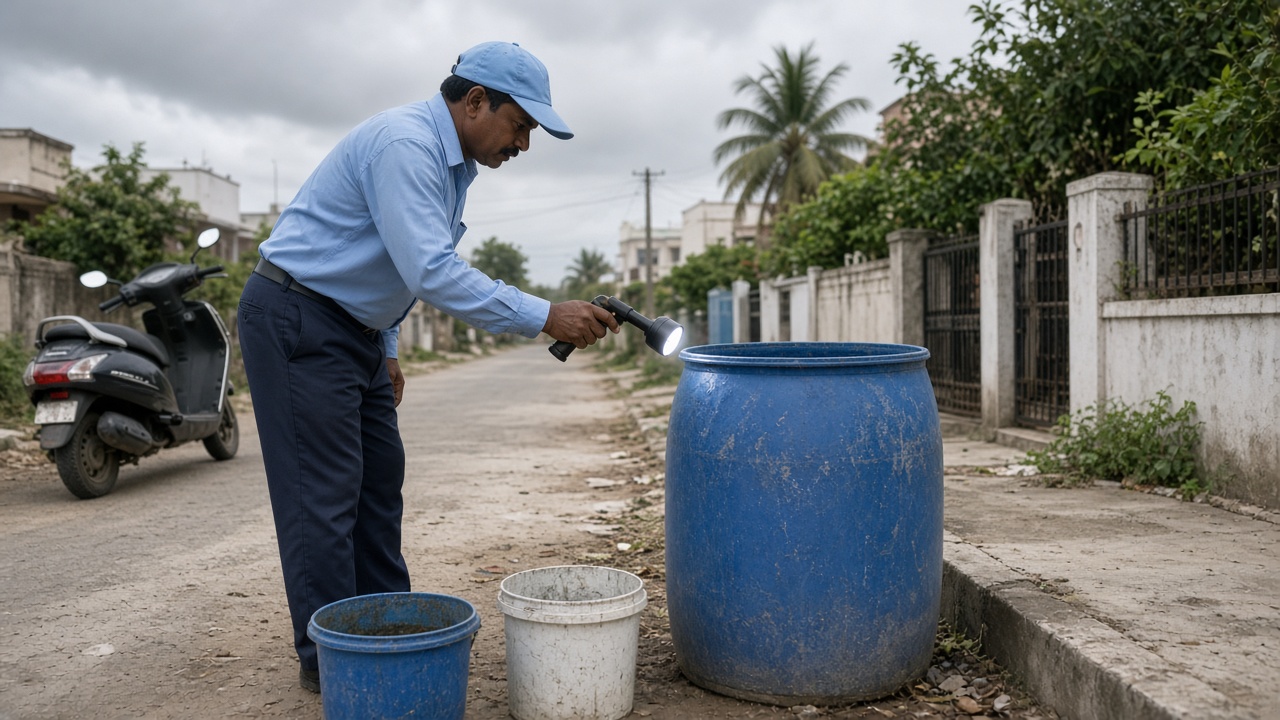
Tamil Nadu has put 26,303 breeding checkers into the field across the state as its dengue case count reached 17,939, with nine deaths, and with the northeast monsoon still weeks away. The tally and the deployment were reviewed in Madurai on September 24 at a stock-taking meeting chaired by senior health department official Darez Ahamed, according to a Times of India report from the city.
The northeast monsoon usually sets in over Tamil Nadu in the second half of October and runs into December. It is the state's main rainy season, and the standing water it leaves behind is what turns a manageable case count into a wave. The monsoon, not the current tally, is the variable that matters.
What 17,939 cases and nine deaths actually mean
Absolute risk first. Nine deaths against 17,939 reported cases is a case fatality ratio of roughly 0.05%. That figure is quoted often, and it is worth being precise about what it describes. It is calculated on reported, mostly clinically or laboratory-diagnosed cases — not on everyone who was infected.
Dengue in India is substantially under-reported: most infections are asymptomatic or mild enough that nobody visits a clinic, and only a fraction of clinical cases are confirmed by NS1 antigen or IgM testing. If the true number of infections is several times the reported figure, the true fatality ratio is lower than 0.05%. If some deaths are attributed to other causes, or occur at home without a dengue diagnosis, the numerator is also understated. Both errors run in the same direction on the ratio, which is why a state-level case fatality number is a rough instrument rather than a verdict on a health system.
What breeding checkers do, and what the number does not say
Breeding checkers are field staff who visit households, inspect water storage containers — drums, tanks, pots, discarded tyres, coconut shells — and either empty, cover or chemically treat what they find. The work produces a specific set of numbers: houses visited, containers inspected, containers found positive for larvae, and the derived house index and Breteau index for a ward or block.
Those indices, not the case count, are what vector control uses to decide where to concentrate. A case count tells you where transmission has already happened; a container index tells you where it is about to. 26,303 is a roster figure. What matters over the next six weeks is coverage: what share of households in the highest-incidence blocks were inspected and then re-inspected, and whether the same containers came back positive on a second visit. Re-inspection, not first-pass inspection, is where most programmes lose ground.
The children question, and why it does not transfer
In Ahmedabad, municipal corporation data reported in September found 183 of 496 cases in children aged 0 to 14, a share large enough to prompt its own round of school and neighbourhood messaging. It would be a mistake to read that proportion across to Tamil Nadu. Case age distribution depends on which serotypes are circulating, how much prior exposure a population has had, and who gets tested in the first place — children with fever are likelier to be taken to a clinic than adults with the same symptoms. The Ahmedabad figures are a prompt for a question, not an answer to it.
What would actually change the picture
Serotype surveillance is the first thing. Dengue has four serotypes, and a second infection with a different serotype is a recognised risk factor for severe disease. Which serotypes are circulating, in which districts, is the single most useful piece of information a state can hold going into a monsoon season. Serotype data for the current Tamil Nadu season has not been published in the reports reviewed here, so that question stays open.
Hospital readiness is the second. Most dengue deaths are linked to late presentation or to warning signs being missed — persistent vomiting, severe abdominal pain, bleeding gums, restlessness or lethargy after the fever breaks. In an Indian waiting room, the practical message is narrow and specific: fever plus any one of those signs means a same-day clinic visit, not a wait-and-watch. Platelet transfusion practice, where it is given and where it is withheld, also varies between hospitals and shapes outcomes at the margin.
Third is whether the deployment holds through the rain. Vector control staffing in Tamil Nadu has historically been supplemented at short notice once cases climb. A roster of 26,303 named in September is more useful than one assembled in November, but only if the checkers stay in the field through the worst of the season.
The state has bought itself a lead on the calendar, which is the only advantage available before a monsoon. Whether 26,303 breeding checkers change anything depends on what the container indices look like by late October — and those numbers have not yet been made public.