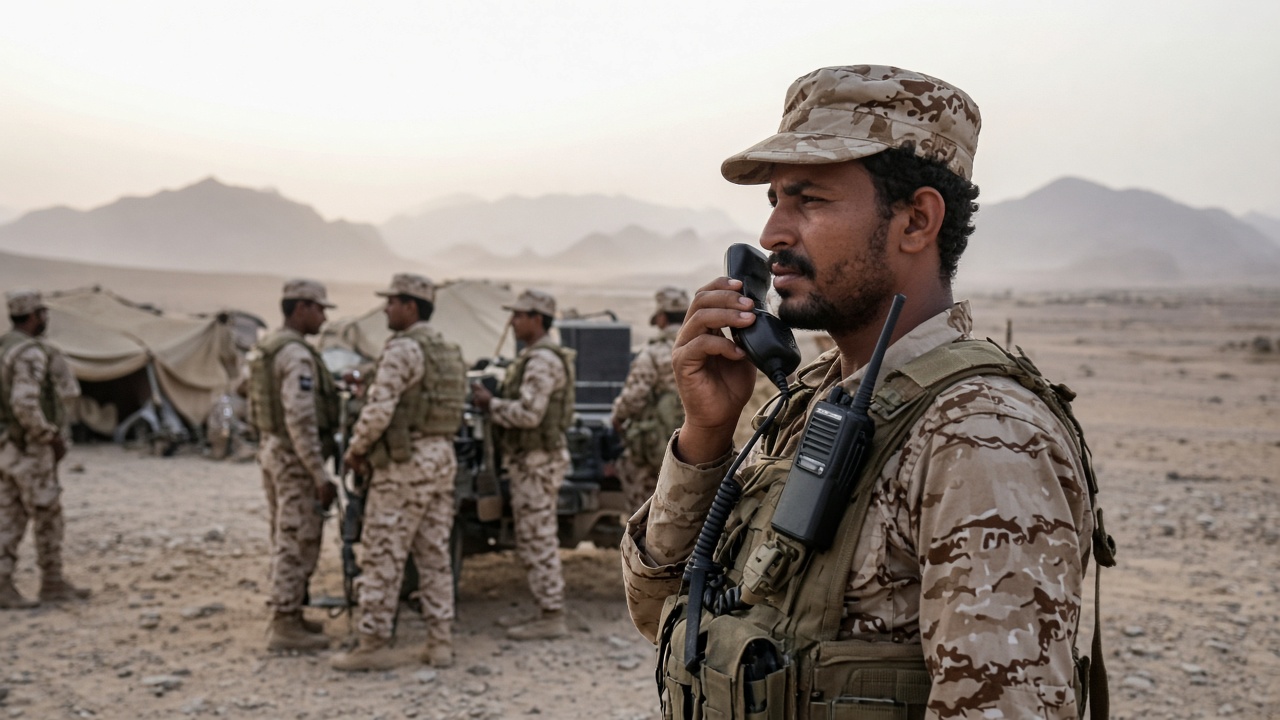
Yemen’s Presidential Leadership Council ordered a general mobilization on Saturday, calling on Yemenis to join the fight against Houthi rebels as the Saudi-led coalition said it intercepted drones headed for Riyadh and the southern Saudi city of Khamis Mushait.
The order from Rashad al-Alimi, the council’s chairman, is the internationally recognized government’s most direct attempt in months to convert political authority into manpower. It does not, by itself, create new brigades or place them under a single command. Its effect will depend on whether tribal, military, and local factions answer a call issued from Aden while the Houthis still control Sanaa and much of the country’s north.
What the mobilization order changes
A general mobilization is a political and military signal as much as an operational plan. It tells aligned commanders to recruit, organize, and prepare for a longer fight. It also raises the cost of neutrality for factions that have hedged between the council and the Houthis.
The statements reviewed did not include a timeline, force target, or command structure. That gap matters. Yemen’s anti-Houthi forces are fragmented among the national army, tribal militias, and groups with separate foreign backers. A mobilization decree can legitimize recruitment, but it cannot quickly solve the coordination problems that have limited past offensives.
Saudi intercepts and the Riyadh threat
The Saudi-led coalition said it intercepted Houthi drones bound for Riyadh and Khamis Mushait. There was no immediate independent confirmation of the coalition’s account. Riyadh is the kingdom’s political and energy center; Khamis Mushait is near the Yemen border and hosts a major air base. A credible drone or missile campaign against both would force Saudi air defenses to cover a wide arc while the kingdom tries to keep its Red Sea and Gulf infrastructure out of the war.
The timing links the Yemen file to a broader regional confrontation. Saudi Arabia has deepened defense coordination with Pakistan, a relationship that gives Riyadh another layer of deterrence but does not remove the day-to-day burden on its air defense units. For the Houthis, the value of launching toward Saudi cities is partly military and partly political: it demonstrates reach, forces costly intercepts, and tries to pull Riyadh back into direct bargaining over Yemen.
Iran, Hormuz, and the spillover risk
Separately, Reuters reported that Iran is awaiting a U.S. move after a Wall Street Journal report said President Trump rejected a peace plan. Al Jazeera’s live coverage said Tehran offered a plan to reopen the Strait of Hormuz within seven days. Those channels are not the same as the Yemen mobilization order, but they sit on the same escalation map. If Iran’s nuclear and maritime file stalls, the Houthis retain value as a pressure point on Saudi Arabia and on global shipping.
That is where the insurance and energy tail becomes visible. A single interception over Saudi territory is a defense story. A sustained campaign that threatens Riyadh, border air bases, and Red Sea traffic becomes a shipping-risk story. Underwriters will look for patterns: how often drones get through, whether ports or terminals are targeted, and whether the Houthis can synchronize launches with Iranian diplomacy.
What to watch
Three indicators matter now. First, whether the mobilization order produces visible units, payroll, and command appointments rather than a statement. Second, whether Saudi Arabia reports more intercepts or changes its air defense posture near the border. Third, whether Iran’s offer on Hormuz advances, stalls, or becomes another deadline that passes without a deal.
For now, the confirmed elements are narrow: the council called for mobilization, and the Saudi-led coalition claimed the intercepts. The wider war spillover is a risk assessment, not a confirmed chain of command. That distinction will matter as governments, shippers, and insurers decide how far to price Yemen back into their regional planning.