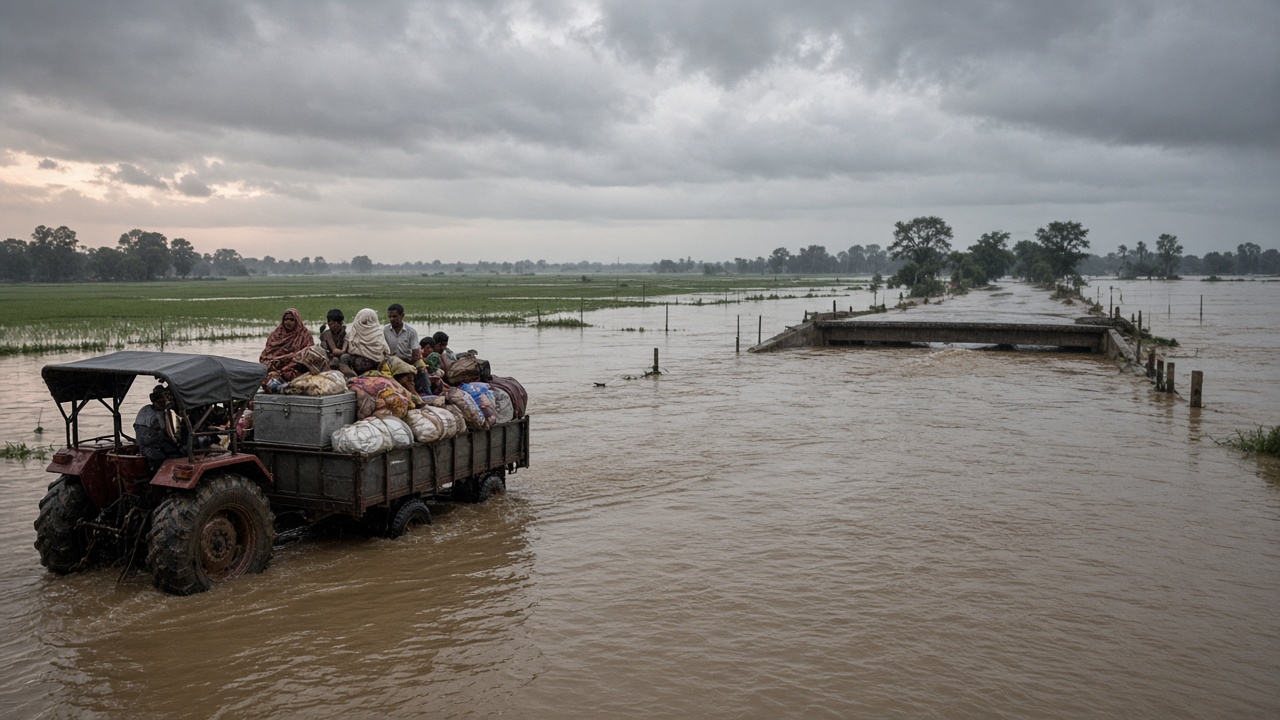
Floodwater from the Kharun river has pushed villagers out of low-lying settlements on Raipur's southern fringe and in parts of Durg district, with the India Meteorological Department holding orange alerts over both districts after a week of heavy monsoon rain across Chhattisgarh.
The Kharun, the seasonal tributary that skirts Raipur before meeting the Shivnath, rose quickly through the Sep 25 to 26 spell. Approach roads and paddy fields on its floodplain went under, cutting off hamlets that sit between the embankment and the city's fast-expanding southern corridor. Families have been shifted to relief camps and to higher ground, with district teams using boats and tractors to reach the worst-hit pockets.
An orange alert is the second of IMD's four colour-coded warning bands and points to heavy to very heavy rain within the next 24 hours. For Raipur and Durg it matters twice over: once as a rain warning, and again as a standing signal that the Kharun and the Mahanadi system downstream are still absorbing water.
What is confirmed
Daily Jagran's Sep 26 round-up of rain damage across seven states placed Chhattisgarh among the worst-hit, naming Kharun flooding as the state's main flashpoint. The same report counted 15 deaths in Uttar Pradesh and put Bihar on alert across 17 districts, a flood watch also carried in The Hindu's Sep 26 news wrap. Uttarakhand suspended the Char Dham and Adi Kailash yatras as a precaution.
What is not in dispute: the Kharun has flooded before, this spell has been unusually concentrated, and the two districts have moved people out rather than wait for the river to peak.
Who has the file
Three sets of hands. The district collectors of Raipur and Durg run the relief and evacuation side, under the state disaster management authority, with state response force units and home guards drawn in as needed. The water resources department controls the barrages and regulators on the Kharun and its feeder streams, which decides how much water moves downstream and when. And the Raipur Municipal Corporation owns the city's drainage, which is where a river flood and an urban flood stop being separate problems.
If the response is judged later, the questions will be about release timing upstream, whether the city's nullahs were cleared before the monsoon, and whether the alerts translated into warnings that actually reached the villages that flooded.
What is still unknown
Numbers are thin. How many people have been moved to camps, how many hamlets are cut off, how much standing paddy has been lost, and what the rainfall totals look like at block level have not been consolidated in public. Nor is it clear whether the Kharun has peaked, or whether releases from upstream structures are still adding to the flow.
The alert level is itself a live question. If the current spell repeats, an orange warning for Raipur and Durg can be upgraded to red, which changes what district administrations are expected to do about schools, movement and camp capacity. Whether Chhattisgarh will seek central assistance, and when a crop loss assessment begins, are open ends that will surface once the water recedes.
The wider week
Chhattisgarh is not alone. The same spell has killed 15 people in Uttar Pradesh, put Bihar's eastern districts on flood watch and forced the suspension of two Himalayan pilgrim routes. It is a reminder that the late-September phase of the monsoon does damage less through volume than through where it lands.
For now the operative question on the Kharun is simple. Does the water recede before the next spell, or does Raipur's southern edge spend the rest of the week watching the gauge?