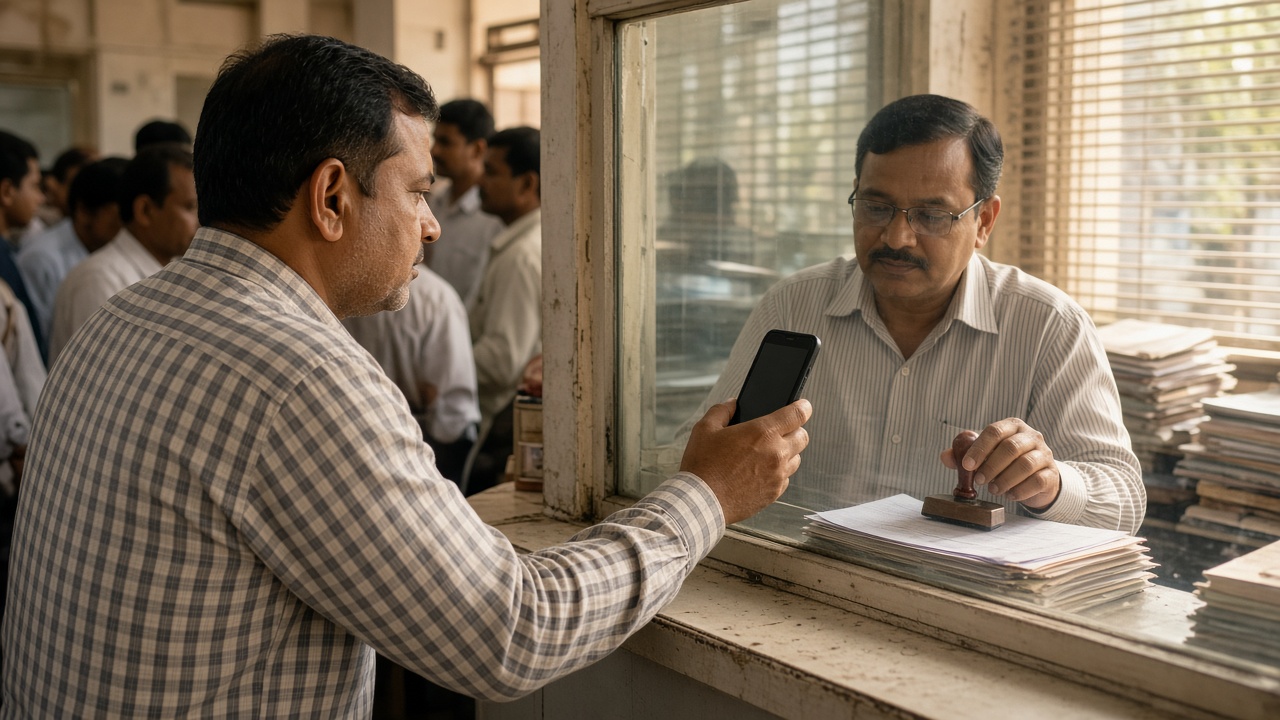
Gujarat has moved twenty of its highest-traffic citizen services onto the Digital Gujarat portal, and Aadhaar authentication is now a mandatory step before an application can be submitted. The list, laid out in the state's Gandhinagar briefing this week, covers the paperwork people actually queue for: income and caste certificates, land-record extracts, ration-card corrections, scholarship filings, pension verification and a set of municipal permissions that until now moved on a self-declaration and a photocopy.
The direction of travel is not new. What is new is the order of operations. On the portal, identity verification now comes first, and the service form opens only after that gate clears.
What actually shipped
Three rails do the work. Aadhaar OTP to the linked mobile number, where the number on record is current and reachable. Aadhaar Paperless Offline e-KYC, where the citizen downloads the XML from UIDAI's site, sets a share code, and uploads it so no OTP round-trip is needed. And the masked Aadhaar route, which displays only the last four digits of the number while keeping name, photograph and the QR intact.
For a state department, the gain is straightforward. A certificate issued against a verified identity is harder to duplicate, and the back end gets a stable join key across land records, welfare rolls and municipal files that were previously reconciled by hand. Gujarat has been consolidating these workflows for years through its larger e-governance stack, and this tranche is best read as the front-door layer finally catching up with the back end.
Masked Aadhaar solves one problem, not the one above it
Masking is a display-level control. It stops a clerk, a queue neighbour or a screenshot from capturing the full twelve-digit number, and it satisfies the requirement wherever a plain Aadhaar copy would otherwise be demanded. It does not anonymise anybody. The same identifier still links a pension record to a land title to a scholarship file, and any department that stores the reference number can do that linking, masked card or not.
The stronger instrument already exists — Aadhaar Virtual ID, a revocable alias a citizen can rotate without touching the underlying number. If the twenty-service rollout takes masked Aadhaar as its ceiling rather than its floor, the state has chosen the more visible control over the more useful one.
Who has to live with the gate
Authentication failures are not evenly distributed. Aadhaar-linked mobile numbers go stale when a SIM is replaced, a handset is shared within a household, or a migrant worker keeps a number registered in another state. Fingerprint matching degrades for people who have spent thirty years on construction sites, farms and salt pans. Elderly applicants, persons with disabilities and hostel students far from their enrolment district all show up in the same failure column.
Each failed attempt is small. A pension that clears a fortnight late, a scholarship form that misses a portal deadline, a land extract that costs a second trip to the taluka office. Multiplied across twenty services and a state of sixty-plus million, the small failures become the load-bearing part of the story.
Which is why the fallback matters more than the mandate. A functioning counter at the district office, a trained Common Service Centre or e-Gram operator who can complete offline e-KYC for someone holding a feature phone, and a printed acknowledgement number are what turn a failed authentication into a delay instead of a denial. If that fallback exists only in the notification and not at the window, the queue outside the collector's office becomes the real interface.
The legal perimeter around 'mandatory'
The word has an edge in Indian law. Section 7 of the Aadhaar Act permits authentication where a subsidy, benefit or service is funded from the Consolidated Fund, and the Supreme Court's 2018 judgment upheld that use while striking down mandatory Aadhaar for school admission and private services. A certificate tied to an entitlement sits inside that perimeter. A routine municipal permission may not.
The consent notice is the second edge. The Digital Personal Data Protection Act's notice-and-purpose requirement applies to every authentication event, and a tick-box buried three screens into a portal is not a notice. Citizens are entitled to know which department is asking, for what purpose, and how long the authentication record is retained.
What to watch from October
Three published numbers would settle most of the argument. First, monthly authentication failure rates, broken out by district and by service, so a taluka with a fingerprint problem is visible rather than averaged away. Second, a department-side audit log of who queried which identity and when — UIDAI logs the transaction, but purpose limitation lives with the requesting department. Third, the volume of offline e-KYC uploads, which is the cleanest signal of whether people are being pushed onto OTP because nothing else is offered at the window.
The rollout also lands while the Centre's identity plumbing is expanding. MeitY's agentic AI platform work has taken DigiLocker as its first use case, and the shortlisted vendors are building toward document fetch and verification on top of exactly the kind of consent-and-auth rail Gujarat is now wiring into citizen services.
The test is not whether the portal loads on a laptop in Gandhinagar. It is whether a widow in Dahod, a salt-pan worker in Surendranagar and a student in a Rajkot hostel all clear the same gate in the same number of attempts — and what the state does for the ones who do not.