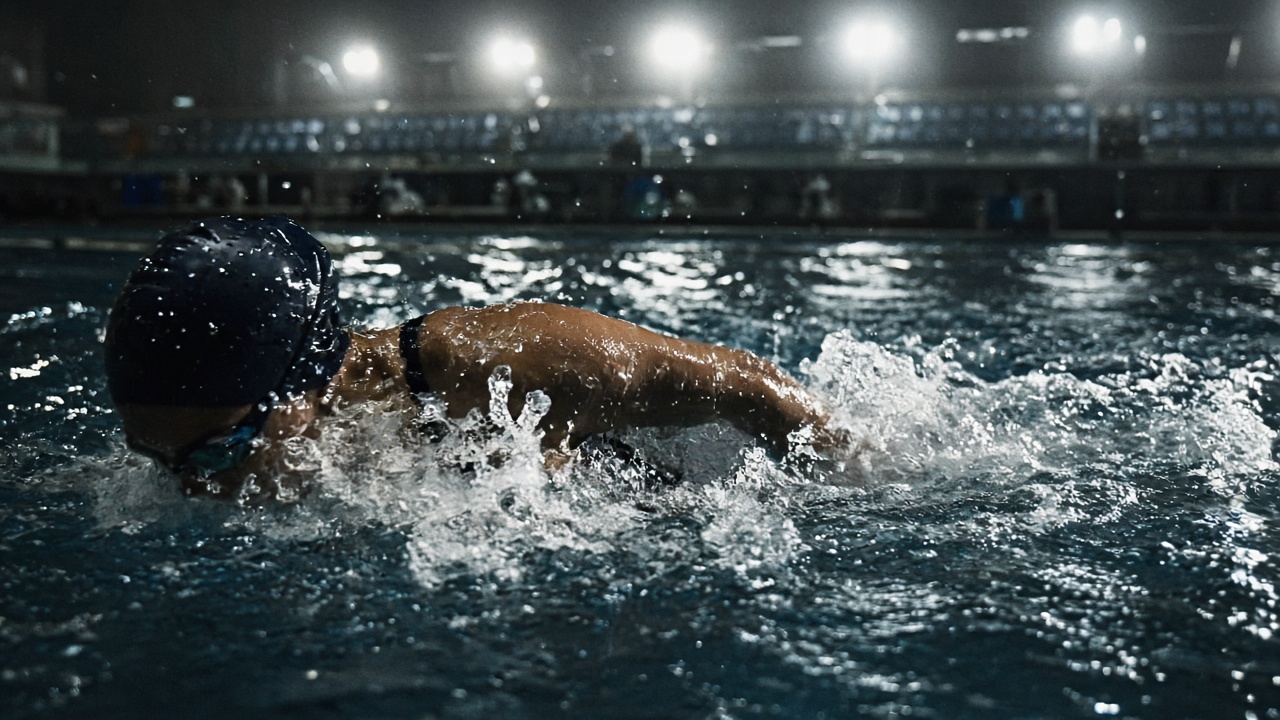
Gan Ching Hwee's third medal of the Tokyo Asian Games came in the 800m freestyle, a silver in 8:26.25 — a swim at national-record pace that followed silvers in the 400m and 1500m freestyle and pushed Singapore's distance programme past its previous continental ceiling.
The result is easy to summarise: one swimmer, eight lengths, 8:26.25, second place. The harder question is the one that never makes the results page. Who paid for the lane she swam in, and what does the system get back?
The clock, and what it takes to hold it
Strip the 800m down and it is arithmetic. Eight minutes and 26.25 seconds is 506.25 seconds of racing, which works out at a fraction over 63 seconds for every 100m leg. Held from the first turn to the last, that is the kind of evenness a swimmer trains into the body over years — it does not fall out of a good taper or a fast opening 200.
Distance finals at this level are attritional. The first four lengths are enthusiasm, the middle third is where stroke rate has to survive the lactic, and the last 100m is whatever the athlete bought with the previous three years of training. A 63-second average across all eight legs is what it looks like when nothing in the middle collapsed.
Who pays for the lane
A medal is the visible end of a supply chain that starts long before the tapering pool. In Singapore that chain runs through public high-performance funding, the national sports association's elite programme, and national Olympic council support for Games preparation and travel. The athlete is the front end. Behind her sit pool hire, coaching salaries, sports science and physiotherapy, overseas training blocks, and the flights and entry fees for the meets that make a qualifying time possible in the first place.
None of that appears beside a silver medal. That is partly by design: funding bodies report medals because medals are countable and appropriations are not. The figure that never gets published is cost per final — total high-performance spend for the swimming programme divided by the number of swims that reach an A final at a Games. It is the only number that separates a model that is efficient from one that is merely well-funded.
The athlete's side of the ledger is more legible. Benchmark times in funded systems frequently double as contractual triggers: a national record can unlock a support tier, a travel grant, or a direct payment. That is the trade at the centre of elite sport. Public money buys performance, and performance re-prices the athlete.
The window
The window matters more than the medal count. A swimmer's competitive life is measured in four-year blocks, and every block has a closing date — the qualifying period for the next major championship, the age curve of a distance event, the season in which a body either absorbs the training load or stops absorbing it. Three silvers in Tokyo locates Gan inside the current window. It says nothing about how many windows remain, and that is precisely the variable the funding cycle is built to ignore.
There is also the event mix to watch. The 400m, 800m and 1500m freestyle sit at different points on the speed-endurance spectrum, and a swimmer who can medal across all three at a continental meet is carrying a training load that has to be defended and scheduled, not simply repeated. What looks like a hat-trick on a results page is three separate preparation problems that all had to be solved in the same block.
What the audience got
For the domestic audience, the return on a night like this is a name, a time, and a rerun. Swimming is a low-visibility sport in Singapore between Games cycles, and an 800m final will not produce the sustained coverage that follows a league season. The realistic yield is a reference point: a time and a swimmer that parents, coaches and the next cohort of distance athletes can measure themselves against.
That is worth something, but it is not the same as a commercial asset. The medal generates attention in a burst and then decays, while the funding obligation runs every month of the cycle regardless. The gap between those two curves is the structural story of Singapore high-performance sport, and no amount of silverware changes its shape.
The results page will say silver, 8:26.25, third medal of the meet. Everything that produced it — the funding cycle, the coaching hours, the qualifying meets, the physio table — stays off the page.