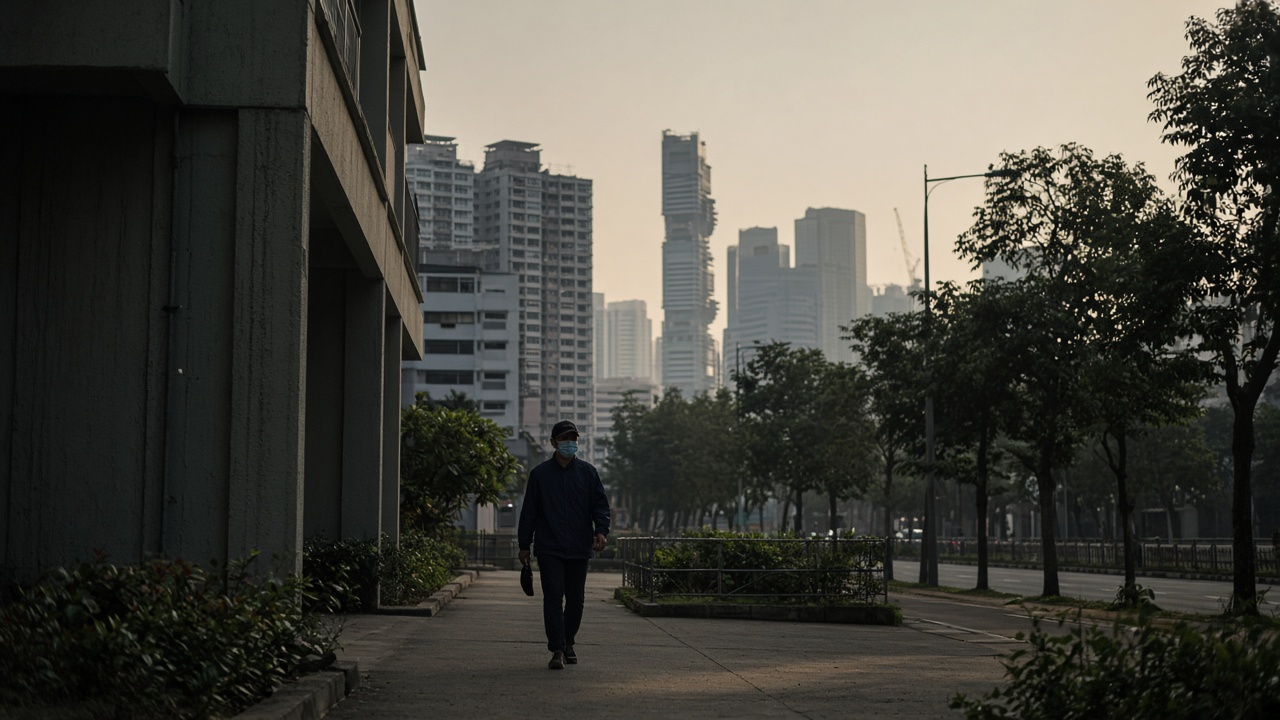
Singapore's Central Region moved back into unhealthy air on Sep 26, with the 24-hour Pollutant Standards Index reading reaching 104 at 8pm. The National Environment Agency expects conditions to sit between the moderate and low-unhealthy range through Sunday, with haze holding into Sep 27.
It is the region's first unhealthy reading of this stretch, and the number matters less for what it says about the island as a whole than for what it triggers. At 101 and above, the standing health advisory changes, and the groups it names are asked to change what they do outdoors.
Why the air turned
The backdrop is seasonal. Dry weather over southern Sumatra and Kalimantan has been building hotspot activity, and prevailing winds have carried the resulting smoke toward the Straits. Regional smoke crossing on those winds is what lifted the Central Region's figure past the 100 mark after a run of moderate days.
Haze forecasts are not a single island-wide verdict. Readings are taken by region, and a Central Region number of 104 does not mean every station in Singapore is in the same band. The agency's Sunday outlook points to moderate-to-low-unhealthy conditions rather than a uniform clearing.
PSI and PM2.5 measure different things
The 24-hour PSI is a rolling average, and in haze episodes it is dominated by fine particulate matter. Because it is an average, it moves slowly: a bad morning keeps the figure elevated well into the night, and a rapid improvement does not show up immediately.
Hourly PM2.5 readings, published alongside the PSI, give the more current picture of what you are breathing right now. That distinction is the practical one for anyone deciding whether to move a morning run indoors. The advisories are keyed to the 24-hour figure, which is what the public guidance and most workplace and school decisions reference, but the hourly particulate number is the one that tells you whether the next hour is getting better or worse.
What the unhealthy band asks of you
Once the 24-hour PSI crosses into 101–200, the general guidance is to reduce prolonged or strenuous outdoor physical exertion. For people in the groups the advisory identifies as more vulnerable, the instruction is firmer: minimise such activity, and seek medical attention if you feel unwell.
Those groups are children, older adults, pregnant women, and people with chronic heart or lung conditions, including asthma and chronic obstructive pulmonary disease. The list is not arbitrary. Fine particles of the size that dominate haze smoke travel deep into the airways, and people whose lungs or hearts are already working harder have less margin when particle levels rise.
The absolute risk question
What the advisory does not do is put a number on how much extra risk a specific person carries at 104 compared with, say, 60. The bands are population-level thresholds, not individual risk scores, and the guidance is written to be applied by everyone inside a band at once.
That is worth holding onto when the figure is in the low hundreds. For someone with well-controlled asthma, a reading of 104 is usually a reason to shift a training session indoors or shorten it, not a reason to change medication. For someone who has been reaching for a reliever inhaler more often than usual, or whose breathlessness is worse than it was a week ago, the same reading is a prompt to check in with a doctor rather than to wait for clearer skies.
The same logic applies to households with young children or elderly parents. The advisory's threshold is where behaviour should change, but the size of the benefit from skipping an outdoor activity is not something the index quantifies for you.
What happens next
NEA updates readings through the day, so the 8pm figure is a snapshot of a rolling average rather than a verdict on the whole of Sunday. If the 24-hour PSI holds in the unhealthy band, the same guidance applies; if it crosses 200 into the very unhealthy band, the advisory escalates and outdoor exertion is discouraged more broadly.
For most residents, the practical routine for the next day or two is unglamorous: check the regional reading and the hourly PM2.5 before planning anything strenuous outdoors, keep reliever medication within reach if you rely on it, and treat a worsening cough or breathlessness as a reason to seek care rather than a symptom to ride out until the haze lifts.