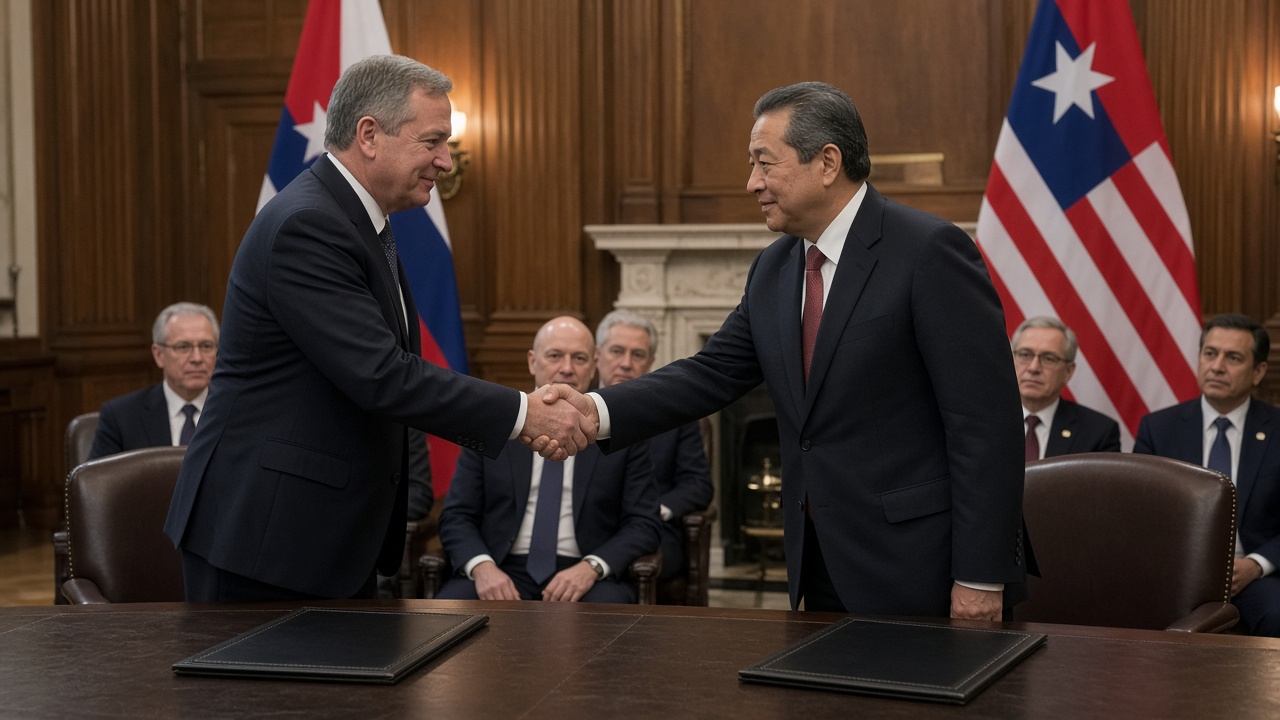
Mexico City - Korea and Mexico signed 17 memorandums of understanding during the Lee-Sheinbaum summit, and AI sits inside the bilateral framework rather than on the sidelines. The two governments also agreed on a 2026-2030 Korea-Mexico Joint Action Plan, with AI listed alongside aerospace, defense, intellectual property, and tourism as cooperation lanes. President Lee Jae-myung returns home Sunday, Sept. 27, according to the presidential readout.
The headline number is 17. The harder question for Korean AI companies is what is actually inside the AI lane. The public summaries name the category. They do not publish the MOU text, the participating labs, the budget lines, or the data-governance rules. That gap matters because an AI cooperation memorandum can mean many things: a government-to-government dialogue, a pilot procurement channel, a research exchange, or a statement of intent that never reaches an operating budget.
Korea's AI policy has increasingly looked outward. The country's model developers and infrastructure vendors need markets beyond the domestic stack, and Mexico's manufacturing base, digital-government agenda, and nearshoring position make it a plausible partner. But plausibility is not a pipeline. For a Korean AI firm, the visit's value depends on whether the AI MOU creates a route into Mexican public procurement, a sandbox for cross-border data, or a research consortium with named Korean and Mexican institutions. None of those details are in the readout.
The joint action plan gives the relationship a five-year frame. That is longer than a single summit and shorter than a treaty. It suggests both sides want a work program, not just a photo. The plan's AI line sits next to aerospace, defense, and IP, which is a reminder that digital cooperation is being bundled with industrial and security priorities. That bundling can help AI projects find budget when they support manufacturing, logistics, or defense supply chains. It can also bury them inside larger negotiations over market access and investment protection.
CEPA is the other moving part. The two sides vowed to speed along a bilateral trade agreement, according to the readout. A comprehensive economic partnership agreement could eventually touch digital services, cross-border data, and public procurement - the exact areas that determine whether an AI MOU becomes commercial. But this week's language only says the push will accelerate. It does not say whether digital trade chapters are on the table, whether Korea's data protection rules would be treated as a barrier, or whether Mexican agencies would open AI tenders to Korean vendors.
The business delegation offers a second signal. LG's Koo Kwang-mo was among roughly 30 business delegates, according to the readout. Chaebol presence at a state visit does not guarantee a deal, but it tells you where attention is. LG has interests across consumer electronics, displays, batteries, and AI research. A Mexico AI lane could connect to smart manufacturing, automotive supply chains, or digital services. Still, no company-specific MOU was disclosed in the public summary. That leaves the AI lane as a government framework with private-sector interest, not yet a named joint venture.
What was evaluated, and what is still missing
For Korea's AI policy watchers, the first question is evaluation. If the MOU includes an AI safety or standards component, which tests, benchmarks, or red-team requirements does it adopt? Korea has been building its own AI governance framework, and Mexican agencies have their own procurement and data rules. A cooperation document that does not name a conformity-assessment path is unlikely to help a Korean model developer sell into Mexico. It may still help research labs exchange personnel or data, but that is a different business case.
The second question is institutional ownership. MOUs signed at summit level often sit with foreign ministries or trade promotion agencies. The technical work then depends on line ministries, standards bodies, and data regulators. If the AI annex does not name those actors, implementation can stall after the delegations fly home. Korea's AI industry has seen this before: ambitious bilateral language, followed by a long wait for a working-level agenda.
The third question is money. An AI cooperation MOU without a joint fund, a procurement commitment, or a co-investment vehicle is a networking document. That is not useless. It can open introductions and create a diplomatic umbrella for later deals. But it does not pay for compute, data curation, or localization. Korean AI startups evaluating Mexico need to know whether the MOU covers pilot projects, how intellectual property is split, and whether Mexican government data can be used for training. The public readout answers none of that.
The practical test for Korean AI firms
The summit's AI lane is best read as a door, not a room. The 2026-2030 joint action plan and the CEPA push create a process. The 17 MOUs create a list. What is missing is the operating detail: which Korean and Mexican entities signed the AI text, what they agreed to share, and what they will buy or build together.
For now, Korean AI companies should watch for three documents: the full MOU text, the joint action plan's AI work items, and any CEPA digital trade chapter. If those documents name pilots, standards, or procurement, the summit will have produced something more durable than a photograph. If they do not, the AI lane remains a diplomatic category - useful for future talks, but not yet a market entry path.
Lee returns home Sept. 27. The follow-up begins after the holiday weekend, when ministries and trade officials turn summit language into work plans. That is when the AI MOU will either acquire a budget and a calendar or join the long list of agreements that never leave the communique.