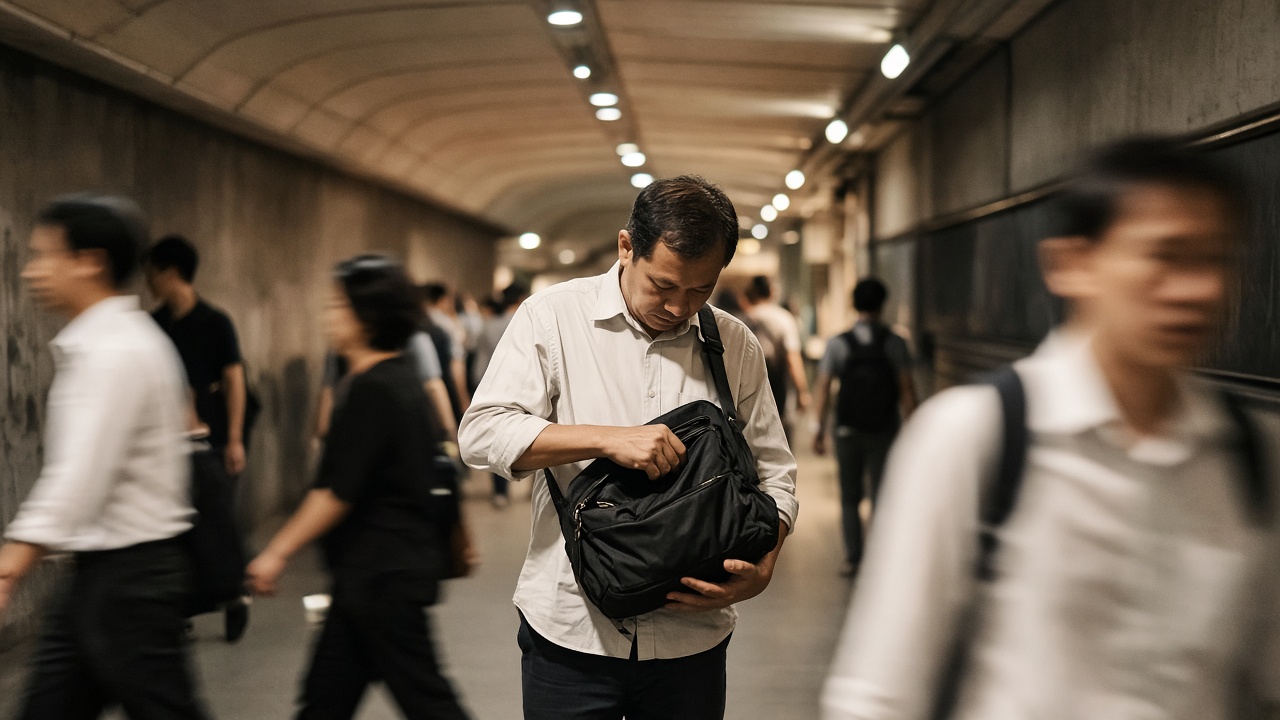
Police have arrested five people after a man reported losing S$155,600 in cash when he was bumped into at an Orchard Road underpass, in a case that investigators have classified as a distraction-style pickpocket theft.
The Straits Times reported on Sep 26 that the man lost the money after the bump, and that police recovered most of the cash. About S$3,000 remained unaccounted for, according to the report, which cited a Singapore Police Force release.
Five Filipino nationals were arrested in connection with the case. They are suspects. No charges or court outcomes were disclosed in the Sep 26 report. Under Singapore law, they are presumed innocent unless and until convicted.
What police have confirmed
The confirmed facts are narrow but serious: a man was carrying a large sum of cash; he was bumped into at an underpass near Orchard Road; the cash was taken; police were alerted; five people were arrested; and most of the S$155,600 was recovered.
The method described is the classic bump-and-take. One person creates a physical distraction — a jostle, a stumble, an apology — while another removes the victim's wallet, bag or envelope. In crowded pedestrian areas, the victim often does not notice immediately. By the time the loss is discovered, the crew may have dispersed.
Orchard Road is one of Singapore's busiest retail and transit corridors. Its underpasses link malls, MRT stations and bus stops, and they carry heavy foot traffic at most hours. That volume is useful cover for pickpockets. It also makes witness accounts and camera footage more important to investigators.
What is still unknown
Several questions remain unanswered in the Sep 26 release as reported. Police have not said where exactly the five suspects were arrested, how the cash was moved, or whether the suspects are linked to other reported thefts. The release did not name the SPF unit handling the file, and it did not specify the charges the suspects may face. Those details will matter for the public record, but they are not yet confirmed.
It is also unclear how the victim was carrying the money and why. Large cash withdrawals or transfers are not illegal. But they attract risk. A person moving S$155,600 in cash is exposed from the moment the money leaves a bank or safe until it reaches its destination. A bump in a confined space is enough to break that chain.
Another open question is recovery. Police said most of the money was recovered. That leaves about S$3,000 outstanding. The report did not say whether the recovered cash was returned to the victim, held as evidence, or subject to further verification. In theft cases, recovery and return are separate steps. Cash can be seized as evidence and later returned through court or police processes.
Who is liable — and what victims should do
Criminal liability rests with the person or people who took the money. If the case proceeds, the charge will depend on the facts: theft, snatch theft, or a more serious offence involving a group. The suspects have legal rights, including the right to counsel and the presumption of innocence.
Civil recovery is a separate track. A victim can seek restitution, but it depends on whether the money is found, whether it can be tied to the accused, and whether the accused has assets. In practice, quick police reporting improves the odds. So does preserving evidence: bank withdrawal records, receipts, serial numbers if known, and a clear timeline.
For the public, the case is a reminder that distraction theft is not only a pickpocket problem. It is a choreography problem. The bump is the signal. The theft happens in the second or two when attention shifts. Busy underpasses, escalators, station exits and mall entrances are prime locations. So are queues, taxi stands and events where people stand close together.
Basic countermeasures remain effective. Keep cash and cards in front pockets or zipped bags. Split large sums if possible. Do not carry a single envelope that can be taken in one motion. If someone bumps into you, step aside, check your belongings immediately, and look for anyone moving away. Report the loss to police as soon as possible, even if you are unsure whether a theft occurred.
Banks and payment providers can sometimes trace transfers, but cash is different. Once it is mixed with other money, tracing becomes harder. That is why police treat the first hours as critical. In this case, the arrest of five people and the recovery of most of the sum suggest the trail had not gone cold.
The open file
For now, the Orchard underpass case sits between two stages: an arrest and a prosecution. The SPF has confirmed the core facts. The courts have not. The public should treat the five arrested people as suspects, not as convicted offenders.
The next developments to watch are straightforward. If charges are filed, the charge sheets will show what police allege and under which law. If the case goes to court, the recovered cash will become part of the evidence. If more victims come forward, the scope of the investigation may widen. Until then, the confirmed bottom line is this: a man lost S$155,600 in a few distracted seconds, most of it has been recovered, and five people are in custody.