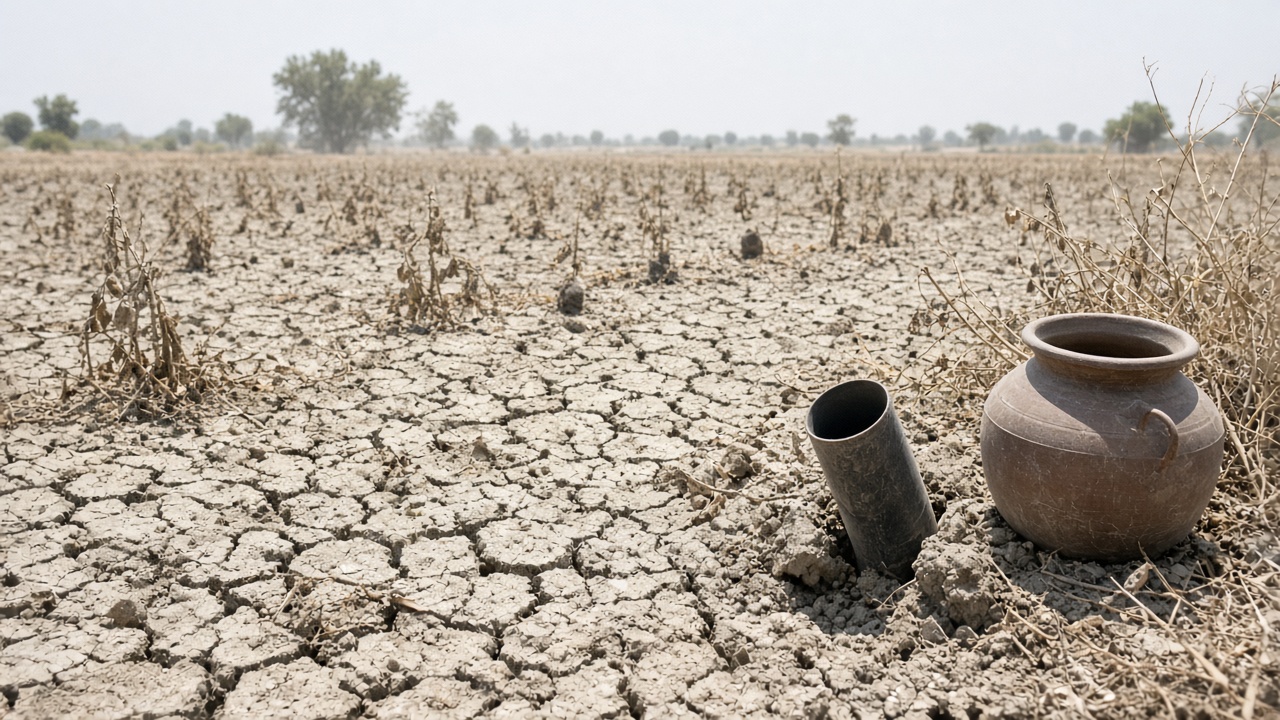
The Maharashtra government's revenue department declared drought in 265 of the state's 358 talukas in a government resolution dated September 26. The district-wise annexure that travels with the order places Yavatmal in Vidarbha and Jalgaon in north Maharashtra at the top of the tally. The GR turns a season of failed rain into a legal status. The status, in turn, starts clocks — for field surveys, for compensation, for water and fodder.
For a cultivator, the operative question is not whether the word "drought" appears in a government file. It is which taluka the word appears against. Relief is administered at taluka level: the circle officer's panchnama, the crop-cutting experiment, the entry in the land record, the signature that releases the input subsidy.
What is on the list
The declaration rests on rainfall departure and on crop-loss assessments rather than on any single district-level average. Vidarbha supplies the largest share of the count, Marathwada the next, and the Pune division a substantial block, with the list running north into Khandesh. Yavatmal and Jalgaon together carry a disproportionate share of the survey work that now follows — more villages to sample, more experiments to record, more entries to verify before any payout is authorised.
The pattern tracks a monsoon that failed unevenly. The same September depression that pulled the all-India seasonal deficit down from 43 per cent to about 22 per cent dumped its heaviest rain on central and eastern India, where seven states were dealing with floods and deaths on September 26. Maharashtra's cotton and pulse belts were left on the dry side of that divide.
What a declaration unlocks
Under the norms governing the State Disaster Response Fund, a scarcity order is the gateway to input subsidy for crop loss, gratuitous relief, cattle camps and fodder depots, tanker water supply, and additional wage employment on public works. Maharashtra has historically paired drought orders with land revenue waiver and postponement of recovery. That is why the revenue department, not the agriculture department, signs the order.
What the resolution does not do is pay anyone. The GR names talukas. The money moves only after the survey chain is complete and the district administration certifies loss at the prescribed threshold.
The clock that starts now
Three calendars converge on the same villages. The first is the survey calendar: panchnamas and crop-cutting experiments must be finished and compiled before compensation can be sanctioned. The second is the insurance calendar: yield data from the same experiments feeds crop insurance claims, and delay in one delays the other. The third is the water and fodder calendar — tanker routes, fodder depots and cattle camps are decided on the strength of the taluka list, and they are needed while the dry spell is still running, not after it breaks.
What the numbers do not settle
A 265-taluka list is a claim about scale, not a guarantee about delivery. The gap between declaration and disbursement is where most drought politics happens, and it is measured in weeks, not in hectares. That is the arithmetic the opposition will press and the government will defend when the legislature next meets, and it is the reason the annexure matters more than the headline figure.
Watch three things. Whether district notices follow within days, naming survey schedules taluka by taluka. Whether fodder and water arrangements are notified before cattle movement begins. And whether the state's next review widens the list, holds it at 265, or quietly narrows it once the late-September rain is reckoned into the totals.