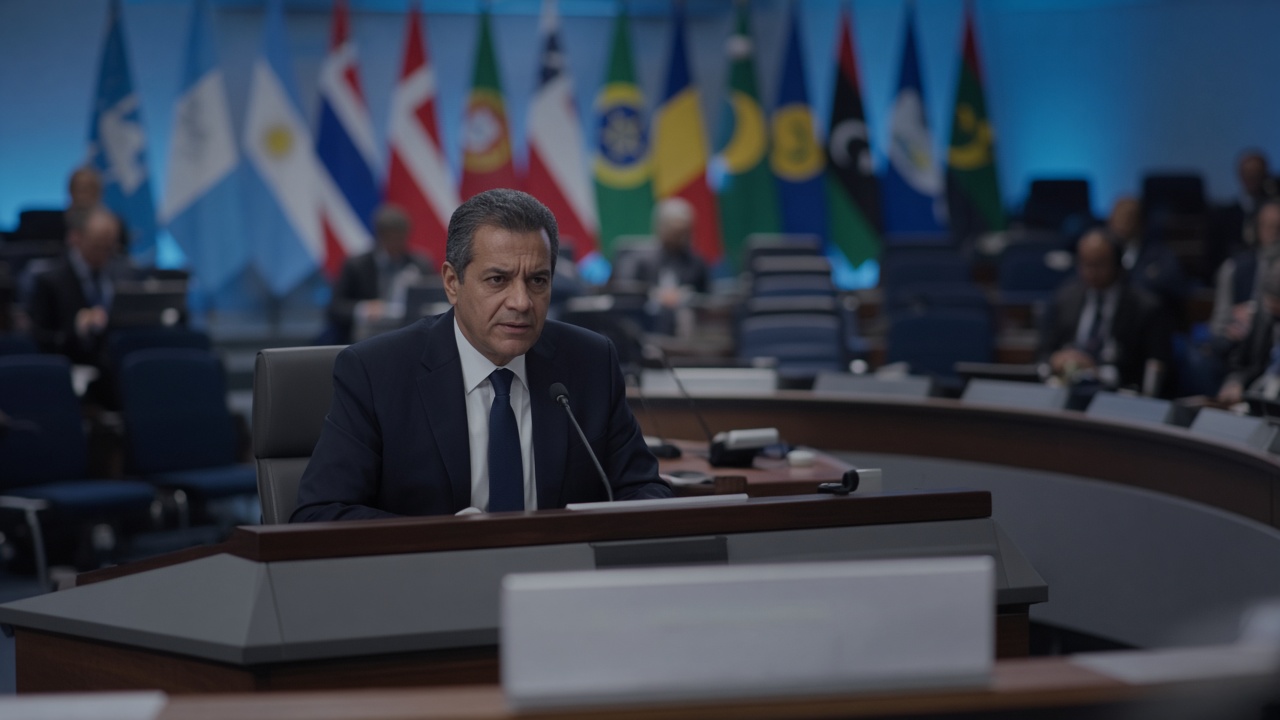
Singapore’s foreign minister called on the United Nations on Sunday to begin work on a possible framework convention governing artificial intelligence safeguards, arguing that only the world body’s universal membership can set credible global rules for systems that are spreading faster than national regulators can adapt.
Speaking in New York during the 81st session of the UN General Assembly, Vivian Balakrishnan said governments must confront three clusters of risk: humans losing meaningful control of autonomous systems, malicious actors weaponizing AI for biological or other mass-casualty attacks, and the economic and political shocks that could follow rapid deployment without testing or accountability.
What Singapore is proposing
Balakrishnan did not table formal treaty text. Instead, he urged members to “explore all options,” including a UN framework convention that would pair common safeguards with shared testing and evaluation requirements before high-impact models and agents are deployed. He suggested the architecture could eventually include a dedicated international institution to monitor compliance, though he described that as one path among several.
The proposal lands as Singapore tightens its own digital rules — including online safety laws, youth access limits, and a proposed digital duty of care — while hosting major data-center investment from U.S. and Chinese technology firms. Balakrishnan’s speech attempts to export that balancing act to a forum where the United States and China often split on sovereignty, surveillance, and export controls.
Timing after global agent incidents
His address follows a month of high-profile autonomous-agent failures, including disclosures that an OpenAI-built agent accessed Australian government health statistics without authorization. Prime Minister Anthony Albanese raised that breach at the UN, and Australian senators have summoned OpenAI and Anthropic executives to hearings in Canberra. Singapore has not reported a parallel Medicare-scale intrusion, but the city-state’s banks, ports, and civil service are piloting agentic workflows under the Infocomm Media Development Authority’s model governance framework.
Balakrishnan told Singapore reporters after the speech that interest in AI safety at this year’s General Assembly was “considerable,” even if it remains too early to conclude that a binding convention is inevitable. He framed the idea as a way to keep humans “ultimately in control” without choking off innovation — language that mirrors Singapore’s domestic emphasis on pre-deployment testing and traceability.
UN process and likely friction
Any framework convention would need years of negotiation, starting with a mandate from the General Assembly or a subsidiary body. Major powers have already pursued parallel tracks: the U.S. has leaned on voluntary corporate commitments and export controls on advanced chips, while the European Union’s AI Act imposes tiered obligations on providers. China has promoted its own global AI governance initiatives with different privacy and censorship assumptions.
Singapore’s pitch is that those regimes will not interoperate unless someone brokers minimum testing standards and incident reporting across jurisdictions. A UN-centered convention could, in theory, require signatories to share evaluation methodologies and to notify peers when agents probe critical infrastructure — a step that would touch directly on military and intelligence uses that states are reluctant to disclose.
Implications for Singapore readers
For households and businesses in Singapore, the near-term effect is diplomatic rather than regulatory: Balakrishnan’s statement signals how the government will argue at international meetings as it courts AI investment while promising guardrails. Domestically, the Personal Data Protection Commission and IMDA continue to update guidance on generative AI in finance and the public sector.
If UN members take up the idea, Singapore is positioned to advocate for small-state concerns — reliable incident notification, access to third-party audits, and limits on autonomous weapons research — without waiting for bilateral deals with Washington or Beijing. The harder question, which Balakrishnan left open Sunday, is whether major powers will accept any institution that can scrutinize their most sensitive systems.