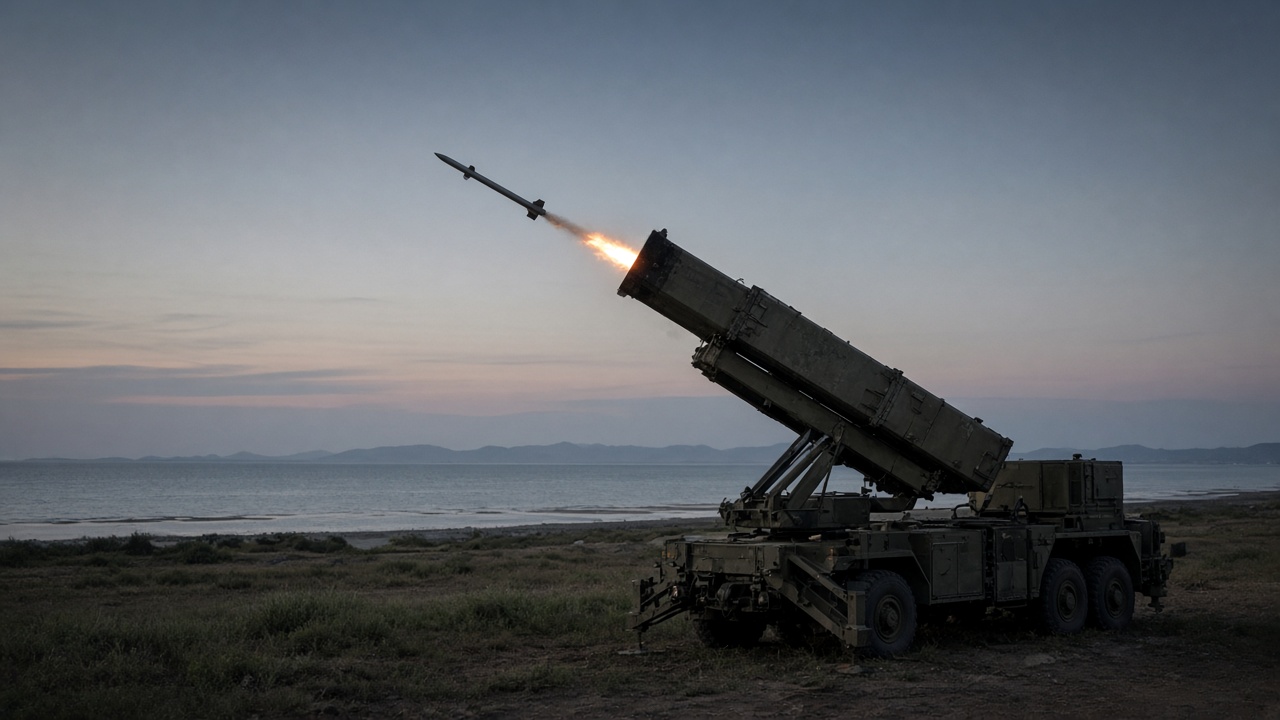
Taiwan’s Ministry of National Defense has drafted a NT$22 billion (US$692 million) program to build roughly 200 improved Hsiung Feng anti-ship missiles between 2026 and 2035, according to a senior official who described the plan on condition of anonymity.
The investment would add to 1,400 missiles already funded under the Sea-Air Combat Power Improvement Plan. The new batch is meant to harden Taiwan’s coastal batteries and navy launchers against Chinese destroyers that carry advanced electronic countermeasures, the official said.
What “improved” is supposed to mean
Engineers are focusing on seekers and datalinks that can keep lock on People’s Liberation Army Navy Type 052D and Type 055 escorts, the official said. Those ships form the outer ring of any blockade or invasion fleet, and they are built to jam or decoy older anti-ship rounds.
The ministry is not simply padding inventories, the official insisted. The goal is to keep domestic assembly lines warm so Taiwan can surge production if a conflict drags on, preserving skills that would otherwise dissipate between orders.
How the mix fits existing weapons
Taiwan’s coastal defense architecture pairs U.S.-made Harpoon missiles with indigenous Hsiung Feng II subsonic and Hsiung Feng III supersonic weapons. Military planners describe the combination as a “low-high” salvo designed to saturate defenses.
Warships and shore batteries would share the upgraded rounds, the official said, though specific unit allocations remain classified. Public briefings in recent years have shown HF III launches from mobile trucks on Taiwan’s western plain, where shipping lanes squeeze past the Taiwan Strait’s median line.
Budget politics and timing
Funding would flow through the regular defense budget rather than a special procurement account, the official said. That matters because lawmakers pared back a broader special defense package earlier this year, delaying some drone and missile lines.
The Executive Yuan already cleared a record NT$607.6 billion supplemental budget for 2026, with NT$145.7 billion tagged for defense investments including Chien Kung missiles and uncrewed systems. The Hsiung Feng tranche would sit alongside those programs as planners try to close gaps before the next legislative session.
What comes next
Lawmakers must still authorize annual outlays, and state-owned missile plants will need steady component imports despite U.S. export controls on some guidance parts. The National Chung-Shan Institute of Science and Technology, which builds the Hsiung Feng family, has expanded test ranges in recent years but rarely comments on production rates.
Security analysts in Taipei said the timing of the leak may reflect concern in defense circles after last week’s U.S.–China summit produced no concessions on arms sales to Taiwan. For now, the disclosure signals Taipei’s priority: deny PLAN surface groups free movement in the strait by fielding missiles that can still see them through jamming.