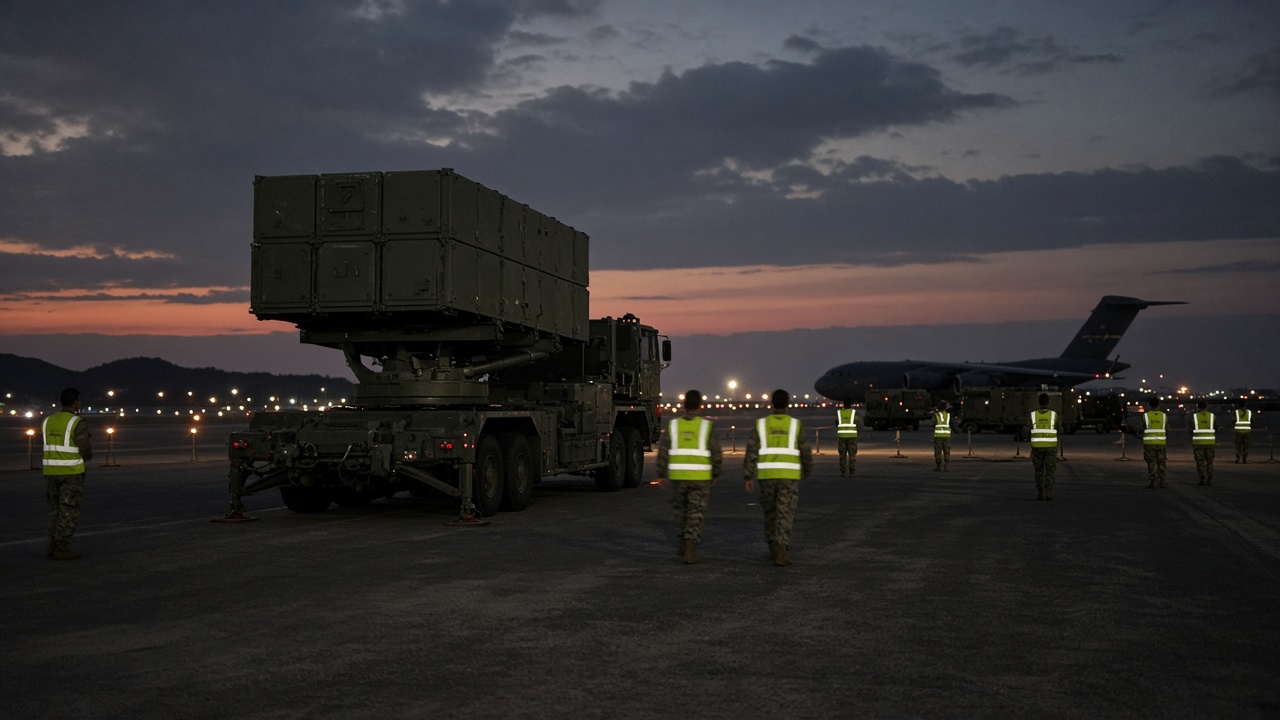
The U.S. Typhon midrange missile battery that trained with Japan’s Self-Defense Forces during this month’s Orient Shield exercises will be moved to Kadena Air Base in Okinawa for storage, Japan’s Okinawa Defense Bureau said Monday. Tokyo and Washington describe the transfer as a logistics step after drills in Kagoshima Prefecture, not a new permanent basing decision, but the weapon’s range has already sharpened debate in Okinawa and drawn protests from Moscow.
Typhon can fire Tomahawk cruise missiles roughly 1,600 kilometers, a reach that would cover parts of the Chinese mainland and Russia’s Far East from Okinawa. The system appeared at the Maritime Self-Defense Force’s Kanoya Air Base in June for Valiant Shield and remained for Orient Shield, which ran from Sept. 8 through Sept. 24 in what Japanese officials called the largest iteration of the exercise.
Timeline and U.S. assurances
The defense bureau said the battery is expected to travel by C-17 transport aircraft to Kadena by mid-October. Japan’s Defense Ministry quoted U.S. explanations that storing the equipment at Kadena “does not constitute a permanent deployment in Japan,” language Okinawa officials repeated in statements to local media Monday.
A U.S. Army release from last year’s Talisman Sabre drills in Australia noted the first live-fire exercise of Typhon outside the continental United States, underscoring how quickly the Army has moved from testing to forward positioning in the Indo-Pacific. Pentagon spokespeople have not announced a withdrawal date from Kadena once the launchers arrive.
Okinawa politics
Governor Denny Tamaki’s office has long pressed Tokyo to reduce the concentration of U.S. forces on Okinawa. Storage of an offensive midrange system at Kadena—even if labeled temporary—feeds opposition claims that central government officials treat the prefecture as a convenient arsenal while economic benefits flow elsewhere.
Base workers and business groups near Kadena note that storage still means additional security cordons, convoy traffic, and emergency drills. Municipal leaders asked the Okinawa Defense Bureau for a public briefing on blast-risk zones and whether Japanese police will have jurisdiction if a mishap occurs on the access road.
Regional reactions
Russia’s Foreign Ministry said on Sept. 3 it sent Tokyo a formal protest over Typhon’s presence in Japan, calling any deployment “unacceptable under any pretext” and demanding removal regardless of duration. China’s defense ministry has previously criticized U.S. intermediate-range systems in Asia as undermining strategic stability.
Japanese Chief Cabinet Secretary Yoshimasa Hayashi told reporters last week that the government would continue to explain the deployment to neighbors while keeping the U.S. alliance focused on deterrence. SDF officials emphasized that Japanese personnel trained on Typhon crew procedures during Orient Shield but that only U.S. forces operate the live battery.
What comes after storage
Defense analysts in Tokyo said storing Typhon at Kadena keeps the launchers inside the first island chain without returning them to the continental United States, shortening reaction time if tensions spike in the Taiwan Strait or on the Korean Peninsula. Opposition lawmakers in the Diet asked whether storage costs will appear in host-nation support budgets and whether local consent laws were triggered.
The bureau said it would publish updated noise and traffic schedules once flights begin. Until then, Kanoya residents are watching for departure convoys, while Okinawa prepares for another round of protests outside Kadena’s gates.