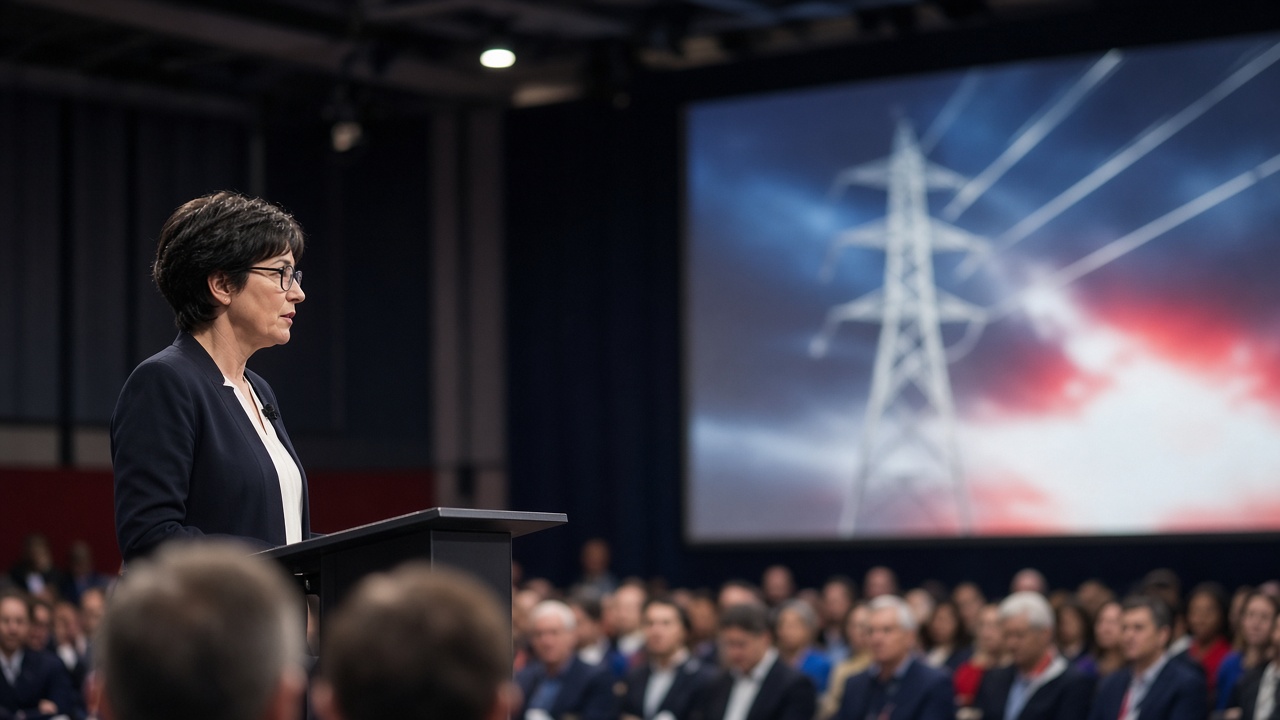
Prime Minister Andy Burnham will use his first address to Labour’s annual conference on Tuesday to promise a publicly owned “Great British Grid” designed to cut connection delays and push British electricity costs closer to European levels within a decade, according to briefing details released ahead of the Liverpool speech.
The new GB Grid entity would sit under the Great British Energy umbrella and become the first state-owned player in electricity networks since Margaret Thatcher privatised the sector in the 1980s. Burnham argues the move gives the government “more public control” to fix what he calls a broken energy market that has left households paying more than many EU neighbours while renewable projects wait years for grid access.
Why grid reform is on the conference stage
Downing Street advisers have framed the announcement as an answer to a complaint heard across manufacturing, data-centre developers, and offshore wind investors: Britain can approve projects faster than it can plug them in. Bottlenecks in transmission upgrades and local connection queues have been cited by the Office for Budget Responsibility and industry groups as a drag on growth and a hidden tax on bills.
Burnham’s prepared remarks say politics-as-usual “has taken Britain backwards” and that he will hold an “honest conversation” about issues leaders usually dodge. Grid ownership is the infrastructure half of that pitch; the other half is expected to be social care, where the prime minister has hinted he will spend political capital even if the full price tag lands in a future manifesto rather than this parliament.
Social care and the pensions triple lock
Ministers have refused to guarantee that the pensions triple lock — which raises state pensions by the highest of inflation, 2.5 percent, or average earnings — will survive unchanged into the next manifesto. That has fuelled speculation Burnham could fund free adult social care in England partly by softening pension uprating, a trade-off that would dominate Westminster chatter even if Tuesday’s headline is energy.
Chancellor John Healey told the BBC the manifesto would be written “at the time,” while Business Secretary Jonathan Reynolds said Labour’s triple-lock commitment remains in force for now. Baroness Louise Casey has yet to publish her social-care review, and Burnham has pointed to his failed 2010-era levy proposal as proof he is willing to touch politically toxic files.
Opposition lines and market questions
Conservative Party chairman Kevin Hollinrake said “hope is not a strategy” and argued Labour tax rises had crushed businesses and jobs. Reform UK’s Robert Jenrick urged Burnham to cut welfare and foreign aid instead of touching the triple lock. Those attacks preview a parliamentary fight over whether nationalising grid functions adds capacity or simply shifts risk onto the state balance sheet.
Investors will ask how GB Grid interacts with Ofgem’s price controls, whether private network owners face compulsory cooperation, and what the borrowing implications are if the state underwrites new transmission. Labour officials have not yet published a costing sheet for the grid plan in the pre-speech briefings.
What to watch after Liverpool
Energy Secretary Ed Miliband’s department will need statutory instruments or primary legislation to give GB Grid real powers, a process that could slip past the next election if timelines slip. Burnham’s speech is also the tone-setter for a government that has promised to decentralise power after decades of London-centric economic policy — grid wires are the literal version of that slogan.