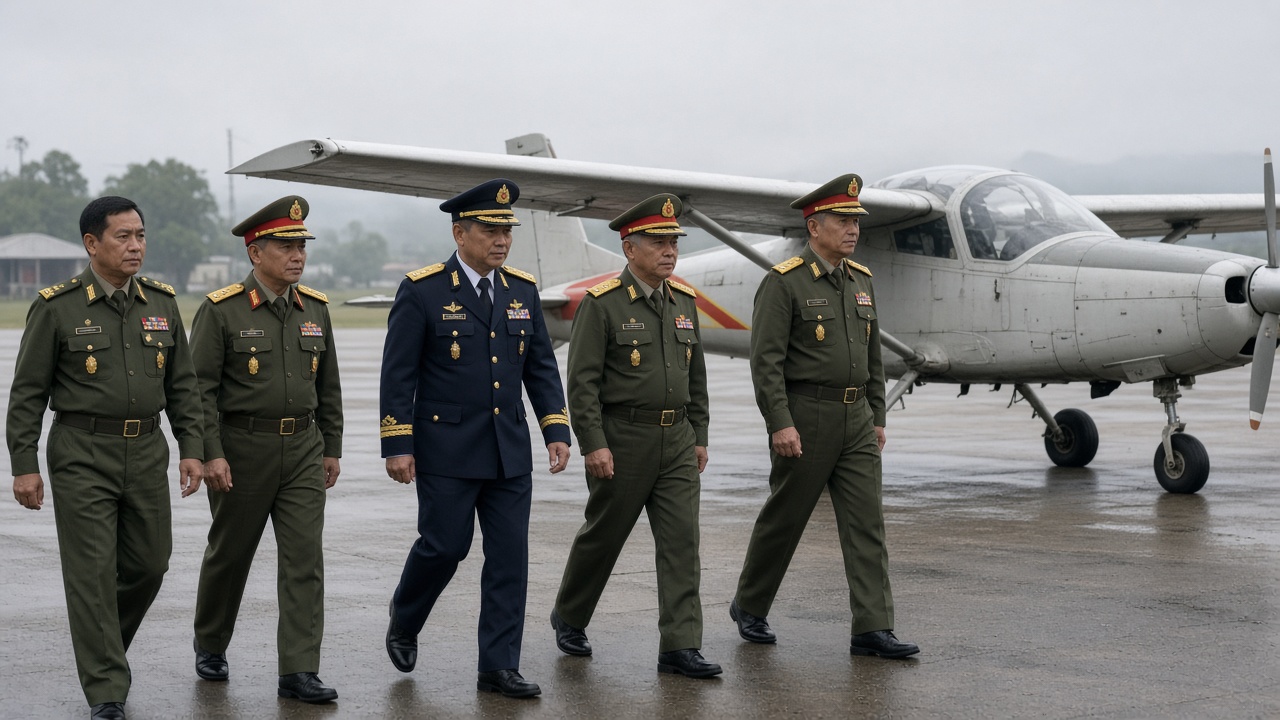
China has opened a joint military support and training centre in Laos, Beijing’s Ministry of National Defence said on Tuesday, marking another outward-facing military facility in Southeast Asia at a time when Washington is pressing allies to scrutinise Chinese access near critical sea lanes.
The ministry said the China-Laos Joint Support and Training Center and the China-Laos Friendship Aviation Academy are now operational at an airport in Ban Keun. The two institutions are “jointly maintained and operated by both sides” and aim to help Laos strengthen training for its air force pilots, according to the statement.
What Beijing disclosed — and what it left out
Chinese officials offered no public breakdown of how many personnel would be stationed at Ban Keun, what aircraft might rotate through the site, or which support functions would be handled on the ground versus in Laos’s own chain of command. That gap matters for neighbours tracking whether the facility is primarily a schoolhouse or could evolve into a logistics node for wider operations.
The Laos embassy in Bangkok did not respond to a Reuters request for comment about the new centre. Vientiane has historically balanced ties between Beijing and other partners, including Vietnam and Thailand, while accepting Chinese investment in transport and energy projects that form part of the Belt and Road footprint.
How the site fits China’s overseas network
The Ban Keun announcement arrives as China already operates a joint training and support centre at Cambodia’s Ream naval base on the Gulf of Thailand, plus a long-running logistics base in Djibouti on the Horn of Africa. Phnom Penh has denied that Chinese troops are permanently stationed at Ream, but U.S. officials have repeatedly warned that expanded Chinese access there could complicate American and allied operations in the region.
Laos, landlocked and heavily indebted on some infrastructure lines, has deepened security cooperation with China in recent years even as it maintains formal non-alignment. An aviation-focused hub differs from a naval support arrangement, yet it still extends the pattern of People’s Liberation Army-linked facilities beyond China’s immediate coastline.
Regional messaging and likely U.S. response
In Tuesday’s statement, China’s defence ministry said the Laos operations are “not directed against any third party” and are meant to deepen practical military cooperation while contributing to regional peace and stability. That language mirrors prior Chinese descriptions of other overseas training sites, where Beijing frames deployments as capacity-building rather than power projection.
U.S. Indo-Pacific commanders and State Department officials are likely to ask whether pilot training includes exposure to Chinese doctrine, maintenance pipelines, or intelligence practices that could bind Laotian officers closer to PLA standards. Congressional staff who track Ream and Djibouti will probably seek satellite and port-call evidence to see whether Ban Keun remains a modest school or grows into a staging point.
What happens next
Analysts will watch for flight activity at Ban Keun, any Lao government white papers on basing agreements, and whether Thailand or Vietnam raise the issue in ASEAN security forums. For Laos, the immediate question is how quickly trained pilots return to operational units — and whether the centre becomes a template for additional joint facilities along the Mekong corridor.