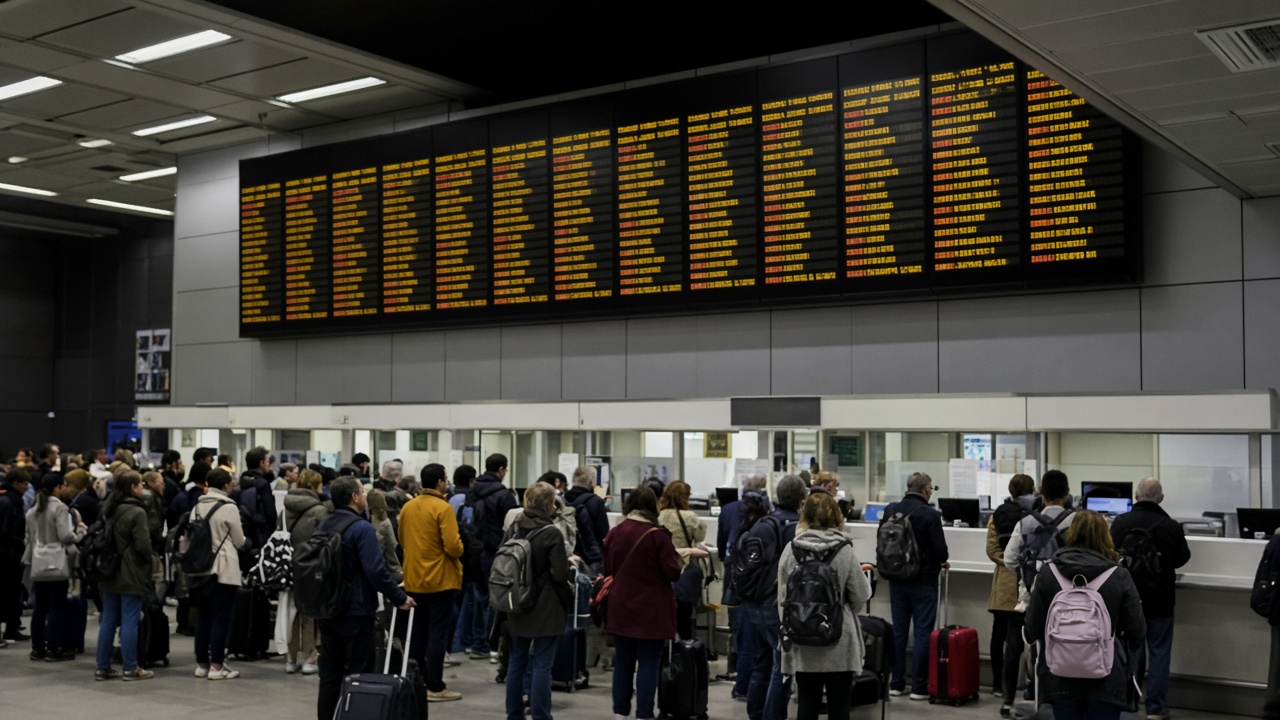
LONDON — A technical failure inside National Air Traffic Services’ flight-data processing equipment triggered one of the widest UK aviation disruptions since the 2023 airspace glitch, grounding departures across England, Scotland and Northern Ireland and sending ripple effects through Amsterdam, Dublin and long-haul routes that depend on British hubs.
NATS said engineers restored the core system by early Tuesday evening, but airlines warned that displaced aircraft and crews would keep schedules distorted into Wednesday. Tracking service Flightradar24 logged 1,055 cancelled flights to or from UK airports by 8 p.m. local time, a figure that climbed through the afternoon as Heathrow paused outbound traffic around lunchtime and Manchester, Stansted and Edinburgh throttled departures to match reduced capacity.
How the failure unfolded
UK airspace technically remained open, yet without reliable automated processing of filed flight plans controllers could not clear the usual volume of departures. NATS described the problem as confined to back-office computers rather than radar or radio links, but the practical effect resembled a partial ground stop: carriers could not obtain timely clearances, so they cancelled rather than hold passengers on jets with uncertain take-off slots.
Heathrow, the country’s busiest airport, told travellers to expect rolling delays even after the fix, citing knock-on congestion in baggage halls and crew positioning. Gatwick and Luton reported shorter queues but still listed dozens of scrapped European rotations. Scottish airports, which rely heavily on early-morning bank schedules to London, saw entire waves erased, forcing business travellers to rebook via Paris or Frankfurt.
European and long-haul knock-ons
Eurocontrol said roughly 90 passenger flights between the United Kingdom and the Netherlands were cancelled, with Schiphol dropping nearly 60 percent of its UK-linked departures and arrivals at one point. Irish operators were hit as well: Dublin Airport reported 43 outbound and 30 inbound cancellations by evening, with Shannon reporting additional curtailments.
Long-haul passengers felt the failure far from Britain. Air India diverted flight AI 131 from Mumbai to London Heathrow to Zurich, where more than 290 people remained aboard awaiting clearance, according to airline statements relayed by Indian media. Other intercontinental services were delayed rather than cancelled, but NATS cautioned that overnight recovery would depend on how quickly airlines could reposition wide-body jets that missed London connections.
Regulators and compensation questions
The Civil Aviation Authority said it was monitoring NATS’ recovery plan and would expect a formal incident report. Under EU and UK passenger-rights rules, technical faults at an air-navigation provider generally still oblige airlines to provide care and, in many cases, cash compensation for cancellations — a distinction that often surprises travellers who assume NATS outages are “extraordinary circumstances.” Consumer groups urged passengers to document expenses and file claims once airlines publish disruption notices.
Transport Secretary Heidi Alexander’s office said ministers were receiving hourly updates. Opposition MPs recalled the smaller NATS glitches that hit Scotland and northern England earlier in September and asked whether redundancy investments promised after past outages had been delivered on schedule.
What travellers should expect Wednesday
NATS said systems were stable as of 7:30 p.m., yet Heathrow’s departure boards still showed clusters of delayed services to New York, Dubai and Singapore. Industry analysts said the critical variable overnight would be crew legality: pilots and cabin staff stuck in the wrong city can legally time out, producing fresh cancellations even when computers work normally.
For passengers with Tuesday tickets, airlines were rebooking automatically where possible and offering hotel vouchers when overnight delays were unavoidable. Rail operators reported higher demand on Anglo-Scottish routes as flyers pivoted to trains, though LNER and Avanti West Coast warned of limited spare capacity on already busy autumn timetables.