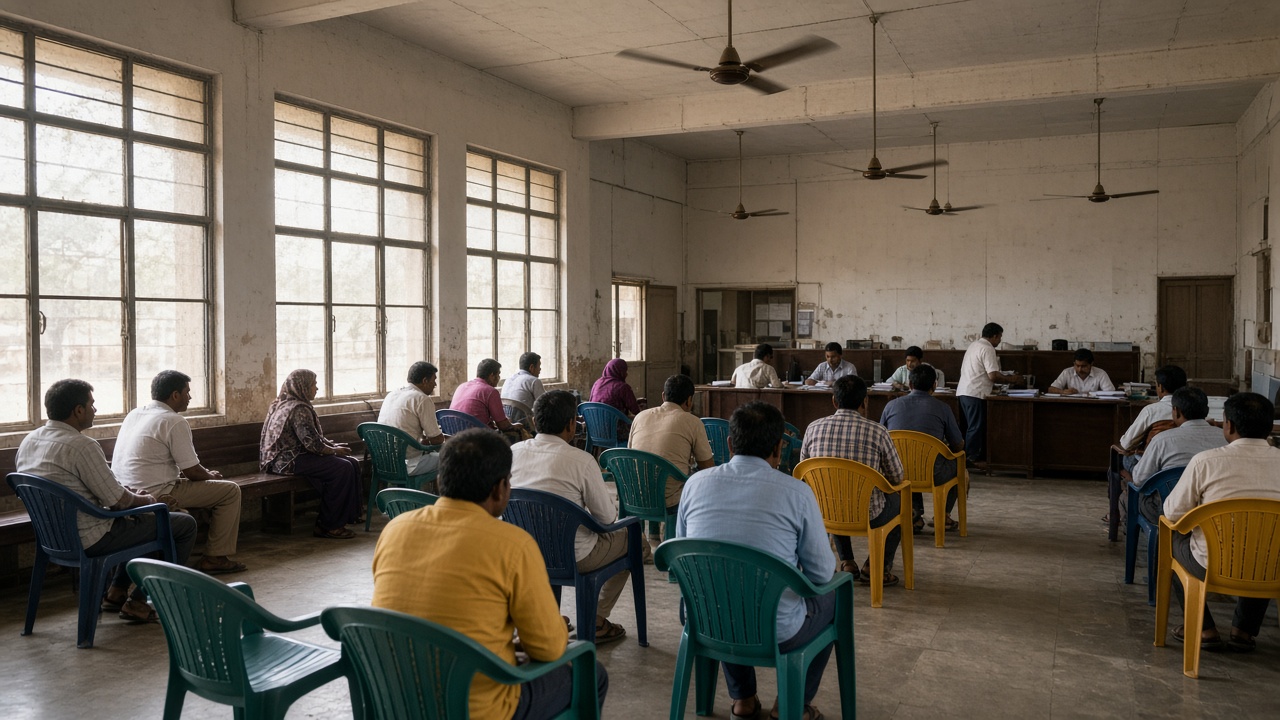
The IndiaAI mission added a Gujarat municipal grievance chatbot pilot to its public catalogue on Monday, describing an open-weight Indic language stack that answers property-tax and sanitation queries while keeping citizen data inside state-owned cloud regions.
The assistant, deployed in two urban local bodies near Ahmedabad, is built on a seven-billion-parameter model fine-tuned for Gujarati and Hindi code-mixed prompts. Unlike closed APIs that route prompts to US servers, the pilot runs inference on Gujarat Informatics Ltd. hardware, a requirement MeitY has repeated in recent procurement templates.
What the bot is allowed to do
According to the listing, the bot can classify complaints, quote ward-level helpline numbers, and summarize status pulled from the existing e-Nagarpalika portal. It cannot approve refunds or alter assessment records without a human officer’s digital signature, a guardrail municipal IT teams said they copied from Karnataka’s earlier waste-management pilot.
Open weights are published under a government enterprise license that forbids exporting fine-tuned checkpoints outside India. Researchers can audit bias metrics, but commercial reuse outside public-sector pilots requires a separate approval letter from the IndiaAI mission secretariat.
Accuracy and limits
Early evaluations quoted on the portal show 88% intent accuracy on a 1,200-question test set drawn from real helpline transcripts, with failures clustered around informal romanized Gujarati spelling. Ananya Krishnan’s desk has seen similar gaps in other Indic assistants; the Gujarat team said it logs every wrong answer for weekly retraining rather than silently correcting transcripts.
Privacy officers mandated on-device caching limits so that conversation logs purge after seven days unless a citizen opens a formal grievance ticket, in which case the thread attaches to the case file under existing RTI rules.
Broader rollout
MeitY officials positioned the pilot as a template for other states ahead of the National AI Mission’s next funding tranche. If Gujarat expands beyond two cities, the mission will require published energy-use disclosures, responding to criticism that local LLM deployments could strain state data centres during heat waves.
For residents, the immediate benefit is shorter hold times on phone lines that clog during monsoon flooding complaints. Whether the bot reduces backlog will depend on officers trusting its summaries enough to act without re-typing the same query.
Funding and audit trail
The pilot draws from IndiaAI mission sandbox grants covering GPU hours and red-team exercises. Auditors require immutable logs of prompt-response pairs for RTI requests, stored separately from citizen identity fields to reduce re-identification risk.
Opposition councillors in one pilot city asked whether bot answers could influence property tax appeals; MeitY responded that administrative decisions remain human-signed, with the bot limited to informational tiers on the escalation ladder.
Academic partners at a Gujarat engineering institute will publish ablation studies showing which tokenizer changes improved Gujarati spelling robustness, a transparency step other state bots have skipped.
Digital India Corporation staff will host office hours for ward officers skeptical of bot summaries, demonstrating how to override incorrect classifications without disabling logging. That change-management piece is often the difference between pilots that scale and pilots that die in PowerPoint.