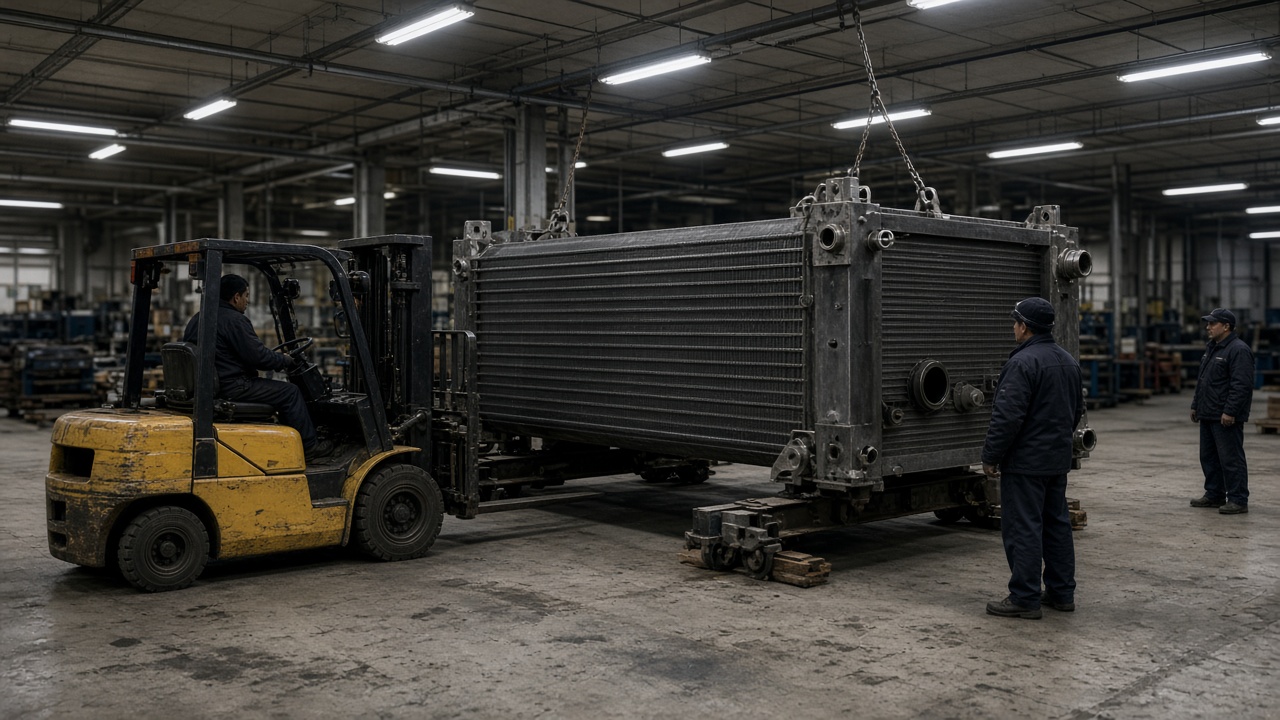
Komatsu Ltd. told suppliers Monday it will run overtime shifts at an Osaka-prefecture component plant through December to build heat exchangers bound for data-center cooling skids, after two unnamed Asian cloud operators accelerated purchase orders that were not in the miner’s July outlook. The schedule change does not alter Komatsu’s full-year mining equipment revenue guide, but it shows how Japan’s industrial base is picking up non-construction work as AI infrastructure spending spreads beyond chip fabs.
What changed on the line
The plant historically stamped plate heat exchangers for hydraulic excavators and wheel loaders. Komatsu’s industrial machinery division said it reallocated two assembly bays after a September audit found idle crane time when mining OEM orders slipped in Southeast Asia. Cloud customers wanted copper-nickel bundles rated for glycol loops common in liquid-cooled racks; Komatsu adapted existing press tooling rather than greenfield a new site.
Shipments begin in late October with partial knockdown kits assembled at partner integrators in Chiba and Fukuoka before installation at suburban Tokyo and Osaka campuses. Komatsu declined to name buyers, citing confidentiality clauses typical in hyperscaler supply chains. METI machinery order data for August already showed a pickup in general-purpose industrial machinery exports to Singapore and Taiwan, categories where cooling OEMs often route through trading houses.
Mining versus infrastructure
Investors still judge Komatsu on yellow-machine cycles. Management reiterated that Indonesian coal contractors delayed fleet renewals after rupiah volatility, keeping mining revenue guidance flat. The Osaka reallocation is small in yen terms—internal planning documents seen by InfoHandle describe roughly 14 billion yen of incremental chiller-module sales if all slots fill—but it signals diversification management has talked about since 2023.
Rivals Hitachi and Mitsubishi Heavy Industries market larger centrifugal chillers; Komatsu’s niche is compact skid modules that fit beside existing building plants. Data-center operators facing power caps in eastern Japan like modules that ship on standard trucks without helicopter lifts.
Supply chain pressure
Copper sheet lead times stretched after summer typhoons disrupted Kyushu rolling mills. Komatsu’s procurement office authorized spot purchases from South Korean mills for the chiller program while keeping excavator lines on contracted volumes. Union representatives at the Osaka plant accepted overtime after Komatsu agreed to cap Saturday shifts at six hours and maintain summer heat-stress protocols into autumn warm spells.
Local subcontractors staffing brazing stations asked for advance notice on December holiday closures because many technicians also work part-time at semiconductor tool vendors nearby. Komatsu published a four-week rolling schedule on its supplier portal to reduce no-shows.
Policy and power context
Japan’s data-center buildout runs into grid constraints METI tracks publicly. Operators applying for high-voltage feeds in Osaka and Tokyo face queue reviews; efficient chillers do not remove the need for substation upgrades but they lower peak demand charges that make colocation math painful. The Japan Data Center Council’s English-language briefings note liquid cooling adoption rising from single-digit percentages toward low teens industry-wide by 2028—still small, but enough to matter for component suppliers.
What investors watch next
Komatsu reports quarterly results in late October. Analysts will ask whether chiller revenue is recurring or a one-off pull-forward before fiscal year-end. If cloud capex slows, the Osaka bays can revert to mining components within a quarter, plant managers said. For now, the story is a familiar one: Japan’s heavy industry finding margin in the AI buildout without abandoning its core yellow machines.
Field checklist for integrators
Partner integrators must log torque specs on each skid before glycol fill because Komatsu’s QA team traces field failures to loose flange bolts more often than to core metallurgy. Integrators shipping by night ferry to Honshu ports should book refrigerated trucks only when glycol is pre-mixed; dry skids can ride standard flatbeds if desiccant packs stay sealed.
Customer service implications
Hyperscaler procurement teams asked Komatsu for Japanese-language failure analysis reports formatted like semiconductor tool vendors provide. The Osaka plant hired a bilingual quality engineer from a disk-drive supplier to standardize reports before December shipments. Integrators said the paperwork matters as much as thermal performance when uptime clauses trigger penalties.