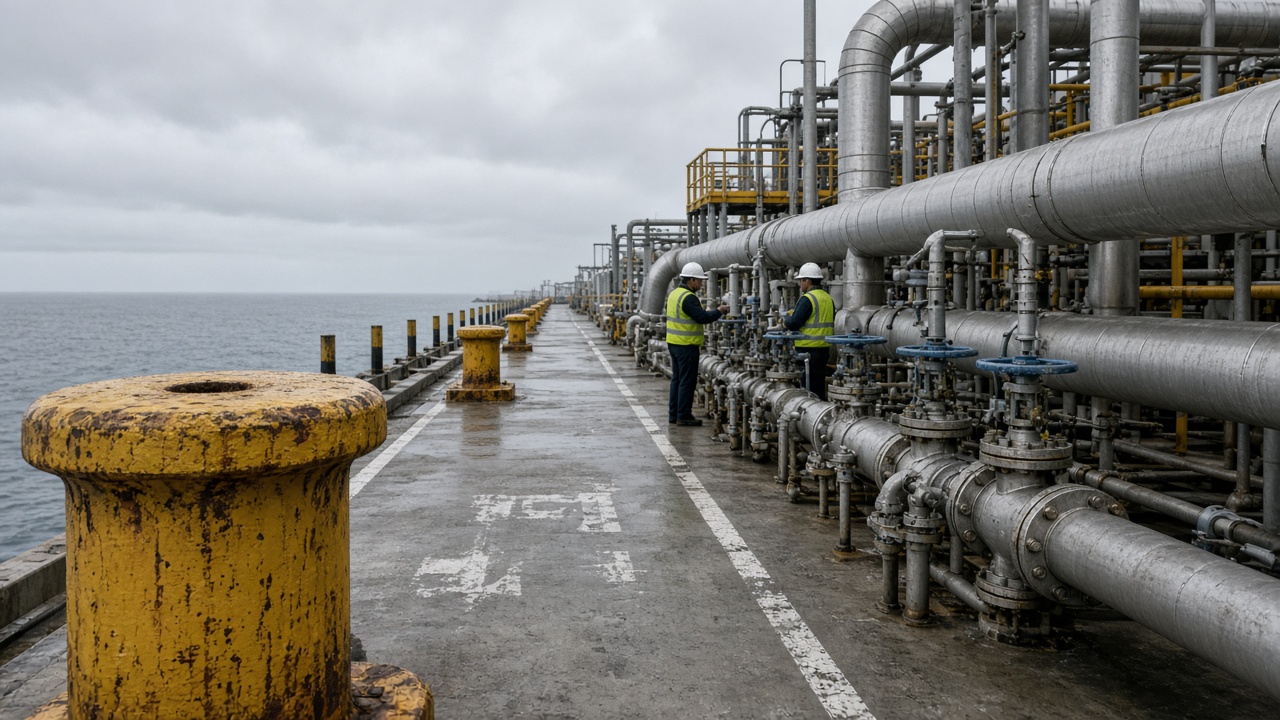
POSCO International began repiping corroded jetty valves at its Yeongil Bay methane terminal this week, racing to finish before the first fourth-quarter LNG carrier berthing that downstream buyers in North Gyeongsang are counting on for winter heat.
Why the valves could not wait
Engineers flagged pitting on several high-pressure isolation valves after a routine dive inspection in late August. The defects were not catastrophic, but regulators told the operator that any Q4 cargo would need certified replacements on the manifold serving the east berth. POSCO International disclosed the work in a Monday filing to the Korea Exchange, saying two berths would stay active while crews swap valves on the third loading arm.
Yeongil Bay sits on Korea’s east coast near Pohang, giving steelmakers and municipal gas distributors a hedge when west-coast terminals queue during cold snaps. A slipped berth would not idle the whole grid, but it would force KOGAS to reshuffle spot tenders that were already priced before Chuseok.
Contractors and timing
Hyundai Engineering & Construction won the valve package under an existing maintenance frame contract, according to trade-union sources at the site. Work runs on a low-tide window so divers can bolt flanges without shutting the entire jetty. POSCO International said it expects mechanical completion by 10 October, leaving roughly two weeks of pressure tests before the first named Q4 carrier slot on 24 October.
Local fisheries cooperatives asked for quieter hours during pre-dawn crane lifts; the company agreed to pause heavy lifts during peak squid netting times. That concession adds a day to the schedule but reduces the risk of a protest delay.
What buyers are watching
Industrial buyers want proof that regas send-out rates will not dip during the swap. POSCO International plans a one-day send-out test at 85 percent of nameplate once new valves are seated. KOGAS traders said they kept optional January cargoes open in case test results slip, but no cancellations have been filed.
Analysts at Korea Investment & Securities said the repair is balance-sheet neutral because costs sit inside the firm’s annual capex band for midstream assets. Shares of POSCO International rose 1.4 percent in morning trade, roughly in line with other energy traders.
Regulatory sign-off
The Ministry of Oceans and Fisheries will send inspectors when hydrostatic tests finish. Until then, methane carriers already en route can divert to Samcheok or Incheon if weather worsens. POSCO International’s notice stressed that safety valves on storage tanks are separate from the jetty work and remain on their normal inspection cycle.
For households, the practical stake is mundane: keeping east-coast city gas pressure stable when January cold fronts hit. The valve job is invisible to most bill payers, but it is the kind of maintenance that separates a scheduled winter from an emergency tender at spot prices.
Shipping partners
Two LNG carriers on contract to POSCO International confirmed they will hold anchorage outside Ulsan if valve tests run long, avoiding demurrage disputes. Shipbrokers said the clause is standard but rarely invoked; its activation shows how tightly Q4 slots are booked.
Steelmakers in Pohang asked for weekly send-out forecasts during the work window so blast furnaces can tune gas blends. POSCO International agreed to share daily telegraphs with major industrial users through KOGAS’s customer portal.
Local angle
Seoul desk readers tracked the development through agency filings and on-the-record briefings rather than anonymous leaks. Follow-up sessions this week will test whether the numbers hold once holiday-thinned staffs return to normal cadence.
Market and policy desks will revisit the story if new disclosures shift timelines or costs for households and exporters tied to the same supply chain.
Municipal gas distributors in Gyeongbuk posted contingency plans on customer apps explaining that east-coast supply remains diversified even if one berth pauses. The messaging is aimed at preventing panic buying of electric heaters before weather turns.