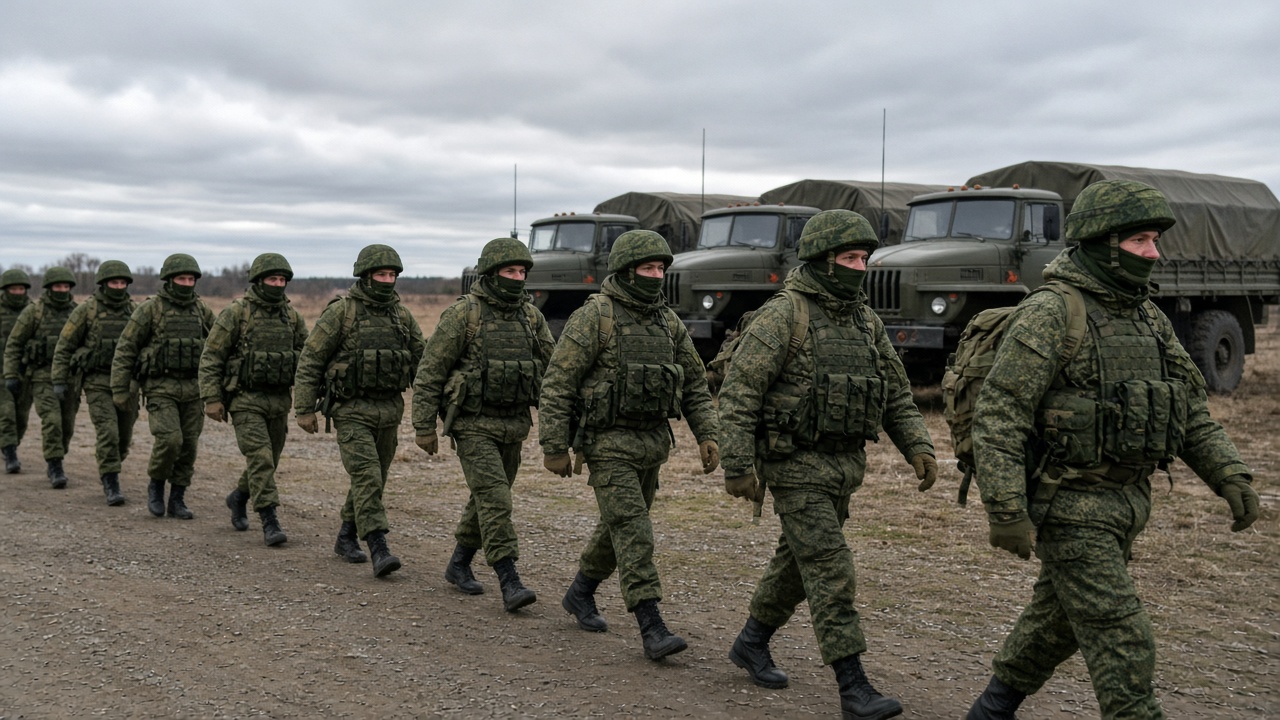
Russian President Vladimir Putin has signed another decree enlarging the country’s armed forces, lifting the authorized active-duty roster by 15,500 troops and bringing total military staffing to 2.44 million personnel. The order, posted Monday on Russia’s official legal portal, is the fourth manpower increase Moscow has ordered this year and arrives as both sides prepare for another winter of attrition in Ukraine.
What the decree changes
Under the new limits, Russia’s armed forces may reach 2,441,630 people, including 1,550,500 in active service. The Kremlin did not attach a public explanation to the adjustment, a familiar pattern for these periodic expansions since the full-scale invasion began in February 2022. Western officials have long treated the published ceilings as planning figures that can mask wider recruitment, contract extensions and battlefield losses.
The increase is modest in percentage terms but politically significant. Each upward revision signals that Moscow still expects a long fight, even as Ukrainian forces press counterattacks in the east and south and as Kyiv’s partners debate how quickly to replenish air-defense stocks. Russia has relied on a mix of mobilized reservists, volunteer contract soldiers and foreign personnel to sustain front-line rotations.
Ukraine’s warnings on mobilization and allies
Ukrainian President Volodymyr Zelenskyy said Monday that Russia has effectively opened a new mobilization push, describing it as part of a broader effort to grind down Ukrainian defenses before cold weather hardens logistics. Speaking after last week’s United Nations General Assembly session, he also renewed warnings about North Korean soldiers operating on Russian territory, estimating that more than 8,000 are already present and that Moscow is preparing another 10,000 for training and eventual deployment.
Independent analysts have cautioned that precise counts of foreign troops are difficult to verify, but the combination of manpower decrees and allied deployments fits a Kremlin strategy of absorbing losses while keeping pressure on Ukraine’s cities and power grid. Overnight, Russia again targeted Kyiv with ballistic missiles and jet-powered drones, according to Ukraine’s air force, continuing a barrage that has piled hundreds of air-raid alerts on the capital since late August.
Winter stakes
Zelenskyy has said the coming winter could be especially painful for Russia if a durable ceasefire cannot be negotiated in the weeks ahead, while acknowledging that Ukrainian civilians face their own risks from heating and electricity cuts if strikes repeat last season’s pattern. European capitals are weighing additional air-defense packages, and U.S. officials have stressed that Patriot interceptors remain among the few reliable counters to ballistic threats.
Putin’s decree does not by itself move units to the border, but it gives the Defense Ministry legal headroom to fill ranks as contracts expire or casualties mount. NATO planners will read the order alongside satellite evidence of training sites, ammunition throughput and any uptick in North Korean flights to Russia’s Far East.
What comes next
Russian parliamentary committees rarely block military staffing changes, so the new ceiling is likely to take effect without public debate. Ukraine’s General Staff is expected to fold the expansion into updated estimates of Russia’s rotational capacity heading into 2027. Diplomatic channels remain sparse: Kremlin spokespeople have dismissed recent Ukrainian peace overtures as incompatible with Russia’s territorial claims, while Washington and Berlin continue to condition long-term security guarantees on battlefield outcomes.
For now, the decree is a paperwork move with battlefield consequences—another signal that Moscow is budgeting for years of war, not a near-term drawdown.