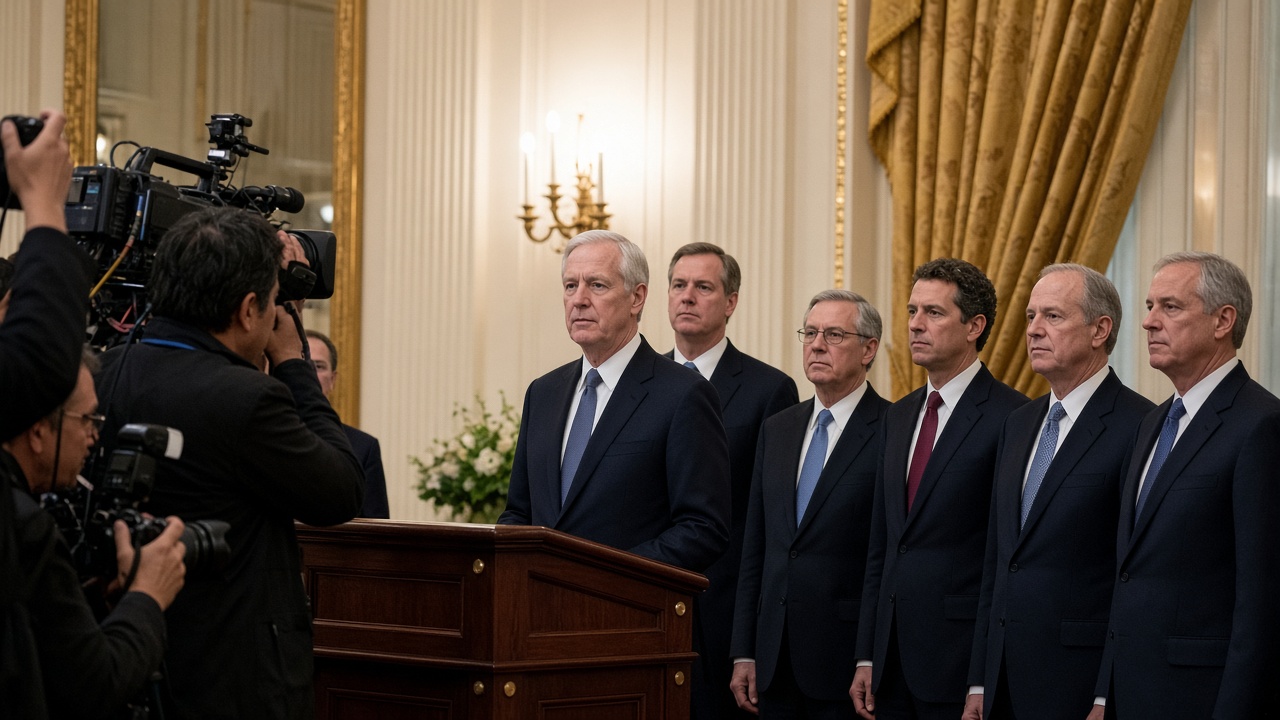
President Donald Trump and the leaders of several major artificial-intelligence companies signed a voluntary safety statement on Tuesday after a White House lunch, describing the document as a set of principles for “super intelligence” rather than a new federal statute. House Speaker Mike Johnson, who joined reporters with Trump after the meeting, called it a “joint commitment” that would keep firms to “strong internal controls.”
What changed at the lunch
Trump stood with a row of executives that included SpaceX’s Elon Musk, Meta’s Mark Zuckerberg, Anthropic’s Dario Amodei and Nvidia’s Jensen Huang, according to CBS News. Johnson told reporters the group signed an accord on super intelligence—Trump’s preferred label for advanced AI—and framed it as industry self-policing backed by public accountability.
Asked whether the agreement was legally enforceable, Trump said he considered it “morally binding,” adding that he saw “tremendous self-policing” from companies that “understand that they have to self-police.” The exchange underscored a recurring tension in Washington: lawmakers and some lab leaders have warned that frontier models are moving faster than oversight, while Trump has repeatedly argued that binding rules would hand China a development edge.
Who attended and what they want
ABC News confirmed attendance by Zuckerberg and Amodei, and reported that Google CEO Sundar Pichai, Nvidia’s Huang and Palantir’s Alex Karp were also expected. The meeting landed amid public warnings from AI executives about catastrophic misuse of powerful systems, and parallel calls from parts of Congress for guardrails short of a development moratorium.
Johnson had previewed the session two weeks earlier as a deliberate discussion about corporate responsibility and the limited role government might play. On Tuesday he echoed that balance, emphasizing U.S. competitiveness even as the signed statement nods to safety culture inside the labs.
America.gov order hours earlier
The lunch followed a separate White House action earlier Tuesday. Trump signed an executive order establishing America.gov, an AI-assisted portal meant to unify public-facing federal services, POLITICO reported. The order gives agencies 90 days to integrate eligible services into the platform, a timeline that will test how quickly cabinet departments can route citizens through a single digital front door without breaking legacy systems.
Together, the order and the voluntary accord sketch a policy day defined by Trump’s instinct to showcase American AI leadership while stopping short of the statutory frameworks European regulators have pursued.
What binding would have meant
Voluntary commitments from AI labs are not new; previous White House summits produced safety pledges that critics said lacked teeth. Tuesday’s language—“morally binding” in Trump’s phrasing—does not create private rights of action or agency enforcement powers. Any future statute would still need Congress, where Johnson’s Republican majority has been wary of rules that could slow deployment.
Trump told the United Nations General Assembly last week that the United States “rejects” a global attempt to regulate AI, a message that clashes with multilateral drafts still circulating in New York. Tuesday’s signing gives the administration a domestic headline to pair with that diplomatic stance.
What happens next
Watchdog groups will look for published text of the accord and any metrics companies promised to disclose. Capitol Hill staffers are likely to ask whether voluntary controls cover model release decisions, red-team results and compute thresholds—the details that turned earlier safety letters into optics rather than obligations.
For markets, the immediate read is continuity: no new compliance calendar, no Federal Trade Commission rulemaking triggered by the lunch itself. For national-security officials, the open question is whether self-policing can coexist with export controls and Pentagon adoption timelines already stretched by classified testing backlogs.
Trump left the door open to further meetings, saying companies understood the stakes. Whether “moral” obligation translates into delayed launches or withheld capabilities will be decided inside boardrooms, not in the Rose Garden.