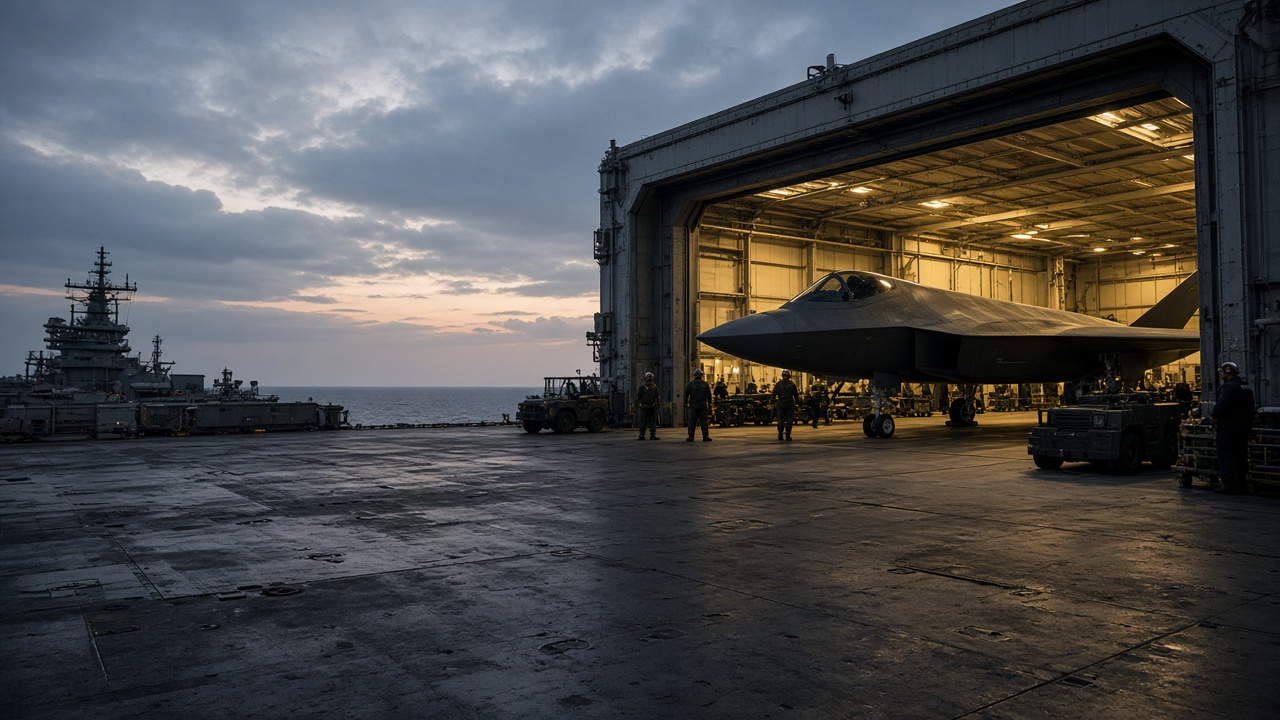
The U.S. Navy has selected Boeing to build its next carrier-based strike fighter, handing the St. Louis manufacturer a full-scale development contract valued at more than $20 billion and completing a rare double win across the Pentagon’s two sixth-generation fighter competitions.
The award, announced on Tuesday, covers design work and multiple test aircraft for ground, airworthiness, systems and weapons integration testing for the program temporarily known as F/A-XX. Northrop Grumman, which had remained in late-stage negotiations, lost the competition. Lockheed Martin was eliminated earlier, in March 2025.
What the Navy is buying
Defense officials cast the jet as the successor to today’s F/A-18E/F Super Hornets and EA-18G Growler electronic-attack aircraft, with initial fielding expected in the 2030s. The aircraft is meant to operate from carriers alongside the F-35C, unmanned tankers such as the MQ-25 Stingray, and the Navy’s emerging family of collaborative combat aircraft.
Michael P. Duffey, under secretary of defense for acquisition and sustainment, said in a Pentagon release that the platform is a “crucial, non-negotiable investment” in long-range carrier air power. Steve Parker, chief executive of Boeing Defense, Space & Security, said the company would draw on investments in new St. Louis facilities built to handle multiple next-generation programs at once—a point Pentagon budget watchers had flagged as a risk when Boeing was already executing the Air Force’s F-47 program.
Congress and classified details
The F/A-XX line had been caught for years in funding fights inside the department, with some officials arguing engineering bandwidth should flow to the Air Force fighter first. Congress nonetheless earmarked $750 million in the 2025 tax-and-spending package and another $1.4 billion in fiscal 2026, effectively reviving the Navy effort, according to Reuters reporting on the contract.
Boeing released an artist rendering of a tailless, low-observable design, but the Navy has not disclosed production quantities or many performance parameters. Both the company and the Pentagon said detailed technical data remain classified under export and national-security rules.
Industrial and alliance implications
Analysts noted that Boeing now holds exclusive roles on both U.S. sixth-generation fighter efforts, concentrating a generation of stealth and mission-systems work in one corporate camp after years in which Lockheed Martin dominated fifth-generation production. For allies that fly Super Hornets or depend on U.S. carrier groups, the decision locks in a single U.S. integrator for the coming replacement cycle, even as European and Indo-Pacific partners pursue their own future combat-air programs.
Contract value covers development and test assets, not serial production. Navy leaders have yet to spell out how many squadrons they expect to convert or how F/A-XX will split strike, electronic warfare and unmanned-teaming missions across the carrier air wing. Program officials said upcoming milestones will focus on digital engineering reviews and supplier readiness before metal is cut on the first flying prototypes.