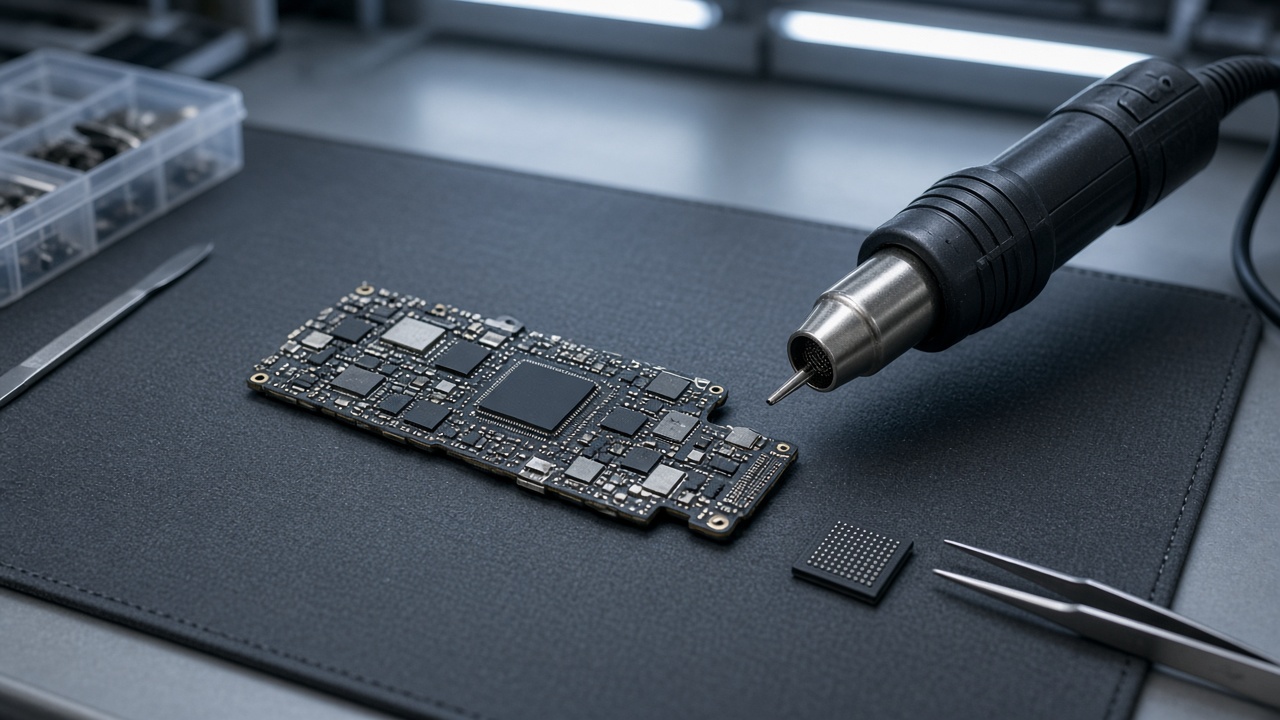
Samsung Electronics said it completed the industry’s first LPDDR6 validation on Qualcomm’s Snapdragon 8 Elite Extreme Gen 6, running 16-gigabit dies at input-output speeds up to 10.7 gigabits per second. The Sept. 23 announcement, tied to Qualcomm’s Snapdragon Summit week, is a compatibility milestone—not yet a retail phone spec—but it locks Samsung’s next mobile DRAM into the reference design for 2027 flagships.
Executives from both companies framed the result as proof that on-device AI workloads will need more than incremental LPDDR5X bumps. Qualcomm product management vice president Salman Saeed said the memory meets bandwidth and power targets for advanced on-device models. Samsung memory vice president Jangseok Choi said sampling and validation followed Samsung’s earlier claim to have developed LPDDR6 ahead of rivals.
What changes versus LPDDR5X
Per-pin speed on Samsung’s validated part matches the top end of today’s LPDDR5X, but LPDDR6 widens the I/O architecture under the JEDEC JESD209-6 standard finalized in 2025. More channels per die lift total throughput; Samsung quotes about 114 gigabytes per second on the Snapdragon platform, versus roughly 77 to 83 gigabytes per second on many current Android flagships. Samsung also advertises roughly 21 percent better power efficiency through dynamic voltage scaling and an efficiency mode that throttles memory activity when models idle.
Those supplier figures still need third-party phone tests. Validation nonetheless matters because it exercises signal integrity, timing closure, and thermals with the application processor—not just a bench card.
Commercial timing
Samsung said it will scale production to customer schedules without naming launch devices. Rumor mills have already linked the Extreme Gen 6 chipset to Galaxy S27 variants in some regions, but Samsung has not confirmed memory choices for that line. Separate reports suggest cost pressure could keep some 2027 models on LPDDR5X, and regional Exynos silicon would not automatically inherit a Qualcomm-specific validation.
For Qualcomm, securing Samsung memory early reduces risk before OEMs freeze bill-of-materials lists. For Samsung’s memory division, a Qualcomm win offsets cyclical DRAM pricing and keeps Korea’s flagship supplier inside the Android performance tier that Apple’s integrated silicon dominates on efficiency metrics.
AI use cases on the phone
On-device AI features—live translation, multimodal assistants, on-phone diffusion—pull bursts of memory bandwidth when models load tensors from storage into RAM. Higher throughput shortens wake latency and can allow larger context windows without spilling to cloud inference. Power efficiency claims matter because sustained AI sessions heat phones and trigger throttling that makes benchmark peaks meaningless.
Carriers and app developers will care about stable latency more than peak gigabytes per second. Validation is the first gate; firmware co-tuning with camera ISP and NPU blocks is the second.
Industry context
Samsung pioneered LPDDR5 in 2018 and LPDDR5X before peers, and it has been active in JEDEC working groups. Micron and SK hynix are racing their own LPDDR6 samples. Winning Qualcomm’s first validation gives Samsung a marketing clock even if dual-sourcing rules force other vendors onto the same platform later.
More details are promised at Snapdragon Summit 2026 sessions. Until a shipping handset is torn down, treat the 10.7-gigabit number as a floor under a standard that JEDEC designed to scale toward about 14.4 gigabits per second in future revisions.
Supply chain ripples in Korea
Packaging and test houses in Cheongju and Giheung will see demand shift if LPDDR6 ramps replace LPDDR5X wafers on the same lines. Equipment makers that sell die attach and wire bond tools are already quoting lead times stretching into 2027. SK hynix’s parallel LPDDR6 program means Samsung’s validation win is not exclusive forever, but being first on Qualcomm’s reference phone gives Samsung’s sales teams a quarter or two of pitch advantage in OEM bake-offs.
Handset brands outside Samsung—Xiaomi, Oppo, Vivo—also license Snapdragon flagships for China and India exports. If they adopt the same memory stack, Samsung’s DRAM division gains volume even when Galaxy marketing does not mention LPDDR6 in keynote slides.