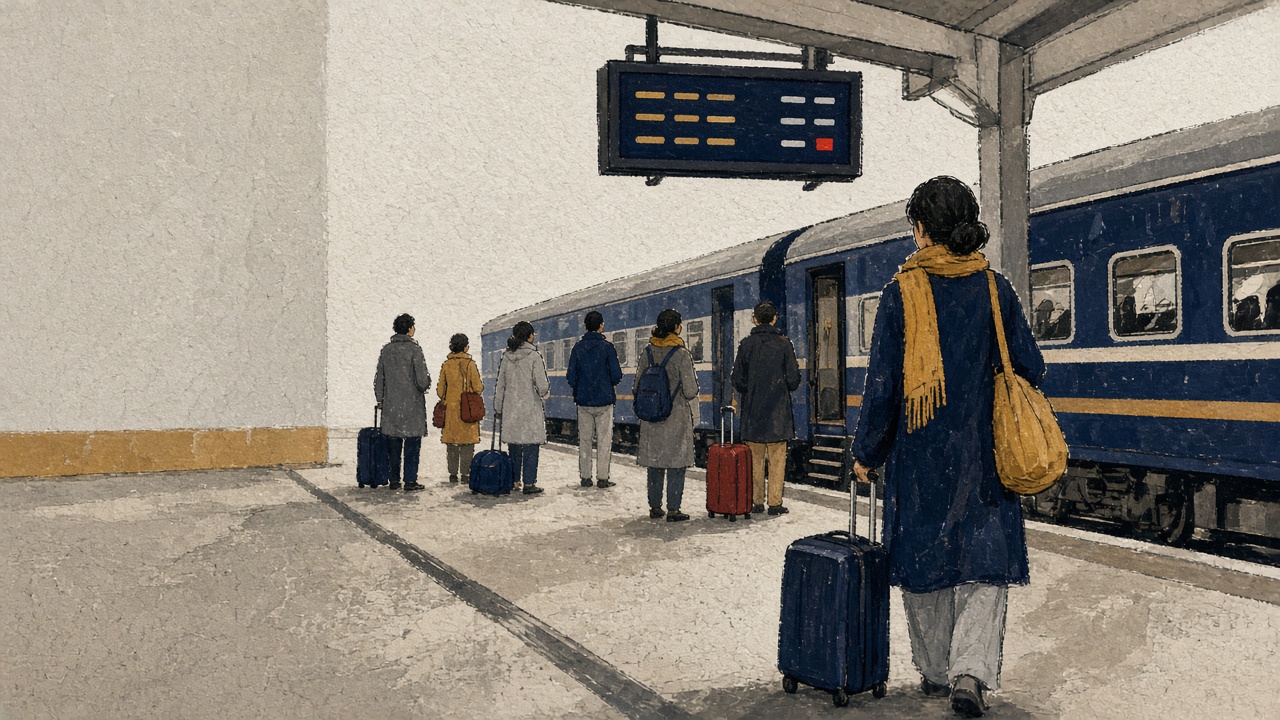
In July 2014, the Ministry of Railways told the Rajya Sabha the ordinary second AC fare on train 12952, the New Delhi–Mumbai Rajdhani Express, was Rs 2,810 once reservation and catering charges were included. Book the same berth under Tatkal rules and the ministry put the premium at 14.77 per cent above that ordinary price on the Delhi–Mumbai sector. The gap is not a rounding error on a luxury train. It is the visible tip of a pricing stack that most passengers only meet when a wedding, a death, or a holiday forces them to travel on someone else's timetable.
The Rs 2,810 ticket that is not the price you pay
12952 is the sort of train people name when they argue about whether Indian Railways still feels like a public utility or a rationed market. The 2014 written reply from Minister of State Shri Manoj Sinha gave reporters a rare pair of numbers: the same coach, the same city pair, two prices separated by policy labels rather than by distance.
That separation is what this story is about. IRCTC does not publish one fare per berth. It publishes a base fare table, then layers quotas and surcharges whose rules live in ministry circulars and FAQ pages, not on the enamel sign at the platform. A sleeper passenger who opens the app minutes after the Tatkal window opens on the day before departure is not buying the same product as a colleague who booked at the general opening window.
By 2013 the Tatkal scheme was available in almost all Mail and Express trains and in all reserved classes except First Class and First AC Class, according to the same ministry release that recounted the 1997 origin story. The quota is no longer a single extra coach on a handful of routes. It is infrastructure woven through the reservation system, which is why a last-minute fare can jump even when the train still shows empty berths in another class.
The obvious guess is airline logic: seats are scarce, so price rises until only the desperate remain. Indian Railways does use demand-sensitive tools, especially on premium trains, but the last-minute bill is also shaped by a 1997 anti-tout design, fixed percentage Tatkal surcharges, and refund rules that would bankrupt a travel agent. The question is not whether berths are scarce. It is which rulebook is pricing the scarcity.
What IRCTC is actually selling
Start with ordinary reserved tickets, the price printed closest to a "normal" fare. Tatkal sits on top for short-notice travel. On Rajdhani, Duronto and Shatabdi services, flexi fare can replace part of that stack by moving the base fare itself in steps as berths disappear. Premium Tatkal and premium specials add another dynamic layer on high-demand trains, with fares that rise with occupancy up to a published ceiling.
For a standard Mail or Express train in sleeper class, IRCTC's Tatkal FAQ fixes the surcharge at 30 per cent of basic fare, no matter how desperate the passenger, subject to a floor of Rs 100 and a ceiling of Rs 200. Second class sitting is cheaper to surcharge: 10 per cent of basic fare, bounded by Rs 10 and Rs 15. Concessions for students, senior citizens, or war widows do not apply. Tatkal is a full-fare lane.
The booking window is brutally narrow. AC Tatkal on the originating station's clock opens at 10:00 on the day before departure; non-AC opens at 11:00. Miss that hour and you are not merely late. You are in a different queue entirely, often staring at waitlist numbers while agents who were blocked from the first thirty minutes of counter sales resume work.

The quota born to beat touts
The Tatkal scheme was initially introduced in 1997 with a view to provide reservation to those passengers who have to undertake journey at short notice and to save such passengers from the clutches of unscrupulous elements/touts, the Ministry of Railways reminded journalists in a 2013 release. The goal was not to mimic airline yield management. It was to give honest last-minute travellers a legal berth while making bulk hoarding unprofitable.
The Tatkal scheme was initially introduced in 1997 with a view to provide reservation to those passengers who have to undertake journey at short notice and to save such passengers from the clutches of unscrupulous elements/touts.
Railways built safeguards around that idea until they read like a criminal statute. Authorized ticketing agents may not book Tatkal tickets during the first thirty minutes after the quota opens. Web agents face caps on how many Tatkal tickets one IP address can pull. Identity checks can turn a group ticket into a fine if one passenger lacks original ID. A 2016 Lok Sabha reply listed eight separate anti-misuse provisions, from automatic logout after one transaction to a monthly cap of six Tatkal tickets per individual user, and noted that instructions modifying Tatkal had been issued on six occasions since 2014 alone.
The rule passengers feel most sharply is simpler: no refund will be granted on cancellation of confirmed Tatkal tickets, according to IRCTC's published FAQ. A tout cannot arbitrage Tatkal if unsold inventory cannot be returned for cash. A family whose plans collapse after a confirmed booking eats the fare.

How flexi fare turns seats into steps
On 7 September 2016 the ministry extended a different logic to Rajdhani, Duronto and Shatabdi trains. Flexi fare does not add a labelled Tatkal charge on those services. It moves the base fare in slabs.
The base fares will increase by 10% with every 10% of berths sold subject to a prescribed ceiling limit as indicated in the table below.
The published table for Rajdhani and Duronto sleeper shows the multiplier climbing from 1.0 to 1.5 times the starting base as each ten-per-cent slice of berths sells, then flatlining at 1.5. Third AC stops earlier, at 1.4 times. First AC and Executive Class were left unchanged. Tatkal berths on those trains were folded into the flexi structure at 1.5 times base fare without a separate Tatkal charge line item.
Vacant berths left at charting are offered for current booking at the last price sold for that class, with full supplementary charges still added. A passenger who slips in after the frenzy can therefore pay the peak flexi price even if demand has cooled, while a waitlisted traveller may inherit a Tatkal berth without paying Tatkal charges when the chart is prepared and unused Tatkal space is released downward.
Premium specials add yet another dial. A 2014 ministry reply described premium trains whose fares rise with demand up to a maximum limit and do not offer waiting lists. That is the ancestor of the Premium Tatkal quota on other high-demand services: confirmed seats only, price climbing with occupancy.
Passenger earnings charts make the stakes visible. Ministry figures compiled in the Economic Survey show earnings collapsing to Rs 15,248 crore in 2020-21 during the pandemic, then recovering to Rs 70,693 crore by 2023-24. Flexi fare arrived in the middle of a long struggle to close the gap between what passengers pay and what it costs to move them. PRS Legislative Research noted passenger revenue of Rs 31,323 crore in 2012-13 rising in steps through the decade before COVID interrupted the climb. Surcharges are one tool in that recovery, not the whole business.
Who pays the premium — and who does not
If surcharges feel ubiquitous at the booking counter, the accounts suggest otherwise. Revenue earned by Indian Railways on account of flexi fare, tatkal and premium tatkal during 2019-20 to 2023-24 is approximately 5.7 per cent of the total revenue earned from passenger services, the ministry told the Rajya Sabha in March 2025. Passenger revenue in 2023-24 was Rs 70,693 crore. Even if the surcharge share held that year, it would represent on the order of Rs 4,030 crore, a large absolute sum that is still a thin slice of the whole passenger business.
The seat mix explains part of the paradox. Non-AC coaches averaged about 82 per cent of passenger seats from 2019-20 to 2023-24 but only about 53 per cent of passenger revenue. AC coaches were roughly 18 per cent of seats and about 47 per cent of revenue. Last-minute pricing tools bite hardest where competition with flights is real, yet most Indians still ride in general and sleeper classes where Tatkal surcharges are capped in rupee terms.
Railways also entered flexi fare while the passenger business was bleeding. PRS Legislative Research, citing Railway budget documents, noted a net passenger loss of about Rs 33,000 crore in 2014-15. Flexi fare was pitched as revenue repair. The Comptroller and Auditor General's review, summarised by PRS, found that after implementation the number of passengers carried declined by 2.65 per cent while revenue increased marginally by Rs 552 crore, and travellers shifted toward cheaper Mail and Express options. The surcharge machinery nudged behaviour before it filled the hole.

The berth that goes back to the waitlist
Return to 12952. The 2014 Rajya Sabha answer gave journalists a clean comparison on 2AC: Rs 2,810 ordinary, Tatkal 14.77 per cent higher. On a Rs 2,810 base, that premium is about Rs 415, enough to notice, not enough to pay for a flight. After flexi fare arrived two years later, the same train category could move between multipliers as berths sold, with Tatkal folded into the 1.5 times base rule on premium trains.
The ending the rules imagine is quieter than the opening rush. When charting begins, empty Tatkal space can drop back into the waitlist pool without Tatkal charges on the passengers who finally board. The last-minute price spike is real for the traveller who confirms at 10:05. It is not always real for the traveller who waits, hopes, and inherits the berth at night.
Indian Railways still runs about 79,000 coaches, the ministry said in 2025, carrying a country that mostly rides non-AC. The pricing fireworks concentrate on a thin upper slice. The rest of the network lives on ordinary fares, waitlists, and the remembered promise of 1997: a legal berth for the journey you did not plan, if you can beat the clock and swallow a surcharge that was never meant to be fair in the airline sense. It was meant to be too expensive for touts and just available enough for you.
