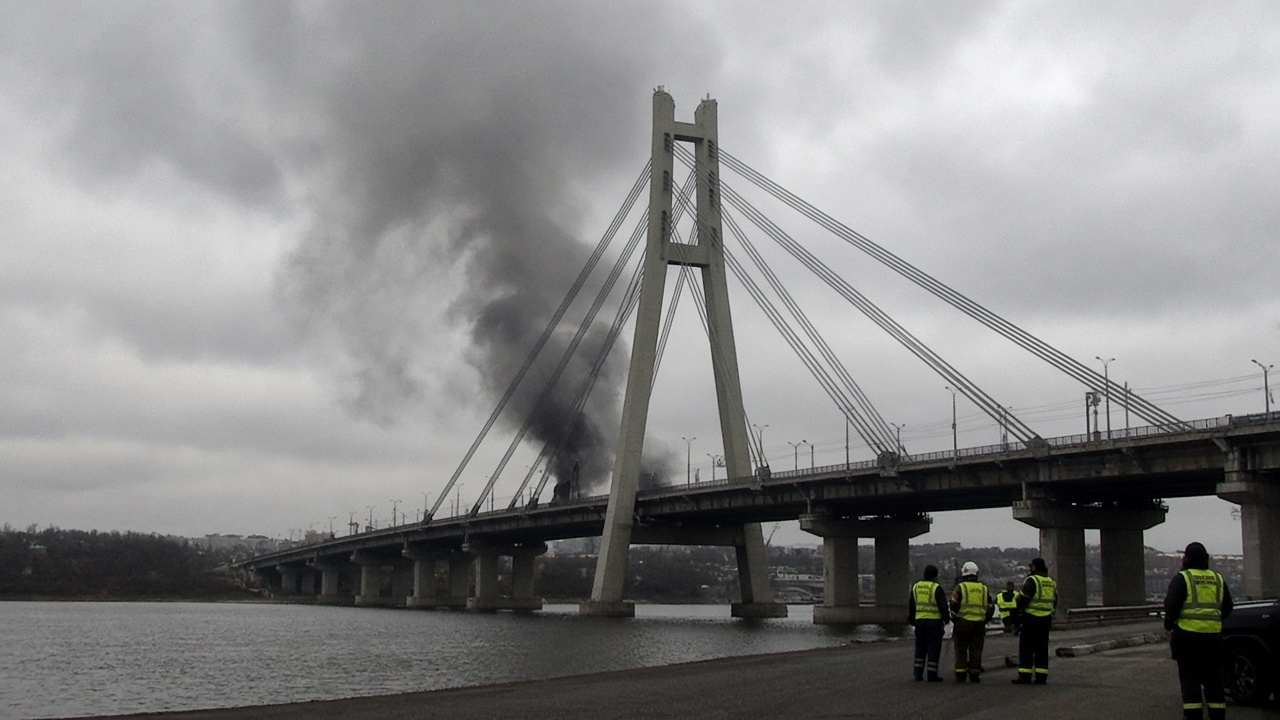
Two Russian drones slammed into the Pivdennyi bridge over the Dnipro on Thursday morning, the first time Moscow has targeted one of Kyiv’s main river crossings since the full-scale invasion began. A metro train was on the span when the blasts hit; passengers described dust pouring into carriages through ventilation shafts as transport across the city seized up.
What officials reported
Kyiv Mayor Vitali Klitschko said the strikes forced the suspension of metro service and ground transport on the crossing, though city engineers later allowed road traffic to resume after preliminary checks found no critical structural damage. Ukraine’s air force said Russia has leaned harder on faster jet-powered drones in recent weeks, complicating interception over the capital.
The bridge attack followed an earlier strike on a school building at about 09:00 local time. Klitschko said children and staff were in shelters when the drone hit the third floor; authorities reported no immediate casualties from that incident. Separately, Ukraine’s nuclear regulator said a Russian drone sparked a fire on the grounds of a nuclear research institute in Kyiv on Wednesday night but did not damage an offline test reactor.
Scale of the air campaign
Ukrainian officials counted more than 3,100 jet-powered drone launches in September alone, exceeding August’s wartime record. Advisers to President Volodymyr Zelenskyy have described a new Russian design with a roughly 40-kilogram warhead tailored for bridges and high-voltage pylons, though the specific model used on the Pivdennyi bridge was not immediately confirmed.
Prime Minister Serhii Koretskyi told Ukrainians that combined strikes on energy infrastructure this week marked the first barrage of that scale since spring, raising fears of renewed winter blackouts even as Kyiv has rushed smaller distributed power projects. Power cuts returned to parts of the capital after Wednesday’s wave.
What comes next
Repair crews were assessing the bridge supports while commuters rerouted through other crossings. Western governments, including Britain, announced fresh sanctions packages on Thursday tied to the continuing strikes. Ukrainian commanders said air-defense units would shift patterns to account for faster drones, but officials warned that protecting both infrastructure and civilians simultaneously would strain already depleted interceptor stocks.
For residents, the daylight attack on a busy bridge underscored how Moscow is probing targets once considered too politically sensitive to hit in central Kyiv. Commuters who rely on the metro to cross the Dnipro faced long bus detours, and taxi fares spiked during the afternoon rush as officials kept rail service suspended pending structural checks.
European Union foreign ministers are scheduled to discuss additional air-defense support next week, and NATO officials have pointed to the rising share of jet-powered drones in Russia’s nightly packages. Ukraine’s government has asked partners for more interceptor missiles and for faster licensing of electronic-warfare kits that can jam guidance links on high-speed unmanned aircraft.
Whether Russia repeats strikes on river crossings will signal how far the Kremlin is willing to disrupt daily life in the capital as diplomacy remains stalled. Until then, Kyiv’s civil-defense apps continued to ping residents with shelter alerts each time radar tracks new groups of drones inbound from the north and east.