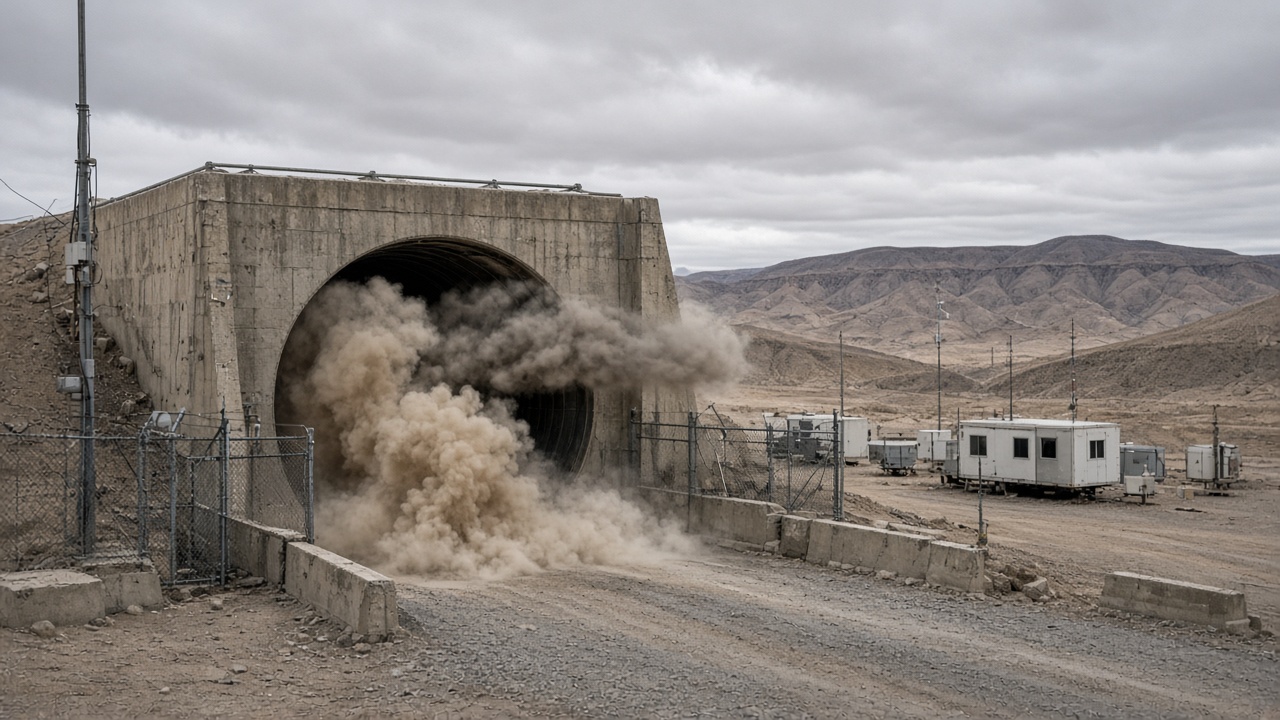
The National Nuclear Security Administration set off a subsurface chemical high-explosive charge inside the Nevada National Security Site on Wednesday, part of a deliberate effort to teach American sensors how to spot underground nuclear tests that are engineered to look smaller than they are.
The experiment used conventional explosives and radiotracers in the P Tunnel at Area 12, the Energy Department said in a statement. No nuclear material was involved. Engineers will compare seismic, acoustic and radiological readings from the shot against computer models that underpin the U.S. treaty-monitoring network and the intelligence products that flag unusual seismic activity abroad.
Why “decoupling” matters to monitors
In a coupled underground test, a device is emplaced in close contact with rock so much of the shock reaches distant seismometers. A decoupled test detonates inside a large cavity, allowing energy to dissipate before it reaches the surface. The effect can make a substantial explosion register like a far smaller event—similar to how stealth shaping shrinks a radar return.
U.S. intelligence assessments cited in NNSA’s release say Beijing used that technique at the Lop Nur site in June 2020, even as China maintains a declared testing moratorium. NNSA Administrator Brandon Williams said Wednesday’s shot was aimed squarely at closing that detection gap. “It takes nuclear expertise to detect nuclear activities,” Williams said in the release, adding that experiments like this are meant to keep U.S. analysts ahead of evasion tactics.
What happens to the data
Agency officials said measurements from the tunnel will validate physics codes and refine algorithms that fuse seismic stations, infrasound arrays and satellite cues. Those tools feed both the Comprehensive Nuclear-Test-Ban Treaty Organization’s international monitoring system—where the United States remains a signatory though the Senate has not ratified—and classified channels used to brief policymakers when analysts believe a foreign test occurred.
Independent analysts have long warned that decoupling is one of the hardest evasion methods to counter without on-site inspections. A controlled chemical surrogate lets NNSA vary chamber geometry and explosive yield without crossing the nuclear threshold, producing a library of signatures analysts can compare to real-world events.
Political context at home and abroad
The test lands amid renewed U.S.–China friction over nuclear transparency and a broader push by the Trump administration to portray American deterrent stewardship as unmatched. Williams framed the experiment as a signal that “you cannot evade American innovation,” language that mirrors recent defense speeches tying laboratory work to great-power competition.
Beijing has not commented on Wednesday’s Nevada shot. Arms-control advocates note that detection improvements do not, by themselves, restart diplomatic verification talks that stalled years ago. For now, the practical effect is narrower: another data point in the quiet contest to see—or miss—the next low-yield blast beneath someone else’s desert.