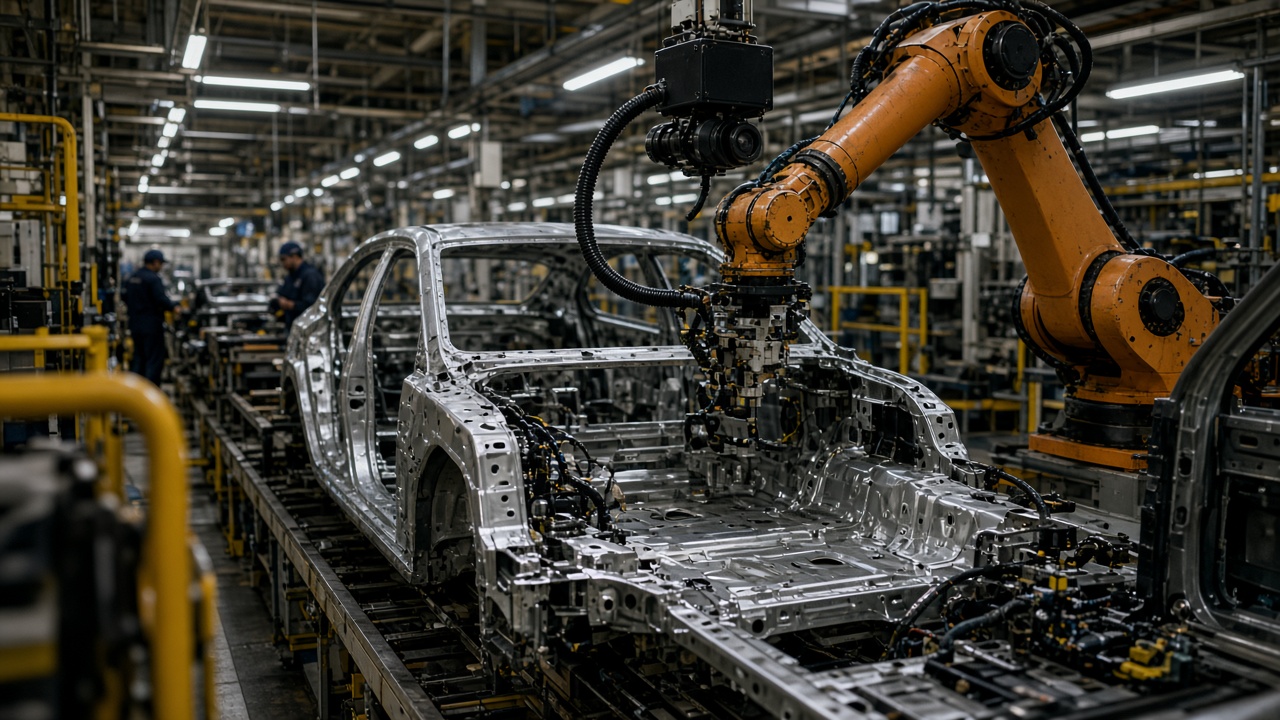
Preferred Networks began shipping bundled edge vision models to Toyota Motor assembly regions this week, letting lines detect torque-sequence errors and paint-surface defects on local servers without routing plant video through public cloud APIs.
What the bundle includes
The PFN Edge Inspect stack combines convolutional models trained on Toyota-specific defect libraries with a lightweight runtime that runs on NVIDIA Jetson-class racks already used for safety monitoring. Plants in Aichi, Fukuoka, and Miyagi receive October deliveries first, according to people briefed on rollout schedules. Each site gets two inference nodes for redundancy and a console that integrates with existing andon boards when confidence scores exceed plant thresholds.
Toyota's manufacturing IT group signed off on air-gapped update procedures: model weights arrive on encrypted drives audited by plant security, addressing trade-secret concerns that slowed earlier cloud-pilot programs. Preferred Networks handles retraining at a Toyota-affiliated data enclave rather than on PFN's general cloud.
Why on-prem won the bake-off
Automakers exporting from Japan face customer audit clauses on imagery leaving the factory floor. Cloud inference also struggled with millisecond latency on high-speed welding lines where PFN's local stack claims sub-40-millisecond inference on 1080p feeds. Toyota pilots in 2025 showed false-positive rates dropped when models saw line-specific lighting profiles unavailable in generic cloud datasets.
Competing bids from cloud hyperscalers emphasized scale and MLOps tooling, but Toyota prioritized outage isolation after a 2024 third-party CDN outage paused unrelated quality dashboards at a Kyushu plant for six hours.
Workforce and union questions
Union shop stewards at one Aichi plant asked whether vision alerts will feed discipline systems or remain engineering diagnostics. Toyota's agreement with worker representatives limits automated alerts to maintenance tickets unless repeat defects correlate with training gaps, according to a plant communication circulated internally.
Preferred Networks staff will co-locate trainers for eight weeks at each site to tune thresholds, a services line item that boosts PFN revenue beyond license fees. Analysts covering Japanese industrial AI say services attach rates determine whether PFN can replicate the Toyota package at Mazda and Subaru lines now testing smaller pilots.
Export and standards angle
Defect models trained in Japan may transfer to Toyota's U.S. and Mexico lines only after revalidation under local lighting and supplier mix, Toyota engineers said in a September technology briefing. PFN's packaging includes documentation mapped to ISO/IEC 42001 AI management themes, easing audits when European customers ask how visual inference is governed.
Investors watch whether the October bundle accelerates PFN's path to sustained profitability after years of research-heavy losses. Near-term proof points are reduction in warranty paint claims and fewer line stops for manual reinspection, metrics Toyota reports quarterly at regional production meetings rather than in public filings.