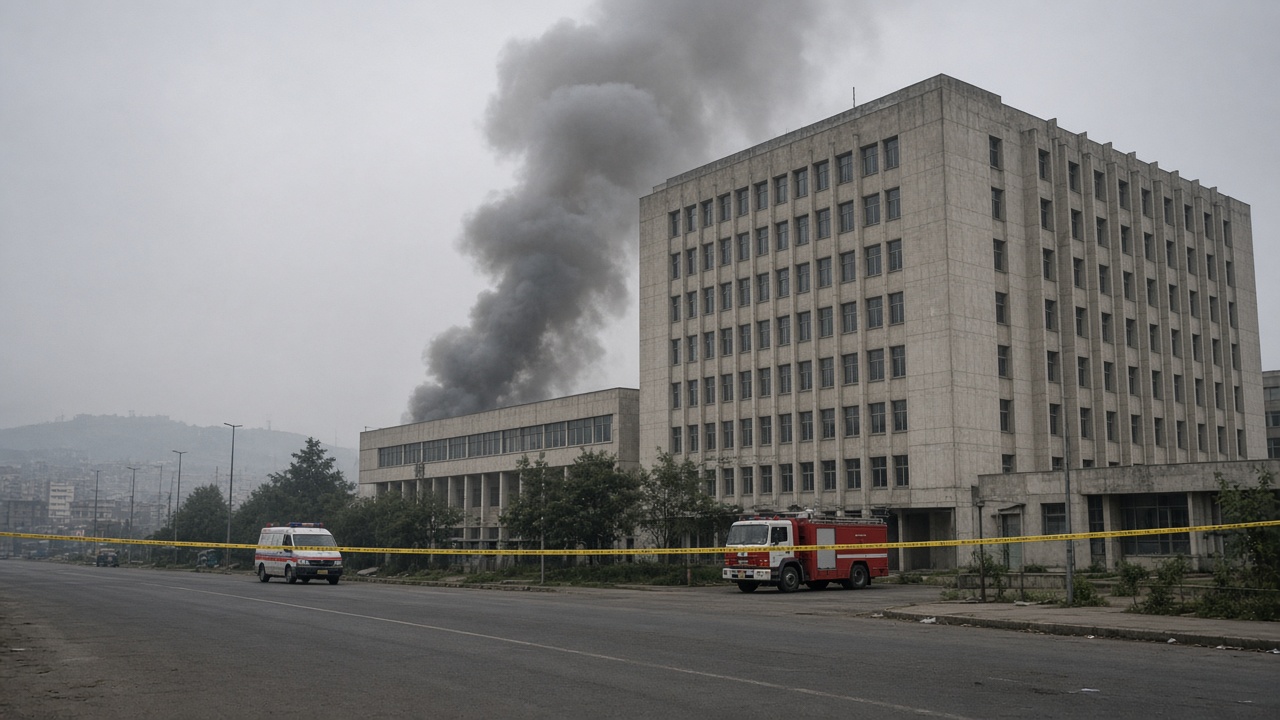
An explosion rocked Ethiopia’s Ministry of Defence in Addis Ababa early Thursday as Eritrea announced it was cutting all diplomatic ties with its neighbour, deepening a crisis that has already drawn Egypt and Sudan into a round of reciprocal expulsions and raised warnings of a wider Horn of Africa war.
Eritrea’s foreign ministry said Ethiopia’s decision to close its embassy in Asmara and declare 10 Eritrean diplomats persona non grata left Asmara with “no option but to reciprocate in kind and sever all diplomatic ties.” Addis Ababa said Eritrea was backing the Tigray People’s Liberation Front and the broader Ethiopian Peoples’ Forces Alliance for Survival, which has been fighting federal troops in northern Ethiopia since last week.
Diplomatic rupture and capital blast
The diplomatic break follows months of friction over Ethiopia’s push for Red Sea access and mutual claims of arming each other’s opponents. Eritrea rejected Ethiopia’s claims as part of an “agenda of incessant hostility,” while Ethiopian officials have portrayed Eritrean support for rebel groups as the trigger for the latest offensive.
In Addis Ababa, residents and diplomats reported an explosion at the defence ministry compound in the early hours of Thursday. AFP quoted a diplomatic source as saying small drones were the most probable cause. Rebel forces have used drones against government airbases before, according to conflict monitor ACLED, though Ethiopia’s military operates a far larger unmanned fleet.
Al Jazeera’s bureau chief in Ethiopia, Mohammed Taha Tawakel, reported that pro-government forces have advanced in Tigray, taking several towns and moving closer to the regional capital Mekelle. In Afar, a pro-government militia said Thursday it had recaptured Erebti with Ethiopian air support after rebel fighters seized the town earlier in the week.
Regional spillover fears
The fighting is no longer confined to the north. Egypt ordered an Ethiopian diplomat to leave on Thursday after Addis Ababa expelled an Egyptian envoy, state-linked media in Cairo reported. The exchange sits atop a longer dispute over Ethiopia’s Grand Ethiopian Renaissance Dam, which Egypt treats as a threat to its Nile water share.
Sudan’s military-led government has also said Ethiopia was harbouring rebels fighting in Sudan’s own civil war, charges Addis Ababa denies. Ahmed Soliman, a senior research fellow at Chatham House, told Al Jazeera the conflicts in Ethiopia and Sudan have become “more interconnected,” with Egypt drawn in through its Nile rivalry.
Laura Hammond of SOAS University of London said Eritrea could deepen its involvement inside Tigray if the war continues, while Martin Plaut, a Horn of Africa analyst, warned that “it would only require a spark to ignite a conflagration” involving Ethiopia, Eritrea and Sudan.
What happens next
Neither government has publicly offered a mediation channel comparable to the talks that ended the last Tigray war. African Union calls for an immediate halt have not produced a ceasefire on the ground, and humanitarian agencies are bracing for displacement if fighting reaches urban centres such as Axum, Shire and Mekelle.
Western capitals have issued generic appeals for restraint but have not announced new sanctions or peace missions. For now, the measurable shift is diplomatic: two states that only recently normalised relations after a 1998–2000 border war are again without embassies, while gunfire and air strikes continue across three northern regions.