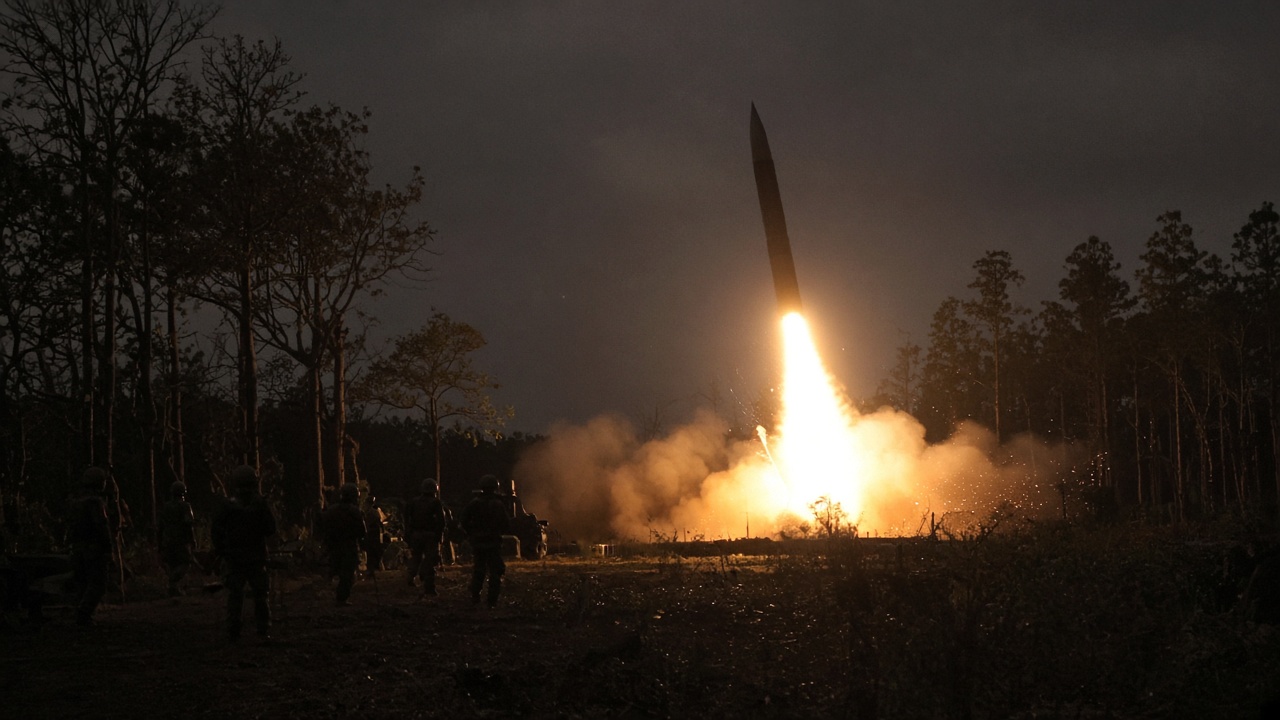
President Volodymyr Zelenskyy said on Wednesday that Ukraine had fired its domestically developed FP-7 tactical ballistic missile in combat for the first time, posting nighttime launch footage on Telegram and telling engineers that manufacturing would follow the debut strike. Ukrainian officials did not identify the target, location, or battle damage, and independent analysts have not yet verified the claim against open-source imagery.
What Kyiv disclosed
Zelenskyy's message was blunt: "Ukrainian tactical ballistic missile FP-7. First combat use. Thank you for the result. Next — production." His communications adviser later told reporters that the military would not disclose what the round struck, a posture Kyiv has used for other long-range systems to avoid tipping Russian air defenses.
The FP-7 is built by Ukrainian defense firm Fire Point, which also produces the Flamingo cruise missile family. Company materials and Ukrainian media briefings have described the weapon as a ground-launched ballistic round with a warhead on the order of 150 kilograms and peak speeds approaching 1,500 meters per second — specifications that, if accurate, would place it in the same tactical class Russia routinely fires at Ukrainian cities.
Why a ballistic option matters
For more than three years, Russia's Iskander and other ballistic systems have given Moscow short flight times and concentrated kinetic energy against hardened targets, while Ukraine leaned heavily on drones and Western-supplied rockets for deep strikes. A Ukrainian ballistic line would not erase that gap overnight, but it would give planners a munition that travels on a different trajectory than slow-moving Shahed drones or terrain-hugging cruise missiles, potentially complicating Russian intercept routines.
Western officials have long encouraged indigenous production as a hedge against fluctuating foreign aid. The FP-7 debut arrives days after Zelenskyy told the United Nations General Assembly that Ukraine must be able to strike inside Russia to end the war, and after Ukrainian forces have expanded a portfolio of home-built drones and modified missiles. Whether the FP-7 can be built at scale inside a defense industry still absorbing daily Russian attacks remains the open question Zelenskyy acknowledged with his "next — production" line.
Verification and naming puzzles
Defense analysts noted that Zelenskyy previously referenced a weapon called Pelican in connection with a September strike on Moscow, and Ukrainian outlets have speculated that Pelican may have been an operational name for the FP-7 or a related variant. Fire Point has not published serial production numbers, and Ukraine's government has not said how many FP-7 rounds exist beyond the one shown in the launch video.
The Kremlin did not immediately comment on the Telegram announcement. Russia's defense ministry continues to claim intercepts against Ukrainian long-range weapons, but without coordinates from Kyiv, outside observers cannot yet match the FP-7 claim to a specific crater or facility hit.
What comes next
Ukrainian parliamentary defense committees are expected to press ministers this month on funding for missile plants and electricity supply to factories that have moved underground or westward since 2022. NATO members, meanwhile, will watch whether the FP-7 uses wholly domestic components or depends on restricted foreign electronics — a compliance issue that has slowed other Ukrainian missile programs.
For now, the milestone is institutional as much as tactical: Ukraine has joined a small group of states that can design, test, and — according to its president — employ a tactical ballistic missile in wartime. The strategic effect will hinge on whether Wednesday's launch becomes a one-off demonstration or the first entry in a sustained magazine that Russian commanders must plan against.