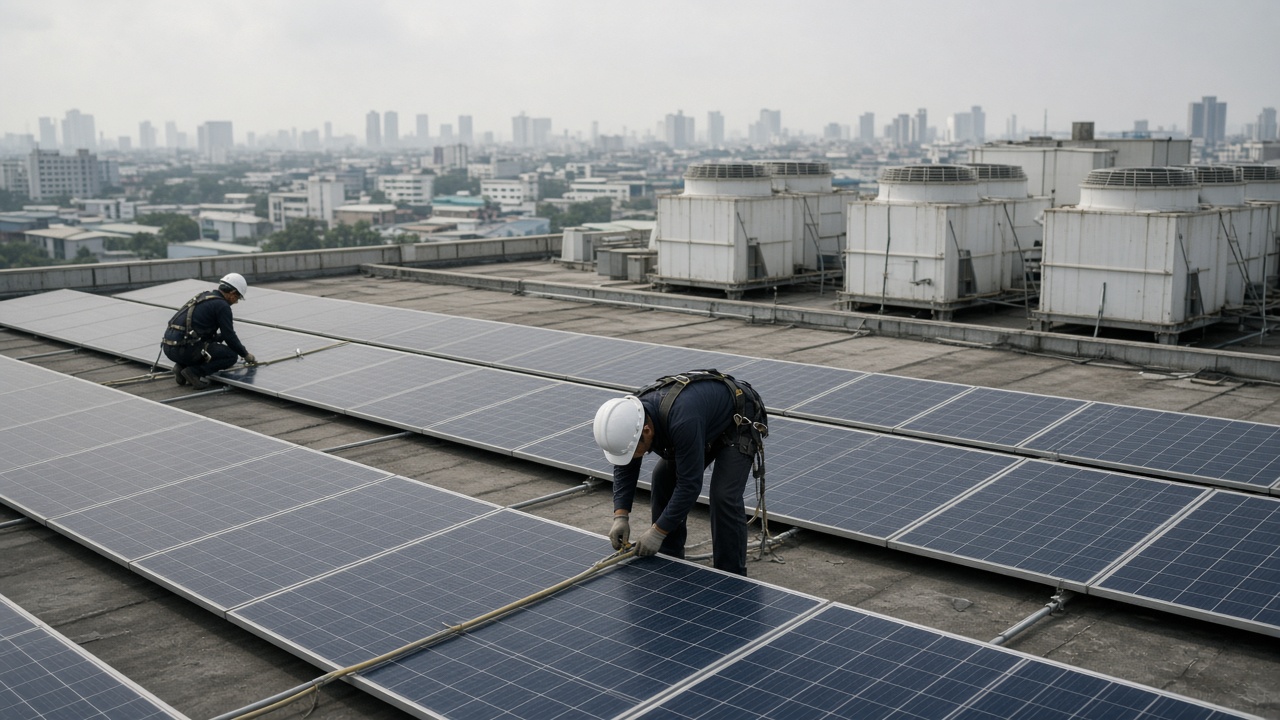
Keppel DC REIT executed a 15-year power purchase agreement on Thursday for a 15 megawatt rooftop solar system atop the Gul Way data centre annex, contracting Keppel’s own energy services arm to build and operate the array before tenants move into the expanded white space in 2027.
Why the REIT moved now
Singapore’s data centre moratorium eased only for projects that meet tightened power and carbon intensity benchmarks set by the Economic Development Board and the Energy Market Authority. Keppel’s sponsor had already committed to district cooling tie-ins at Gul; the solar PPA adds a contracted renewable slice that managers can cite in green lease riders demanded by hyperscale and financial-services clients. The tariff band is fixed in real terms with a small annual escalator tied to consumer price inflation, not volatile wholesale electricity pool prices that spiked during 2024 fuel shocks.
Technical footprint
Fifteen megawatts of DC capacity on a rooftop implies roughly 18,000 panels across the annex’s flat roof and partial carport structures, feeding inverters housed in a refurbished switchgear room on level two. Engineers plan to synchronise commissioning with the annex’s chilled-water plant so that daytime solar generation overlaps peak cooling load, reducing draw from the grid during the highest carbon intensity hours. Battery storage is not part of this phase; Keppel left open a future retrofit if EMA expands incentives for behind-the-meter storage at industrial sites.
Investor read-through
Units traded flat on the announcement, but REIT analysts noted the deal as a template for Keppel’s other Singapore assets where roof rights remain unused. Frasers and Mapletree industrial trusts face similar tenant questions on scope 2 emissions; Keppel’s early PPA may help renewal talks with cloud providers publishing science-based targets. Debt investors watching interest coverage ratios care less about the solar headline than about whether the PPA reduces operating expense volatility over the lease term.
Policy context
Singapore raised its carbon tax trajectory and required large emitters to submit granular energy reports. Data centres are conspicuous users; a 15MW solar block does not eliminate backup diesel generators required for tier-four uptime, but it signals compliance intent to regulators reviewing expansion applications. EMA’s grant schemes for solar on warehouses apply here, though Keppel declined to disclose the exact subsidy quantum until financial close on construction loans.
Tenant implications
Existing Gul campus tenants may negotiate green power allocations once the array is live; the REIT’s prospectus supplement says priority goes to the annex anchor rack, with spillover credits sold as renewable energy certificates if surplus generation occurs on low-load Sundays. Contractors on site said cabling work starts in November, with grid tie-in tests scheduled before the monsoon season peaks. For Singapore’s data centre cluster, the deal is modest in megawatts but clear in direction: renewable contracting is becoming part of the lease stack, not a voluntary brochure claim.