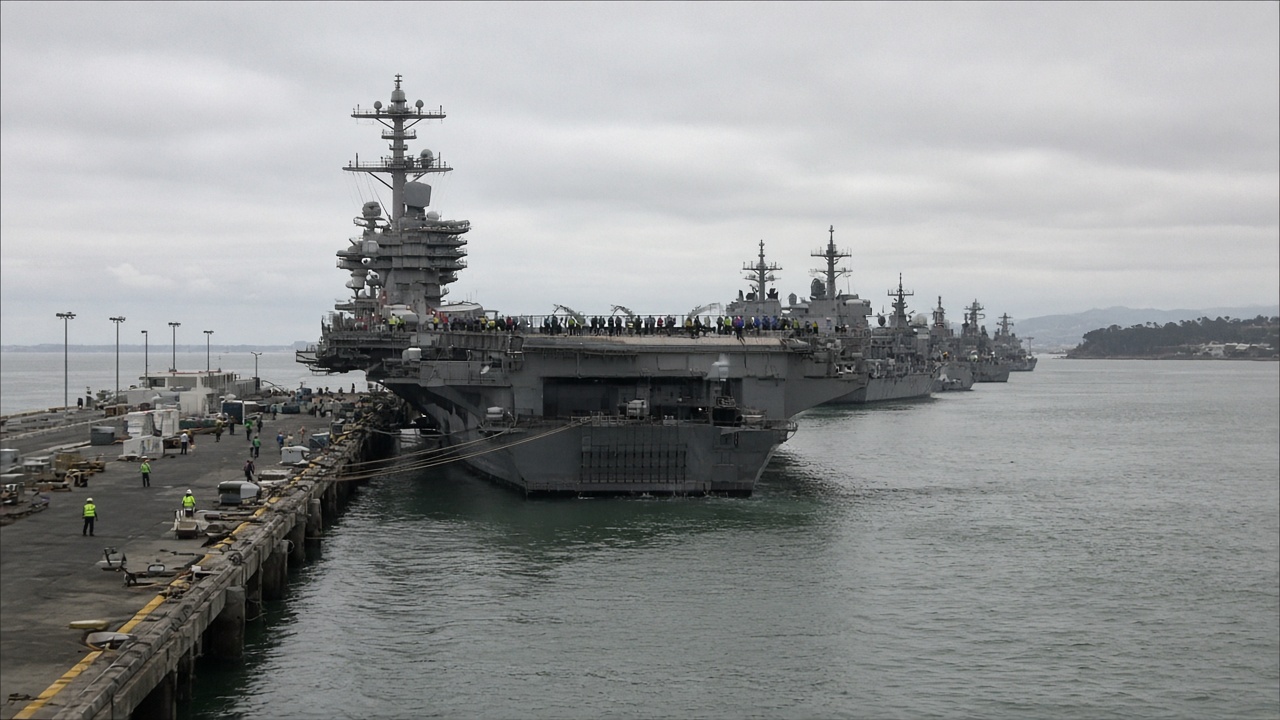
The USS Theodore Roosevelt carrier strike group and the Makin Island amphibious ready group carrying roughly 2,000 Marines departed San Diego on Thursday, U.S. officials said, in the latest surge of American naval power toward the Middle East as the war with Iran enters its eighth month without a diplomatic off-ramp.
A U.S. official told Al Jazeera that the Roosevelt group and the Makin Island force were part of a buildup that would eventually place three carrier strike groups and two amphibious landing groups around Iran, with the full deployment expected to finish by November. The movement comes days after President Donald Trump signaled to aides that he may resume strikes on Iran after the November midterm elections, according to reporting by the Wall Street Journal and others.
Hormuz tanker fire raises shipping risk
Maritime security agencies reported fresh danger in the Strait of Hormuz at the same time the carrier groups were getting under way. The United Kingdom Maritime Trade Operations center said a supertanker with capacity for about 2.5 million barrels was struck by an unknown projectile and caught fire while transiting the waterway. Iran's Fars News Agency also reported the incident. Neither account immediately identified the vessel or casualties, but the strike underscored why insurers and oil traders have kept Brent crude above pre-war levels even when talks flicker.
Indirect negotiations between Washington and Tehran have stalled. U.S. officials rejected an Iranian proposal to reopen Hormuz transit in exchange for lifting the American blockade, according to CNBC and other outlets, leaving tanker operators to route around risk rather than bet on a quick ceasefire.
Sanctions and carrier math
The Treasury Department announced a new sanctions package Thursday targeting Iran's state-owned rail operators, automotive suppliers, and a Russia-linked financial network U.S. officials described as a sanctions-evasion channel. The measures hit firms in the United Arab Emirates, Hong Kong, Turkey, and Indonesia, widening the economic pressure parallel to the naval surge.
For military planners, the Roosevelt deployment fills a gap left by carriers already operating in the region. American bombers have used bases in the United Kingdom, including RAF Fairford, for strikes tied to the conflict, while carrier aviation provides persistent presence off Iran's coast. Adding Marines aboard Makin Island signals readiness for contingency operations beyond air strikes, though the Pentagon has not published a formal mission statement for the new groups.
What allies are watching
Gulf governments have condemned separate attacks on energy infrastructure, including a drone strike on a power station serving Medina in Saudi Arabia that Riyadh blamed on Iran-backed Houthis. Turkey and Qatar issued their own condemnations of that strike earlier Friday on the wire, keeping diplomatic attention split between Yemen-linked incidents and the Hormuz shipping lane.
Secretary of State Marco Rubio's decision to shorten the stay of Iran's delegation in New York after Qatari-mediated talks failed to produce a breakthrough, as reported Thursday, highlighted the mistrust on both sides. Iranian President Masoud Pezeshkian said Tehran has not avoided dialogue even while under attack, but U.S. officials have treated recent proposals as insufficient.
Until the Roosevelt and Makin Island groups arrive, the immediate question for markets and militaries is whether the Hormuz tanker fire marks an isolated hit or the start of another week of escalatory strikes on energy corridors. Shipping insurers will price that uncertainty long before the third carrier is on station.