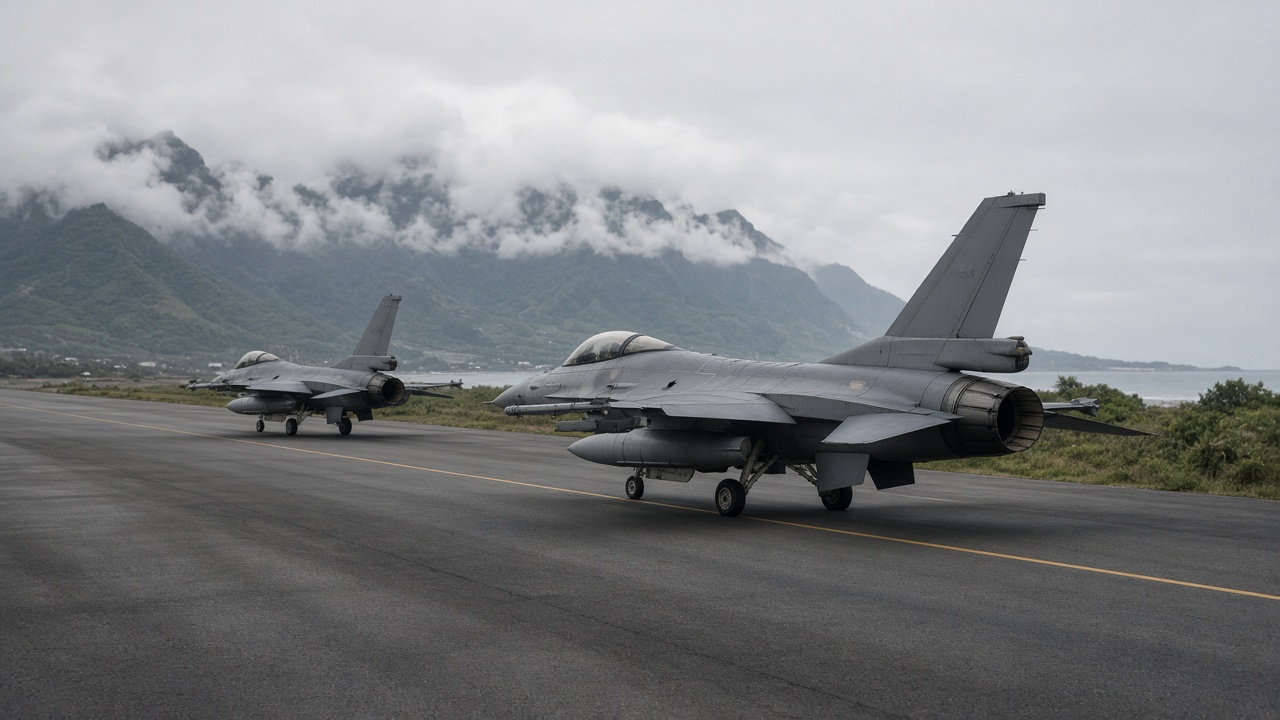
Taiwan’s air force received the first two F-16C Block 70 fighters at Chihhang Air Base in Taitung County on Friday, completing a trans-Pacific delivery leg that aviation trackers had followed since the jets left Hawaii earlier in the week.
The single-seat aircraft, tail numbers 6727 and 6728, are the leading edge of a 66-jet package ordered from the United States. Ministry of National Defense officials had confirmed the schedule would hold if weather permitted, inviting media to the base for arrival imagery as the island marks National Day preparations elsewhere in Taipei.
Why the delivery matters
Taiwan has not taken delivery of a factory-new fighter in 29 years, making Friday’s landing a symbolic as well as operational milestone. The Block 70 configuration adds advanced avionics and radar upgrades over earlier F-16V conversions, giving the air force a mix of modernized legacy jets and fresh airframes as cross-strait military activity remains intense.
The jets departed the United States on Aug. 17 but remained in Hawaii for an extended period, a delay Defense Minister Wellington Koo had previously attributed to coordination and readiness checks rather than a cancellation of the program. Their arrival coincides with renewed U.S. congressional pressure to expedite other defense items tied to Taiwan, including roughly $1.3 billion in congressionally approved assistance and a separate $14 billion arms package still moving through the pipeline.
East coast airspace activity
Aviation enthusiasts monitoring open flight data spotted an unidentified drone track off Taiwan’s eastern coast Friday morning, labeled on tracking sites with the call sign TU501. Taiwan media cautioned that public transponder data alone cannot confirm the platform or its mission, and the defense ministry did not tie the track to the F-16 arrival.
The eastern corridor is sensitive after recent MQ-9B tests at Hualien and routine Chinese pressure operations around the island. For now, the air force’s public focus stayed on integrating the two new fighters into training and maintenance cycles at Chihhang, home to units that cover Taiwan’s southeastern approaches.
What comes next
Remaining Block 70 deliveries will roll out on a schedule the ministry has not fully disclosed, but planners must balance pilot conversion, spare-parts stockpiles and hangar capacity with political expectations in Washington and Taipei. Friday’s pair is a down payment on a fleet modernization effort that will stretch well into the decade.
Lawmakers in the United States are simultaneously debating how quickly other systems — including munitions and air-defense batteries — can follow the fighters. For Taiwan’s military, the immediate task is turning two new tail numbers into operational squadrons without disrupting the National Day aerial rehearsals already roaring over the capital.