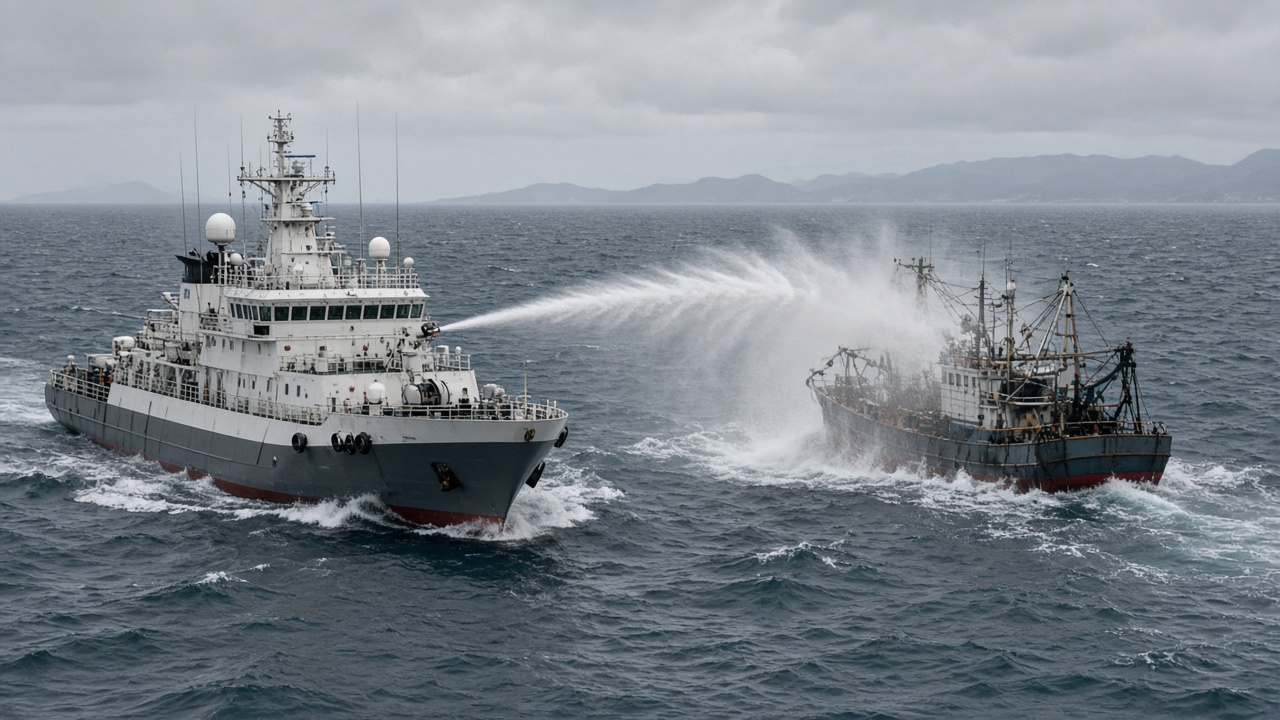
Taiwan’s Coast Guard Administration said its Yunlin patrol ship used water cannons Thursday to force the Chinese fishing boat Jin Sha to leave restricted waters east of Dongsha Island after the vessel ignored repeated broadcast orders to weigh anchor. A second boat, Yue Hui Dong Yu 75066, complied earlier and sailed away without escalation, the agency said in statements issued Friday.
How the encounter unfolded
According to the CGA, the Yunlin found both vessels about 27 nautical miles east of Dongsha — roughly eight nautical miles inside Taiwan’s restricted zone — illegally anchored and fishing. Officers warned both crews to depart. The Yue Hui Dong Yu raised anchor and left; the Jin Sha did not.
After three unsuccessful broadcast warnings, the Yunlin fired water cannons from about 200 meters, spraying upward for 30 seconds and then toward the Jin Sha’s wheelhouse for 90 seconds, the agency said. The Jin Sha then weighed anchor and moved outward, and the patrol ship stopped using the cannons once the trawler was under way.
Breakdown, meals, and handover
While leaving, the Jin Sha lost propulsion, the CGA said. The Yunlin stayed alongside, launched a small boat to check the crew, and confirmed no injuries. At the crew’s request, the patrol ship later provided 35 hot meals before towing the disabled trawler out of restricted waters.
Shortly before 6:15 a.m. Friday, the agency said, the Jin Sha was handed to the Chinese work vessel Ocean Petroleum 681 for the return tow, with Taiwan patrol units monitoring until the transfer completed. The sequence mixed enforcement with the humanitarian assistance the CGA says it offers even during expulsion operations.
Why Dongsha matters
Dongsha lies about 450 kilometers southwest of Kaohsiung and hosts roughly 300 coast guard personnel. It is one of two island groups Taiwan controls in the South China Sea, alongside Taiping Island far to the south. Beijing claims the surrounding waters; Taipei enforces prohibited and restricted zones that mainland fishing fleets frequently test.
The CGA urged Chinese authorities to restrain fleets, saying recent incursions involved multi-ton catches that damage local ecology. For Taiwan’s government, Thursday’s episode is another data point in a summer of tighter patrols — one that ended without casualties but with an unusually public account of water-cannon use and a tow to a mainland-linked workboat.
Defense officials in Taipei did not link the fishing dispute to the air force’s Double Ten National Day flyover rehearsal over the capital earlier Friday, but the timing underscores how maritime enforcement and military symbolism run on parallel tracks in Taiwan’s October calendar. Legislators from the governing Democratic Progressive Party praised the CGA for documenting each warning step; opposition lawmakers asked whether radio de-escalation channels with Beijing remain active when encounters escalate to water cannons.