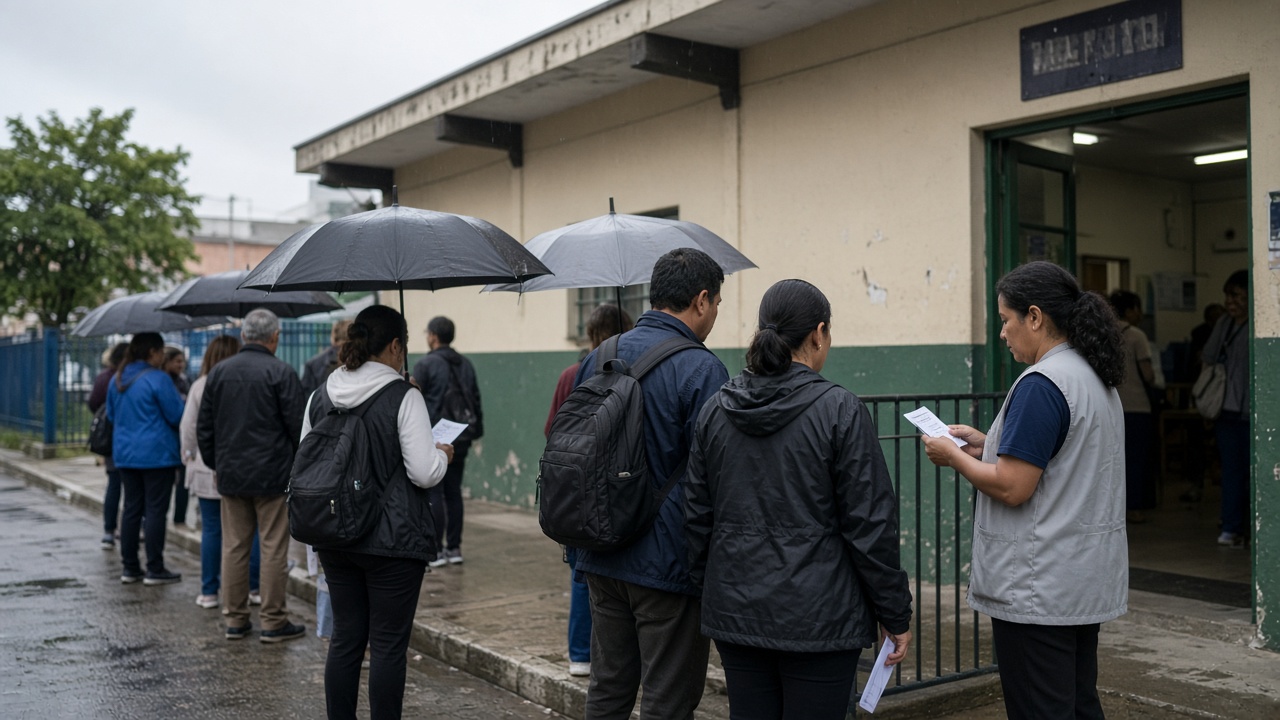
Brazilians began voting Sunday in a presidential first round that reprised the country’s bruising 2022 contest—only this time President Luiz Inácio Lula da Silva is defending the Planalto against Senator Flávio Bolsonaro, the son of the jailed former president he narrowly defeated four years ago. Polls heading into election day showed neither man likely to clear the 50 percent valid-vote threshold needed to win outright, setting up an almost certain runoff on October 25.
What is on the ballot
Voters across Brazil’s 26 states and the Federal District are choosing a president, all 513 seats in the Chamber of Deputies, a third of the Senate, and governors in every state. Thirteen candidates qualified for the presidency, but opinion surveys consistently placed Lula and Flávio Bolsonaro far ahead of the field, together drawing more than four-fifths of intended votes in late-September polling.
The race is personal as well as ideological. Jair Bolsonaro, Flávio’s father, is serving a 27-year sentence after Brazilian judges found he plotted a coup to overturn his 2022 loss, a scheme Brazilian investigators said included plans to kill Lula. Flávio has promised to pardon his father if elected, while Lula, 80, is seeking a fourth presidential term and argues that a Bolsonaro return would reopen the democratic crisis that followed the last transfer of power.
What the polls suggest
Surveys registered by Brazil’s Superior Electoral Court showed Lula with a narrow first-round lead. A Quaest poll cited by Reuters on the eve of voting put Lula at 46 percent and Flávio at 45 percent among valid votes—both short of an outright win. In a hypothetical second round, the same poll showed Flávio at 44 percent and Lula at 42 percent, underscoring how much undecided and minor-candidate support could swing the finale.
Prediction markets on U.S. platforms have priced Flávio slightly ahead in the overall contest, but Brazilian pollsters caution that online contracts and telephone surveys measure different things. Election officials emphasize that only the electronic count after Sunday’s close will show how firm each camp’s floor really is.
How results will emerge
Brazil uses nationwide electronic voting machines, and the Superior Electoral Court typically releases near-complete presidential results within hours of polls closing at 5 p.m. Brasília time. State-level races can take longer, but by Sunday night analysts expect clarity on whether Lula or Flávio finished first and how much distance separates them from the rest of the field.
International observers and foreign ministries will watch turnout in the Amazon and the industrial southeast, where Lula’s Workers’ Party has deep roots, and in evangelical-heavy districts where the Bolsonaro movement has expanded since 2022. A high abstention rate—or a stronger-than-expected showing by center-right governor Romeu Zema or other challengers—could still reshape coalition math before the runoff.
What comes next
If no candidate crosses 50 percent of valid votes, the top two finishers advance to the October 25 runoff. Campaigns would then pivot from multi-candidate messaging to a straight choice between Lula’s left-leaning economic agenda and Flávio’s promise to unwind parts of the current government’s environmental and social policies while restoring his father’s political movement.
Financial markets in São Paulo have traded cautiously through the final week, with investors weighing the prospect of policy continuity against the volatility that accompanied the 2022 transition. Whichever candidate leads after Sunday’s count will claim momentum, but Brazilian runoffs have often tightened as smaller-party voters choose sides—making tonight’s tally a starting line, not a coronation.