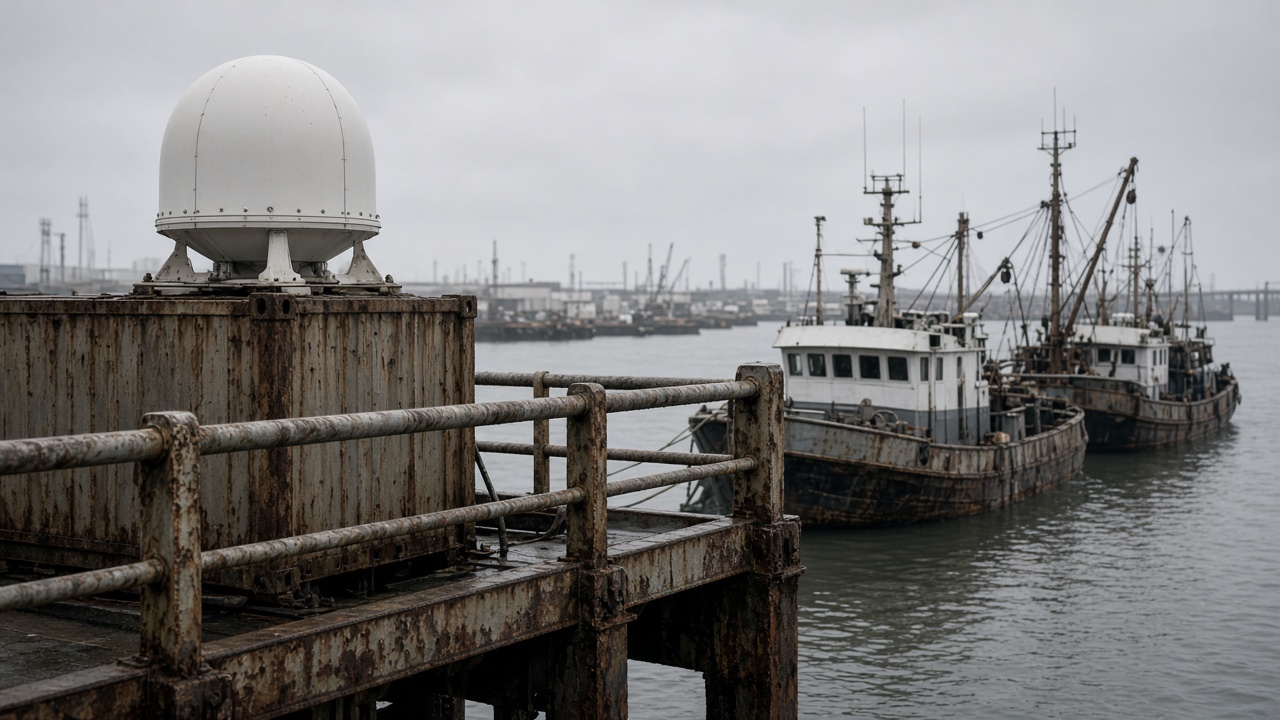
Hon Hai Precision Industry Co. technicians bolted low-Earth-orbit antenna modules to a Kaohsiung harbor pier Saturday morning, preparing weeklong sea trials with two inshore fishing associations that want satellite backup when cellular base stations trip during typhoon swells, according to harbor police logs and a company filing summary InfoHandle reviewed. The test does not replace Taiwan’s terrestrial 5G build-out, but it gives Hon Hai a domestic reference site before export customers ask for harbor-mounted kits that can be installed without permanent towers.
What the harbor rig includes
Each module pairs a phased-array panel with a sealed power cabinet sized for diesel-generator handoffs. Cables run to a shipping-container shelter where engineers can swap firmware over wired Ethernet because over-the-air updates are disabled until the National Communications Commission signs off on radiation reports. Hon Hai said the harbor location lets crews simulate pitch and roll without leaving protected waters.
Fishermen volunteers will carry handheld routers that bond cellular and satellite paths. If LTE drops below a set threshold, traffic should fail over within eight seconds—a target harbor safety officers want for distress messaging even when voice calls congest.
Regulatory path
The NCC has not licensed consumer LEO terminals for roaming fleets; this trial operates under a temporary experimental permit tied to Hon Hai’s research institute registration. Staff must log transmitter azimuth every four hours and shut down if interference complaints arrive from Kaohsiung port radar operators.
Hon Hai’s filing noted the experiment is separate from Digital Ministry debates on 6G auction calendars. Satellite backhaul is treated as a maritime safety pilot, not a mobile carrier product.
Why Kaohsiung first
Southern harbors see faster weather swings than Taipei, and fishing associations documented dozens of incidents last season where crews lost data links while still within sight of shore. City marine bureau staff attended Saturday’s install to map emergency channels that could carry automatic identification system supplements if the trial succeeds.
Export logic matters too: Hon Hai customers in Southeast Asia want proof that harbor mounts survive salt spray without sending teams to open ocean. Kaohsiung’s container terminals provide a controlled backdrop with crane interference patterns similar to Busan and Haiphong.
Commercial implications
If failover metrics hit targets, Hon Hai could bundle antenna cabinets with existing server-rack power shelves sold to edge data centers—a cross-sell slide investors saw in August but without a live harbor photo until now. Telecom carriers remain skeptical; Chunghwa Telecom Co. told regulators it prefers fiber backhaul to offshore wind substations rather than LEO links for grid telemetry.
Until NCC publishes a consultation, the story is engineering: harbor-mounted LEO modules, fishing-fleet failover tests, and a weekend install that turns Kaohsiung into Hon Hai’s domestic satellite bench.