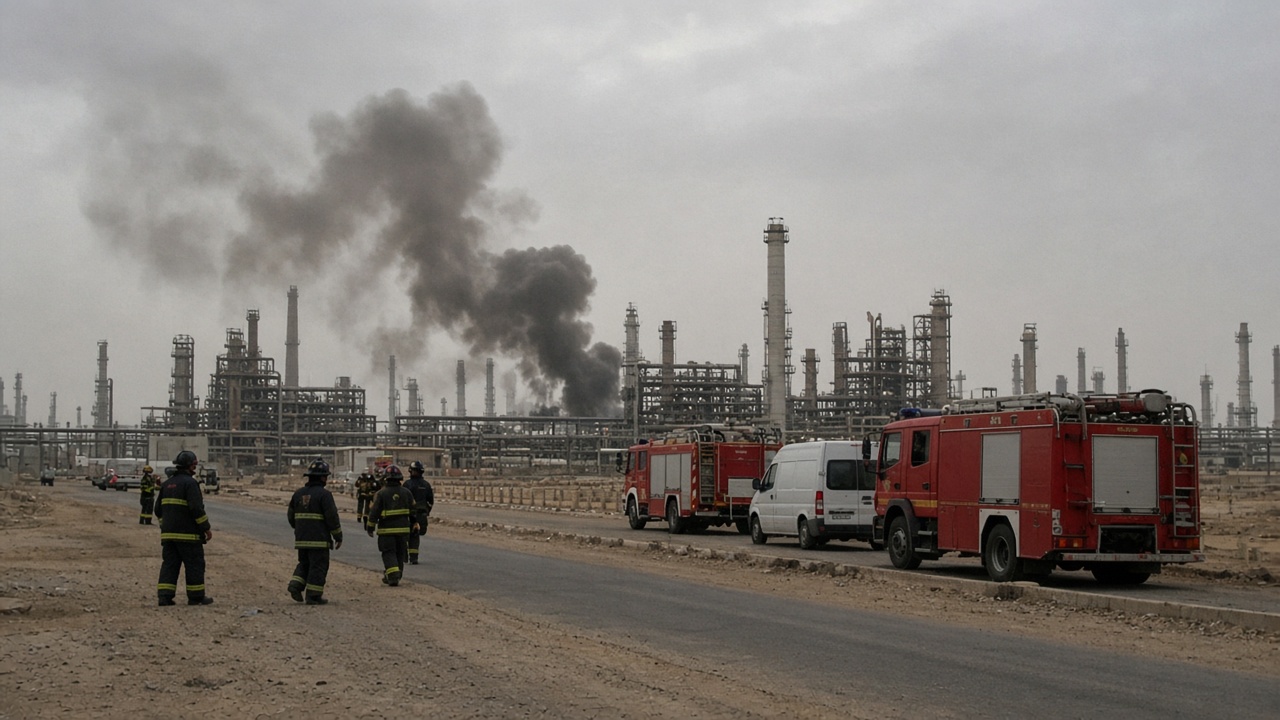
Flames and smoke rose from an Aramco facility south of Riyadh on Saturday afternoon as Yemen’s Iran-aligned Houthis claimed a coordinated strike on Saudi oil infrastructure and Riyadh answered with a heavy wave of airstrikes on the Yemeni capital. An AFP journalist at the scene saw firefighters working the blaze at the refinery complex while ambulances and police vehicles stood nearby; Saudi authorities had not issued a detailed public account of damage by late Saturday.
What the Houthis claimed
Houthi military spokesman Yahya Saree said the group targeted an oil facility in Riyadh with ballistic missiles and drones, adding that fires broke out at the sites struck. The claim came hours after Houthi-affiliated Al-Masirah television reported that Saudi aircraft had hit Sanaa with 26 strikes, part of a broader exchange that has accelerated since fighting reignited in July.
The Houthis have repeatedly threatened Saudi energy assets during the latest round of hostilities, which followed Saudi strikes on Sanaa airport and a Houthi push along Yemen’s Red Sea coast. Saturday’s visible fire at a major refining node near the Saudi capital is the most concrete sign yet that those threats are landing on infrastructure, not only remote fields.
Saudi retaliation and the Sanaa corridor
While Riyadh has often kept details of counter-strikes sparse, Houthi media portrayed Saturday’s bombardment of Sanaa as retaliation for earlier Saudi attacks, including a Thursday night raid the group said was the first on the capital since the current escalation began. Houthi sources also said Saudi forces carried out 94 strikes on areas under their control in the preceding 24 hours, with ground fighting concentrated around Taiz, where both sides reported dozens of combat deaths on Friday.
The pattern—cross-border missile and drone salvos answered by air campaigns over Houthi-held cities—mirrors earlier phases of the Yemen war, but the timing matters for global markets already on edge over Middle East shipping and crude supply.
Oil markets and the G7 buffer
Traders have been watching Yemen’s spillover into the Gulf closely since tanker incidents and Houthi naval threats resurfaced alongside the land war. Saturday’s blaze near Riyadh lands in the same week that Group of Seven energy ministers committed to a coordinated release of emergency oil stocks, front-loading diesel draws in the first three weeks of a 100-million-barrel program coordinated with the International Energy Agency.
Analysts caution that a single refinery fire does not by itself reset global balances, but sustained hits on Saudi downstream assets would test both physical supply and the political willingness of importers to keep releasing stocks if prices spike again.
Humanitarian pressure
Inside Yemen, aid agencies warn that renewed urban bombing is compounding hunger in a country where the World Food Programme said on Friday that roughly three-quarters of the population cannot meet basic food needs. Port closures, currency collapse, and interrupted fuel imports have already strained hospitals; additional strikes on Sanaa raise the risk that civilians bear the brunt of a conflict framed on both sides as an existential struggle over territory and maritime control.
What remains unconfirmed
Saudi Aramco and the Saudi government had not published a damage assessment by the time AFP filed its eyewitness report. Independent verification of Houthi launch sites, intercept data, and refinery throughput losses typically lags by days. Until Riyadh or Aramco speaks, outside observers are left with satellite imagery, shipping schedules, and on-the-ground reporting to judge whether Saturday’s fire marks a one-off escalation or the opening of a sustained campaign against Saudi energy nodes.