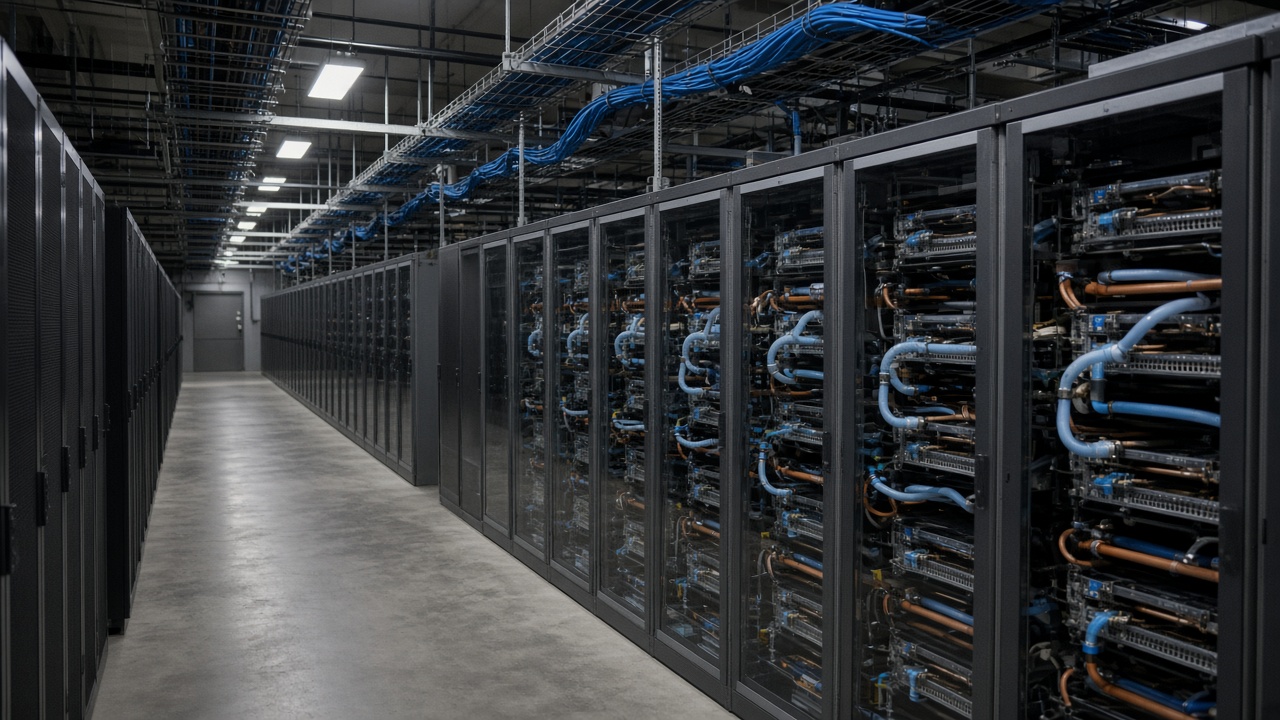
Yotta Data Services began running workloads on the first NVIDIA Blackwell B300 racks at its Greater Noida hyperscale campus this week, activating a slice of the 20,736-GPU supercluster it promised would go live by mid-2026.
Chief executive Sunil Gupta told industry forums the initial tranche is reserved for IndiaAI Mission applicants and NVIDIA DGX Cloud customers, not walk-in startups. More than 10,000 of the ordered GPUs remain earmarked for public-sector language model projects such as Bhashini and private foundation-model labs that have been queueing for domestic compute since export controls tightened on advanced accelerators.
Infrastructure specs
Yotta’s February announcement described liquid-cooled HGX B300 servers linked by 800-gigabit InfiniBand fabrics and 40 petabytes of parallel file storage. The Greater Noida D2 building offers 60 megawatts today with expansion headroom toward 250 megawatts on the same plot, part of a broader gigawatt roadmap the company has floated ahead of a potential initial public offering.
NVIDIA committed to a four-year, more than $1 billion DGX Cloud engagement inside the cluster, consuming roughly half the new capacity for Asia-Pacific customers, according to Yotta’s press materials. Reuters reported the company is simultaneously raising up to $1.2 billion from investors to fund expansion before a listing that could arrive as early as this financial year.
Sovereign AI angle
India’s policy goal is to host frontier training inside national borders rather than relying solely on U.S. hyperscalers. Yotta’s deployment is among the first physical evidence that Blackwell-class hardware is actually racked in Noida—not just ordered on slide decks.
Gupta said in August interviews that Yotta is also negotiating a follow-on order for Vera Rubin accelerators destined for a 120-megawatt Delhi facility targeted for 2027. That deal is separate from the Blackwell tranche now humming in Uttar Pradesh.
Customer reality
Developers should expect rationing. Yotta already operates more than 10,000 older GPUs in production, with another 8,000 scheduled before the Blackwell ramp completes. Mission applicants who received provisional approvals may still wait weeks for dedicated partitions while NVIDIA and Yotta finish acceptance testing on power and cooling redundancy.
For the broader market, the milestone matters because it sets a domestic price anchor. Once public tenders cite rupee-per-GPU-hour on Indian soil, startups can model costs without assuming Singapore or U.S. regions. The hard part—keeping those racks fed with reliable power through Uttar Pradesh summers—now moves from procurement slides to operations logs.