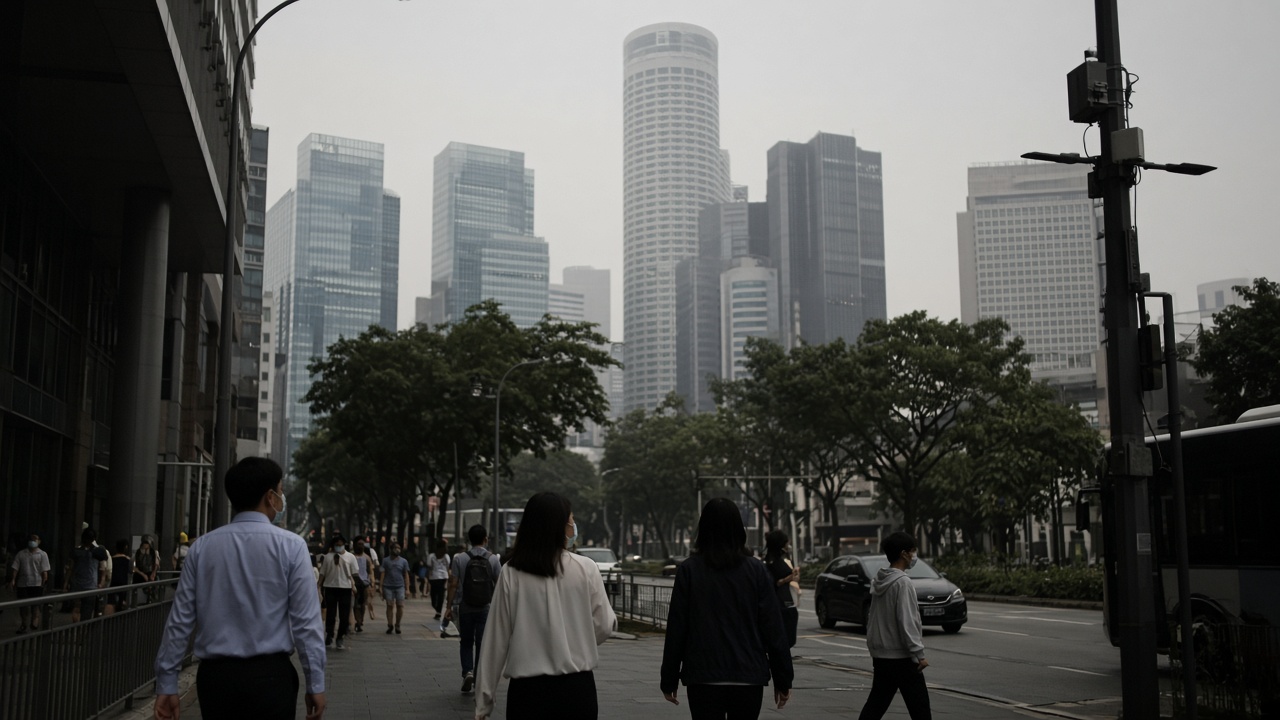
Singapore’s central region slipped back into unhealthy air overnight, undoing a few hours of relief that had arrived late Saturday. National Environment Agency readings show the 24-hour Pollutant Standards Index for the central zone climbing from 100 at 11 p.m. on 3 October to 103 at 3 a.m. on 4 October, then holding at 102 at the 7 a.m. update while other sectors remained in the moderate band.
How fast the air turned
Hazy skies had returned to downtown streets by Saturday afternoon, with the Straits Times photographing muted visibility along North Bridge Road around 1 p.m. The central region first crossed into unhealthy territory at 11 a.m. on 3 October—the first islandwide breach since 30 September—before easing slightly toward midnight.
That short moderation gave households a window to ventilate flats and schools a brief pause in haze protocols, but the overnight rebound means principals and employers must again treat central Singapore as the hot spot within an otherwise mixed map.
What the readings mean in practice
NEA classifies a 24-hour PSI above 100 as unhealthy. At that level, the agency advises the general population to reduce prolonged or strenuous outdoor exertion, while elderly residents, children, and people with chronic lung or heart conditions should minimize outdoor activity altogether. Saturday’s pattern—moderate readings in the high 80s to low 90s across most sectors with a central spike—suggests localized particulate loading rather than a uniform blanket, but the central band is where dense housing and the CBD concentrate daytime foot traffic.
Regional haze context
South-east Asia’s dry season often pulls smoke from biomass burning and industrial sources across the Strait, and Singapore’s compact geography leaves little room for pollutants to disperse before they register on the PSI network. NEA has not, in its public updates cited by local media this weekend, attributed the latest spike to a single upstream fire; investigators typically correlate satellite hotspots with wind fields before naming sources.
For residents who endured a similar central-region reading above 100 on 27 September, this weekend’s repeat reinforces that brief dips below the threshold do not mark the end of an episode—only a lull.
Schools, sport, and weekend plans
Although Sunday morning readings outside the central zone stayed moderate, youth sports leagues and outdoor markets that draw families from across the island must decide whether to proceed or shift venues. The Ministry of Education’s haze task force has kept schools open during recent episodes while tightening indoor exam conditions when PSI forecasts warrant; operators of open-air attractions face a narrower calculus because tourists cannot easily relocate once tickets are sold.
What to watch next
NEA’s three-hour PSI, updated more frequently than the 24-hour average, will show whether central readings stabilize or climb further if overnight winds stall. Until the agency forecasts a sustained return below 100, households in the central region should keep N95 masks accessible and monitor updates before scheduling strenuous outdoor work—a routine Singaporeans know well, even when the rest of the island still looks deceptively clear.