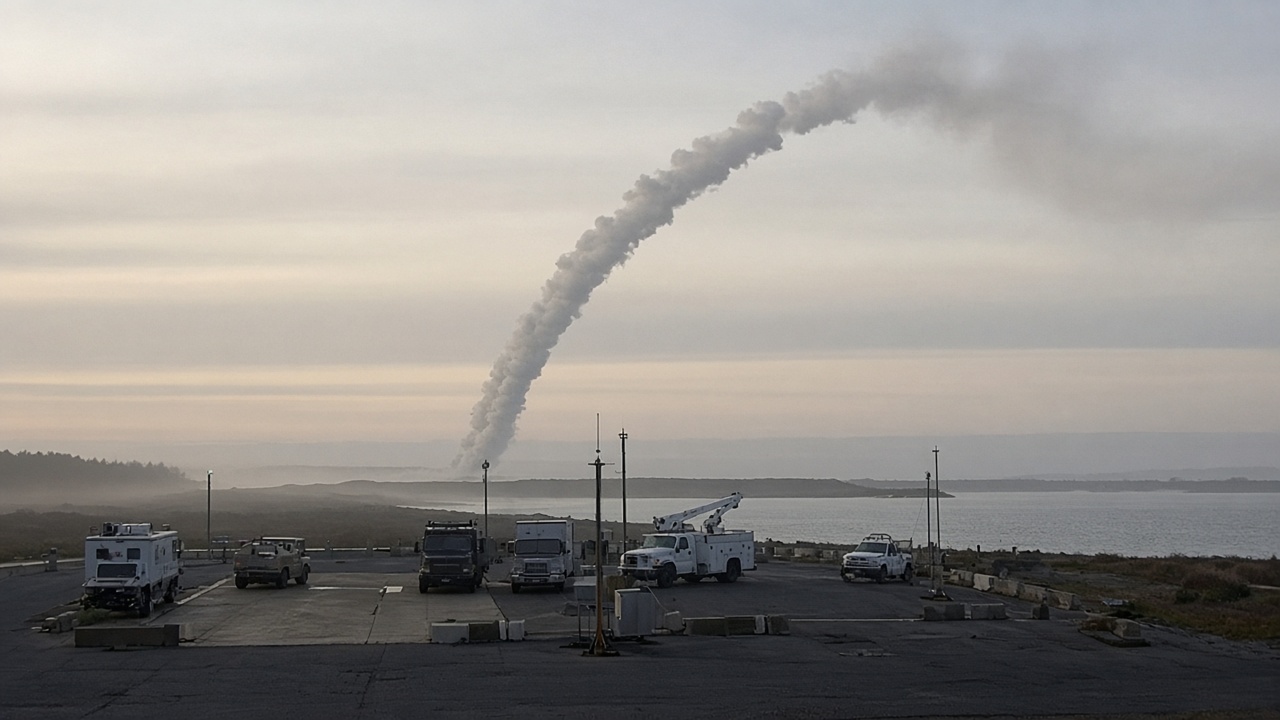
North Korea test-fired an intermediate-range ballistic missile early Saturday from its eastern coast, with state media saying leader Kim Jong Un oversaw a drill meant to stress evasive flight and nuclear delivery roles.
South Korea’s Joint Chiefs of Staff said the missile flew more than 700 kilometers before landing in the sea outside Japan’s exclusive economic zone. Japan’s Defense Ministry estimated roughly 680 kilometers. Hours later, North Korean state media claimed the weapon traveled about 1,000 kilometers, a figure Pyongyang has used before to challenge foreign tracking data.
What Pyongyang claimed
Kim’s sister, Kim Yo Jong, said the test involved a “strategic” intermediate-range system capable of low-altitude trajectory changes and unspecified artificial-intelligence guidance she argued would make interception extremely difficult. State outlets linked the launch to training on a hypersonic strategic weapon family North Korea has showcased since 2024, including solid-fuel designs aimed at U.S. bases and cities in the region.
The Korean Central News Agency said the exercise evaluated reliability, efficiency, and mobility of the country’s war deterrent. It did not specify the splashdown coordinates beyond describing an eastern launch.
Seoul and Tokyo react
South Korea raised surveillance posture and shared telemetry with U.S. and Japanese counterparts, standard practice after ballistic launches. Officials in Seoul noted the test followed a week of border tensions that included landmine incidents and a North Korean demand for an apology over southern loudspeaker broadcasts.
Japan issued standard protests through diplomatic channels while confirming no damage to territory. The U.S. Indo-Pacific Command said the launch did not pose an immediate threat to American personnel or allies, but reiterated calls for denuclearization talks that have been stalled since 2019.
Why the range dispute matters
Intermediate-range systems can reach U.S. bases on Okinawa and Guam depending on trajectory, which is why Tokyo and Seoul publish divergent range tables after each test. A 300-kilometer gap between allied estimates and North Korean claims affects how quickly governments must trigger public alerts and whether new interceptors are prioritized in budget debates this autumn.
President Lee Jae Myung’s administration is simultaneously managing trade pressure from Washington over investment pledges and security crises on the peninsula. Another missile test gives opposition lawmakers ammunition to demand resumed U.S.–South Korea field exercises, even as Seoul tries to keep dialogue channels with Beijing open.
For now, the Joint Chiefs said no further launches were detected Sunday, but maritime patrol aircraft remained on expanded sorties along the eastern sea border.