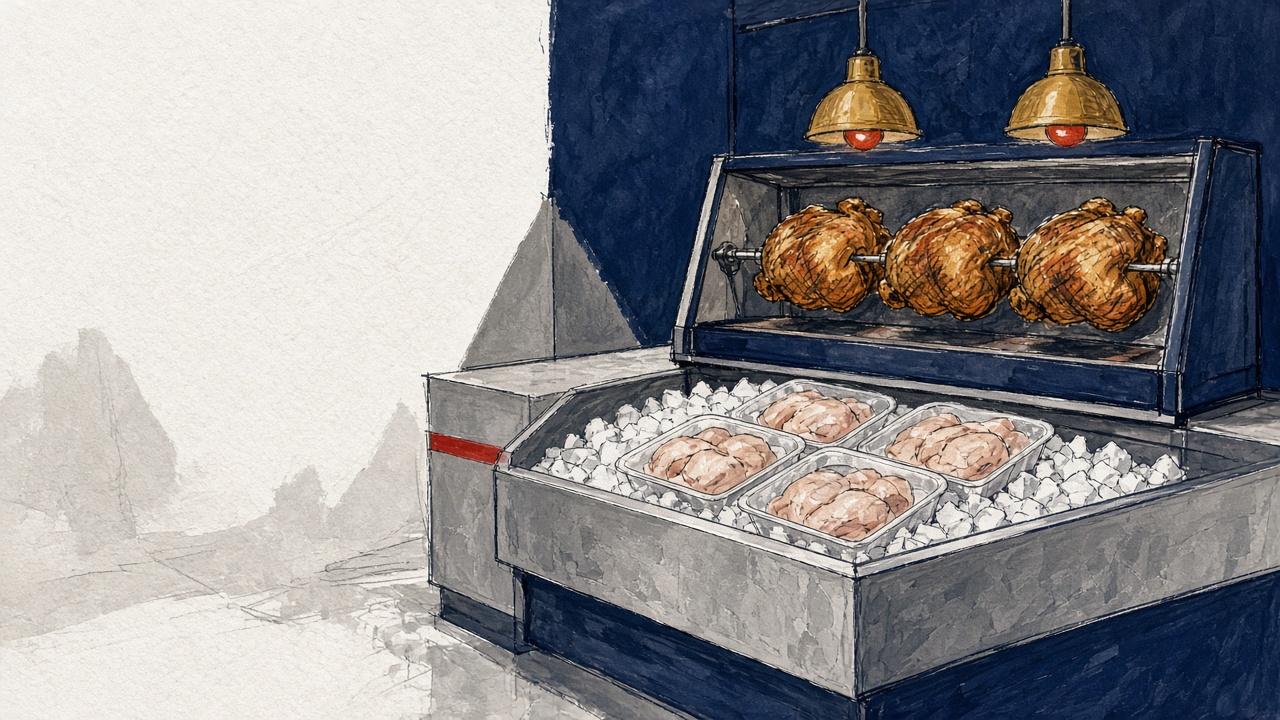
The rotisserie chickens spin under the heat lamps at the end of the meat case, beside raw birds wrapped in plastic and marked for tonight's oven. At checkout, the difference is not nutrition or price per ounce. It is temperature. Swipe an EBT card for the raw chicken and the sale clears. Swipe for the same bird already roasted and the register blocks the item, because federal rules treat it as food sold for immediate consumption, not groceries for the trip home.
That pattern repeats across delis, soup stations, and coffee urns in supermarkets that accept SNAP. The program fed 41,678,341 people in June 2025, according to USDA state totals. Preliminary data put June 2026 enrollment at 36,352,716. The gap is policy as much as economics: Congress wrote a temperature test into the food-stamp statute in 1977, and USDA still enforces it one scanner beep at a time.
The lamp that changes the price
On its public list of eligible items, USDA is blunt. Households cannot use SNAP benefits to buy foods that are hot at the point of sale. The same page groups fruits, bread, and uncooked meat as fair game. The rotisserie line sits on the wrong side of that sentence.
Grocery workers learn the rule through denials, not training manuals. A customer who planned dinner around the ready-made bird either pays cash, buys raw poultry and waits an hour, or hunts for a package that cooled on a rack and was repriced. None of those workarounds show up on the sign above the lamp. They show up when the card reader flashes ineligible.
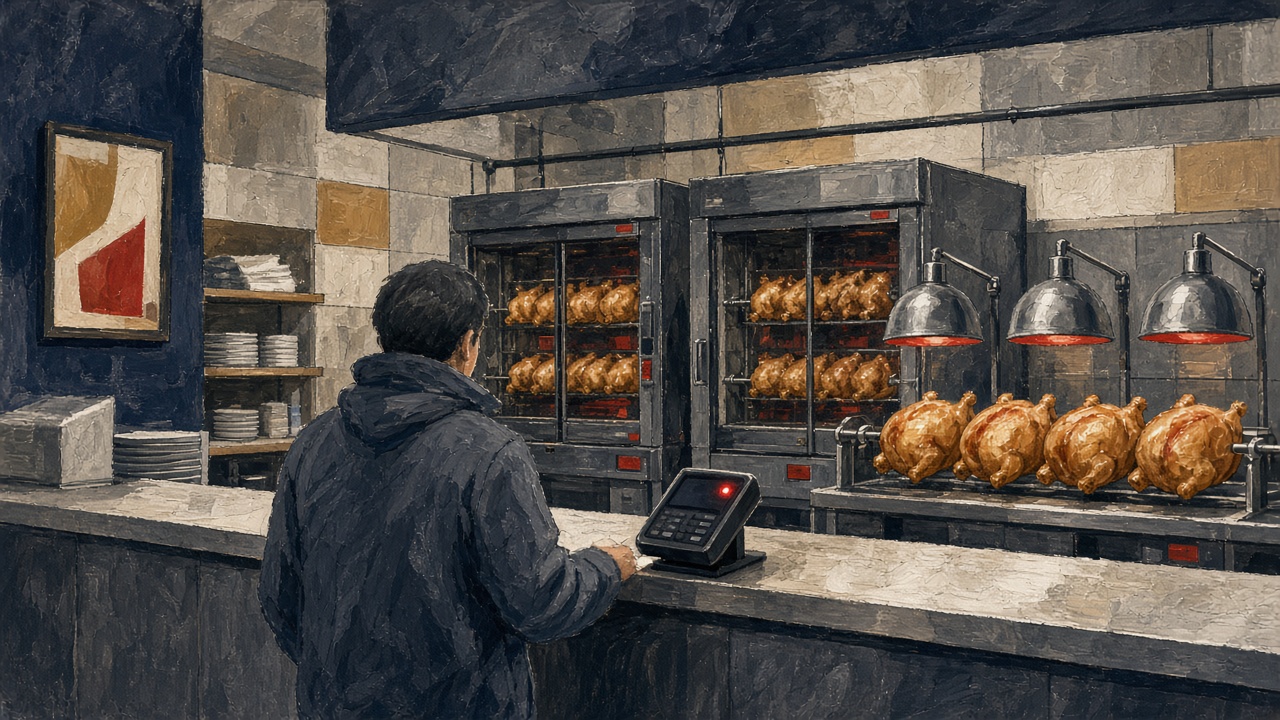
Why tie benefits to a heat lamp at all? The answer is not a single villain in the store manager's office. It lives in the U.S. Code, in USDA guidance memoranda, and in a 1977 fight over who counts as a grocer versus a restaurant.
Home food, not a meal
Federal law defines SNAP food as products for home consumption, with explicit carve-outs for seniors, treatment programs, and a handful of other cases. The baseline exclusion is plain language: hot foods or hot food products ready for immediate consumption. Alcoholic drinks and tobacco sit in the same sentence.
USDA's Food Determinations guidance turns that line into deli-case examples. Chicken that has been broiled, fried, barbecued, or roasted is ineligible when it is hot at the register. So are soups, stews, and hot drinks. Prepared foods meant to be eaten in the store are out as well.
The same document leaves a narrow path open. Prepared foods intended for off-premises consumption can be eligible if they are not hot at the point of sale. That is why a cold packaged sandwich may ring up while the steam table will not, and why some stores move birds from the spit to a chilled shelf and relabel them.
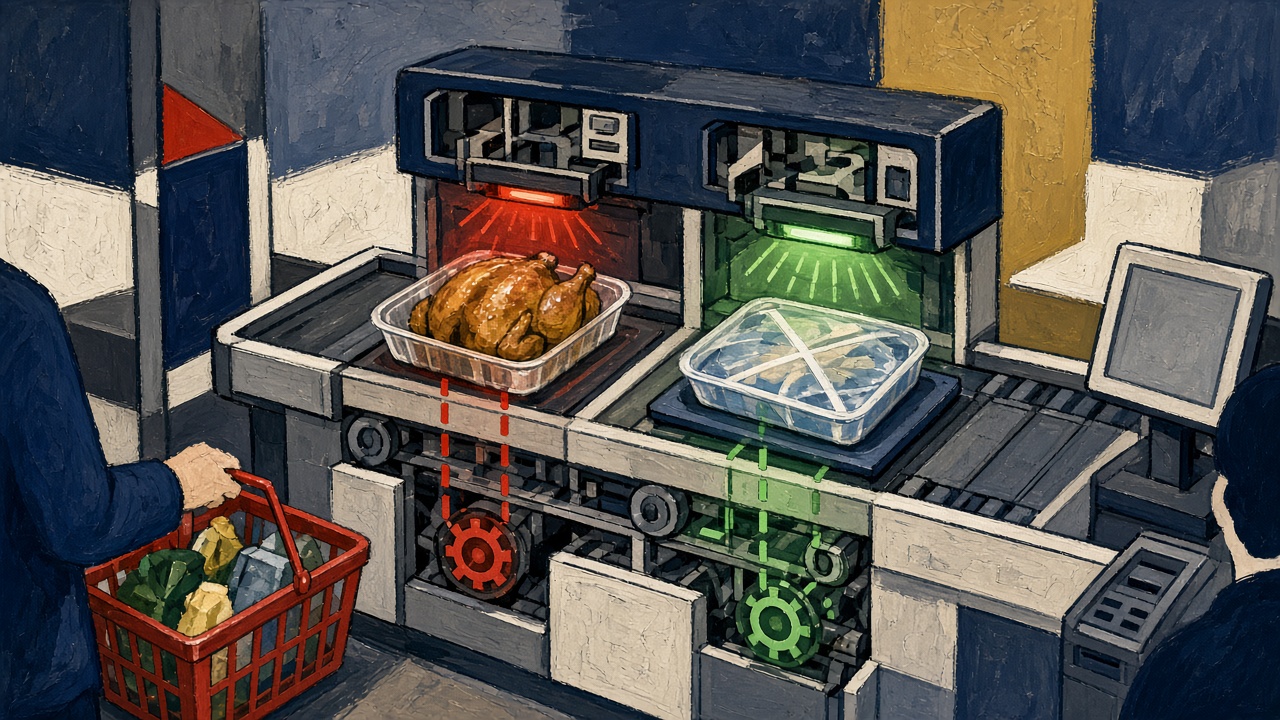
Eligibility for the underlying benefit is a separate bureaucracy. A 2008 Government Accountability Office summary noted that gross income cannot exceed 130 percent of the federal poverty level and net income cannot exceed 100 percent. Meeting those tests opens an EBT account; it does not change which SKUs the account can buy.
Accessory foods illustrate how fine the lines get. USDA can classify the same item as a staple, an accessory, or a prepared food depending on why the agency is looking. Staple foods are always eligible. Accessory and prepared items may qualify only when they are not hot at the register and not sold for eating inside the store. Coffee beans in a bag pass. Coffee poured steaming into a cup does not.
Seeds and plants are eligible, a reminder that Congress imagined gardens as well as kitchens. Vitamins with Supplement Facts labels are out, even when sold beside produce. Live animals are out except for shellfish and fish on ice. Each rule encodes a theory of what counts as feeding a household versus supplementing a lifestyle.
Retailers also need authorization to accept SNAP at all. The program is supposed to route dollars through stores that sell staple groceries, not through outlets whose business is ready-to-eat meals. That second test matters when a gas-station kiosk starts selling pizza by the slice.
What Congress wrote in 1977
The hot-food line is older than EBT cards. Before the 1977 rewrite, USDA refused to let Kentucky Fried Chicken redeem food stamps. The chain sued, won once, then lost in the Fifth Circuit on October 7, 1971, when judges upheld the department's power to keep fast-food outlets out.
When Congress rewrote the Food Stamp Act in 1977, it copied the restriction into statute. Senate Agriculture Committee text from that year excludes hot foods ready for immediate consumption except in the communal-meal programs Congress already allowed for seniors and similar groups. President Jimmy Carter signed the Food and Agriculture Act on September 29, 1977, making the ban permanent law rather than agency discretion.
Later congressional histories, summarized by the National Academies Press, quote House committee thinking that has not aged into folklore: if fast-food chains could not take benefits, grocery stores should not gain an unfair advantage by selling the same meal under fluorescent lights. The rotisserie spit is not a kitchen innovation. It is a competitive boundary drawn in 1977.
When the store becomes a restaurant
Blocking hot items at checkout is only half the machine. USDA also decides which firms may accept SNAP. For decades, regulations capped how much of a store's sales could come from prepared foods. A 2016 final rule, described in a Congressional Research Service report, kept a 50 percent threshold on hot or cold prepared foods for many retailers, but tightened what counted toward the cap.
The rule targeted a loophole. Under older guidance, nothing stopped a store from selling an uncooked item for SNAP and then heating it free or for a fee after purchase. USDA told Congress it wanted to preserve the intent of the hot-food restriction. Starting October 16, 2017, the stricter language applied to foods cooked or heated on-site before or after purchase.
SNAP benefits may not be redeemed for alcohol, tobacco, or hot foods intended for immediate consumption.
Participation meanwhile fell from a fiscal 2016 average of 44,219.66 thousand people to 35,702.47 thousand by 2019, then rose again to 41,709.12 thousand in 2024, according to USDA annual tables. Monthly tallies in 2025 and 2026 show the roller coaster continuing as emergency allotments expired and state economies shifted.
The chart is national scale, not deli policy. It matters because the temperature rule hits a program that still covers tens of millions of households. A restriction written for fast-food competition now applies to a bird spinning beside the budget-priced thighs.
The exceptions that almost fit
Congress did not leave every low-income diner without options. It built parallel meal programs for groups assumed unable to cook. Senior centers, homeless shelters, and similar sites can serve prepared food under narrow statutory clauses. States may go further through the Restaurant Meals Program, a USDA state option that lets certain clients buy prepared meals at approved restaurants.
Eligibility is tight. Every household member must be elderly, defined as 60 or older, disabled under program rules, homeless, or the spouse of someone who qualifies. An EBT card codes those permissions; otherwise the restaurant terminal declines the sale like the deli register.
California stretched that option statewide.
When California went statewide, 18 counties had already run local versions. CDSS took over vendor outreach in places that had never participated, signing agreements with restaurants willing to accept coded EBT cards. That is a different supply chain from the deli spit: sit-down chains, pizza counters, and other FNS-authorized vendors, each approved after state review.
Illinois limits its program to Cook and Franklin Counties. Michigan, Massachusetts, Maryland, New York, Rhode Island, Virginia, and Arizona also appear on USDA's state contact list. A homeless recipient in Texas still faces the rotisserie lamp unless they relocate to a participating state and meet household rules.
Assembly Bill 942, signed in 2019, required the Department of Social Services to run the CalFresh Restaurant Meals Program in every county. Legislative intent language says many recipients lack the tools, appliances, or physical ability to prepare meals and need safe ready-to-eat food. After county pilots, including early work in San Francisco, the program went statewide on September 1, 2021.Only a handful of states operate a Restaurant Meals Program at all. For a parent in a mixed household, someone able-bodied under 60 sharing an address with a disabled sibling, the statewide California fix still does not unlock the deli chicken. The household fails the all-members test, and the heat lamp rule remains.
Cooling on the rack
Stores know the workaround. Move the bird off the spit, chill it, package it, and sell it as a cold prepared item for off-premises consumption. USDA's guidance allows that when the item is not hot at the scanner. Shoppers describe hunting for the sticker change at closeout time. The policy nudges people with limited mobility toward timing tricks instead of a hot meal at 6 p.m.
Advocates who pushed AB 942 made the counter-case in public record: food insecurity tracks with costly health problems, and people without kitchens should not have to trade nutrition for eligibility paperwork. Federal law still draws the bright line at temperature, and USDA's published examples still name roasted chicken first.
One bird on the rack is groceries. The other, still warm under the lamp, is classified as the kind of meal Congress refused to subsidize in 1977. Until that statute changes, the heat does what the law says. It turns dinner into a restaurant sale, even when the receipt names a supermarket chain.
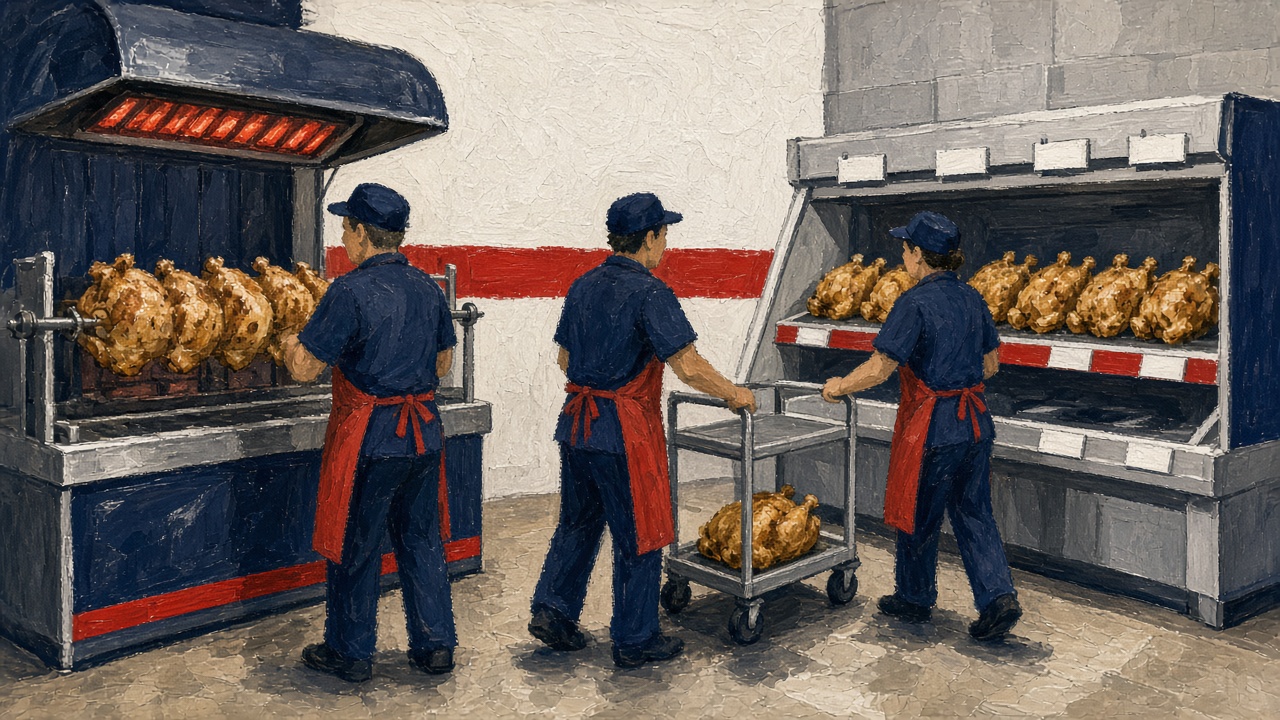
The December 15, 2016 retailer rule also sat inside a broader fight about whether convenience stores stock enough staple foods to deserve SNAP terminals. Congress later delayed parts of that inventory crackdown in a 2017 appropriations law, but the hot-food language still moved ahead on its own schedule. Grocers kept the rotisserie ovens because shoppers pay cash for them. They just cannot sell them to every EBT shopper at the deli line.
That split checkout is the whole story in one beep.