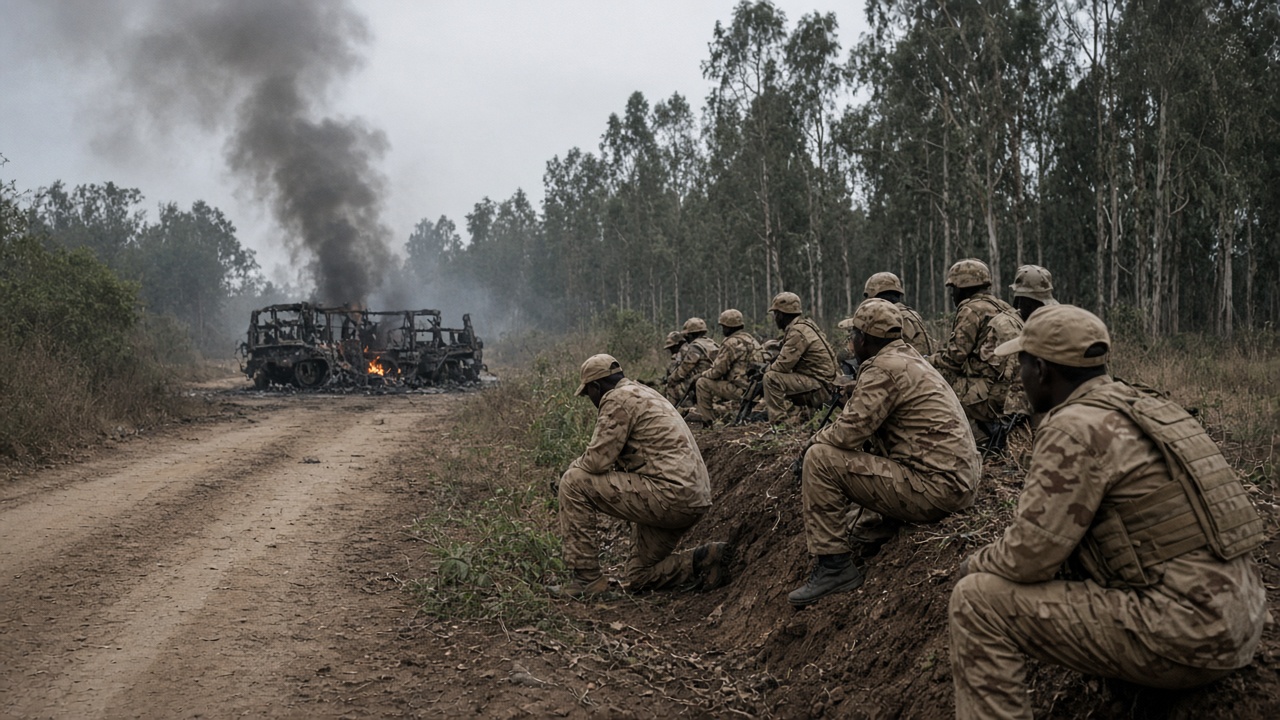
Sudan’s military said Saturday that its Fourth Infantry Division had repelled a combined assault by the Rapid Support Forces and the Sudan People’s Liberation Movement-North in eastern Blue Nile state, describing the engagement as a “knockout blow” that destroyed vehicles and pushed attackers back from army lines near the Ethiopian border.
The statement, issued after fighting in the Minza and Bashkarkad areas, could not be independently verified and the RSF did not immediately respond. It landed on the same day authorities in Damazin reported drone attacks against the state governor’s residence and other civilian sites, underscoring how the southeastern front has become both a ground-war corridor and a target set for unmanned strikes.
What the army said happened
According to the division’s account, RSF and SPLM-N elements moved toward government positions in Minza and Bashkarkad, localities the military has treated as strategic ground east of the Roseires Dam complex. Troops and allied forces engaged the column with artillery and small-arms fire, the statement said, inflicting unspecified personnel losses and destroying several vehicles before the attackers withdrew.
Commanders framed the operation as defensive: they said the assault was meant to advance on army-held ground and that the response “disrupted” rebel movements. No casualty breakdown was published, a familiar gap in Sudan’s information war where both sides routinely claim decisive victories without third-party battlefield access.
Drone strikes in the state capital
Earlier Saturday, Blue Nile Governor Ahmed al-Omda Badi said air defences intercepted drones over Damazin after strikes targeted his home and other locations in the capital. He did not detail injuries or structural damage. Sudanese media and Anadolu Agency linked the episode to a wider escalation in Blue Nile, where the RSF and SPLM-N have pressed offensives in recent weeks after earlier army gains around Kurmuk and Geissan.
The United Nations has separately documented the human cost of drone warfare across Sudan, reporting more than a thousand civilian deaths from such attacks in the first half of 2026. Saturday’s sequence — drones over Damazin, then a major ground clash to the east — fits a pattern commanders on both sides have used to stretch rival logistics along the border with Ethiopia.
Why Blue Nile matters now
Blue Nile sits at the junction of Sudan’s wider civil war and older insurgencies. The SPLM-N, led in much of the region by Abdelaziz al-Hilu’s faction, fought the central government for years before aligning tactically with the RSF after the April 2023 rupture between the army and the paramilitary force. Minza, in the Wad al-Mahi district, has served as a government strongpoint; the International Organization for Migration said fighting late last month displaced roughly 7,000 people from Minza, Jabal Nimr and Manshalang.
Analysts watching the Horn of Africa have warned that gains or losses along this border can ripple into Ethiopia’s own security calculus, especially as federal forces in Addis Ababa grapple with renewed conflict in Tigray. For Khartoum’s generals, holding Roseires and the roads toward Damazin is as much about energy and water infrastructure as it is about denying the RSF a foothold near international borders.
What comes next
The Fourth Infantry Division said it was reinforcing eastern sectors and maintaining heightened readiness, language that usually precedes further artillery duels rather than negotiated pauses. Diplomatic efforts to end the national war remain stalled; humanitarian agencies continue to cite displacement figures approaching thirteen million nationwide.
Until monitors regain access, outside observers will be left weighing competing statements — army claims of a knockout blow, governor accounts of intercepted drones, and silence from RSF media channels. The next credible signal may be migration data from Minza itself: whether families return or whether another column of displaced civilians heads toward safer towns inside Ethiopia or deeper into Sudan.