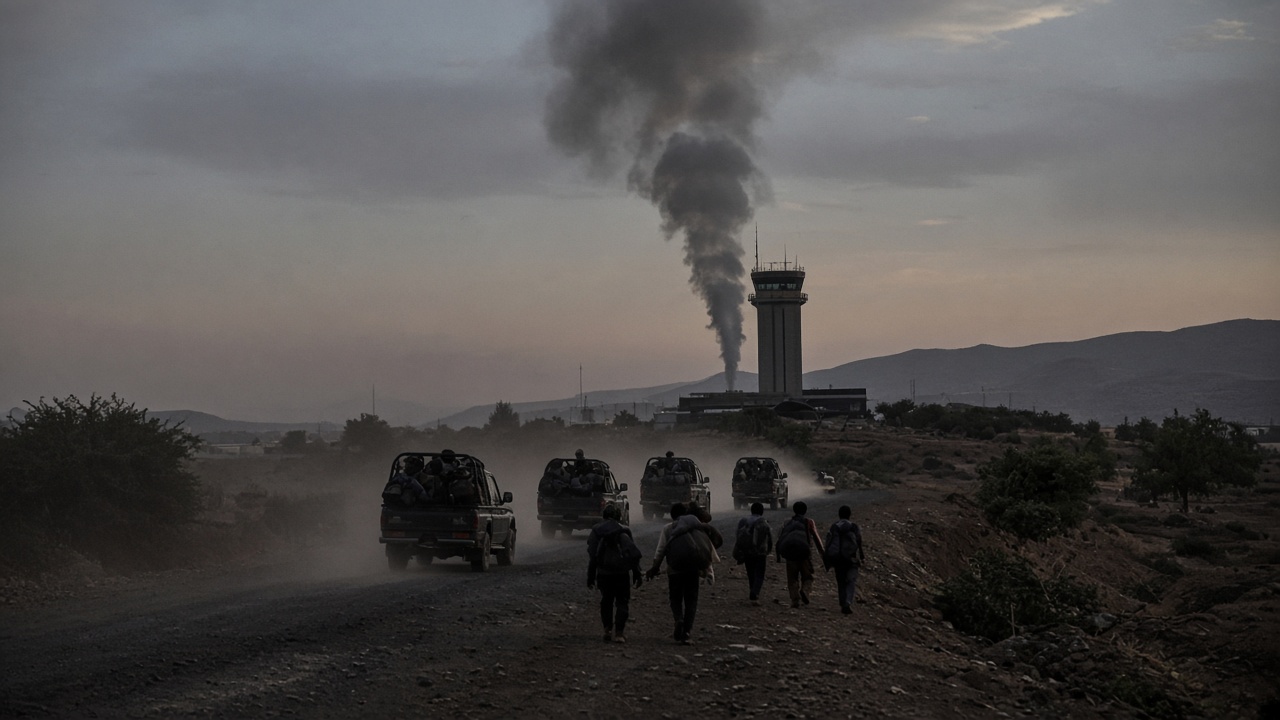
The Tigray People's Liberation Front said late Saturday that it had "temporarily moved out of Mekelle" after Ethiopian federal troops and allied militias recaptured the regional capital's main airport and entered the city centre. Humanitarian workers and residents told Reuters and AFP that government forces were visible across Mekelle on Sunday, marking the sharpest reversal since rebels seized the airport on 23 September and reignited a conflict many hoped had ended with a 2022 peace deal.
From airport to empty offices
The pro-government Tigray Peace Forces said on social media that they had taken full control of Alula Aba Nega Airport on Friday and were clearing Mekelle block by block. A source close to that militia told Reuters that its fighters reached the city centre on Saturday afternoon, followed by units of the Ethiopian National Defense Force. Neither Prime Minister Abiy Ahmed's office nor the TPLF's leadership issued a formal broadcast confirming who holds every district, and reporting remains constrained by communications blackouts and restricted media access.
What is clearer is the political cost. The TPLF's withdrawal statement framed the move as a tactical regrouping, not a surrender. Its leader, Debretsion Gebremichael, had already warned in a video message that the group would revert to guerrilla tactics if pushed out of urban strongholds, echoing the cycle that preceded the devastating 2020–2022 war. That earlier conflict killed more than 600,000 people by African Union estimates and left Mekelle changing hands twice before the November 2022 truce.
A collapsed truce and a seven-group alliance
Fighting restarted on 23 September when seven armed and political groups, including the TPLF, announced an alliance aimed at removing Abiy's government. Rebels initially advanced into neighbouring Afar and Amhara and briefly held Mekelle's airport, forcing airlines to cancel flights into Tigray. Federal forces and regional militias pushed back along three axes in recent days, according to analysts at the Critical Threats Project, reversing many of those gains before the push into the capital.
The renewed war has already spilled into diplomacy. Ethiopia expelled 10 Eritrean diplomats and shut its embassy in Asmara on Thursday, accusing Eritrea of backing the rebels. Cairo and Addis Ababa traded expulsions after Ethiopia removed an Egyptian diplomat without public explanation. Egypt is hosting a regional meeting on the crisis on Sunday, a day after humanitarian sources reported federal troops inside Mekelle.
Washington's warning and what comes next
The United States State Department on Saturday called for "maximum restraint" and a return to dialogue, saying cross-border tensions between Ethiopia and Eritrea "have the potential to affect the entire region." Aid agencies warn that blackouts and blocked routes are complicating casualty counts and displacement tracking; hundreds of thousands fled when the truce collapsed in July.
Officials in Addis Ababa have not outlined a political offer to Tigray beyond military pressure. If the TPLF follows through on an insurgency strategy, Mekelle's recapture may prove a symbolic victory rather than a stable end state. Neighbouring states, already juggling Sudan's war and Red Sea shipping risks, now face the prospect of a second Horn conflict drawing in outside sponsors. For civilians in Mekelle, the immediate question is whether basic services and humanitarian corridors reopen—or whether the city becomes another front in a war that outlasts any single flag raised over its airport.